Love The Birds is reader-supported. When you purchase through one of our links we may earn an affiliate commission (at no cost to you).
5 Hawks In Georgia: Top Species To Spot In The Region
Share your love
Georgia, with its varied topography encompassing the Appalachian Mountains, Piedmont, and coastal plain, offers a rich tapestry of habitats that support a diverse population of raptors.
Among these magnificent birds of prey, hawks are particularly visible, gracing the skies and perching in trees across the state. For both seasoned birdwatchers and curious nature enthusiasts, understanding the most common hawk species in Georgia is key to appreciating these powerful and vital components of the ecosystem.
Here are five top hawk species you're most likely to spot in the Peach State, along with easy tips for identification.
Hawks of Georgia
1. Red-tailed Hawk (Buteo jamaicensis) – The Ubiquitous Soarer
Red-tailed Hawk
Without a doubt, the Red-tailed Hawk stands as Georgia's most widespread and easily recognizable hawk species. This adaptable raptor is a familiar sight year-round, often seen perched atop telephone poles, circling high above open fields, or soaring gracefully over fragmented woodlands. Its ability to thrive in a vast array of habitats, from agricultural lands and urban fringes to dense forests, makes it the state's most frequently encountered hawk.
Identification: Adult Red-tailed Hawks are most distinctly identified by their rusty-red tail, a feature that becomes particularly striking when seen from above or with good backlighting. Their underparts are generally pale, often displaying a subtle but characteristic "belly band" of dark streaking across the lower breast.Dark "patagial marks" (bars on the leading edge of the underwing) are also visible.Upperparts are typically dark brown, and they possess broad, rounded wings ideal for soaring.Juveniles, however, have a tail with narrow brown and white bars instead of the characteristic red.Their call, a long, raspy "kee-eeeee-arr," is iconic and often used as the quintessential raptor sound.
Habitat and Behavior: Red-tailed Hawks favor a mix of open country and woodlands. They use tall trees, utility poles, and even building ledges for perching and nesting. Their diet is broad, consisting primarily of small to medium-sized mammals such as rodents and rabbits, but also including reptiles, amphibians, and other birds. They employ a "sit-and-wait" strategy from a high perch or soar overhead before executing a swift dive.
2. Red-shouldered Hawk (Buteo lineatus) – The Woodland Vocalist
Red-shouldered Hawk
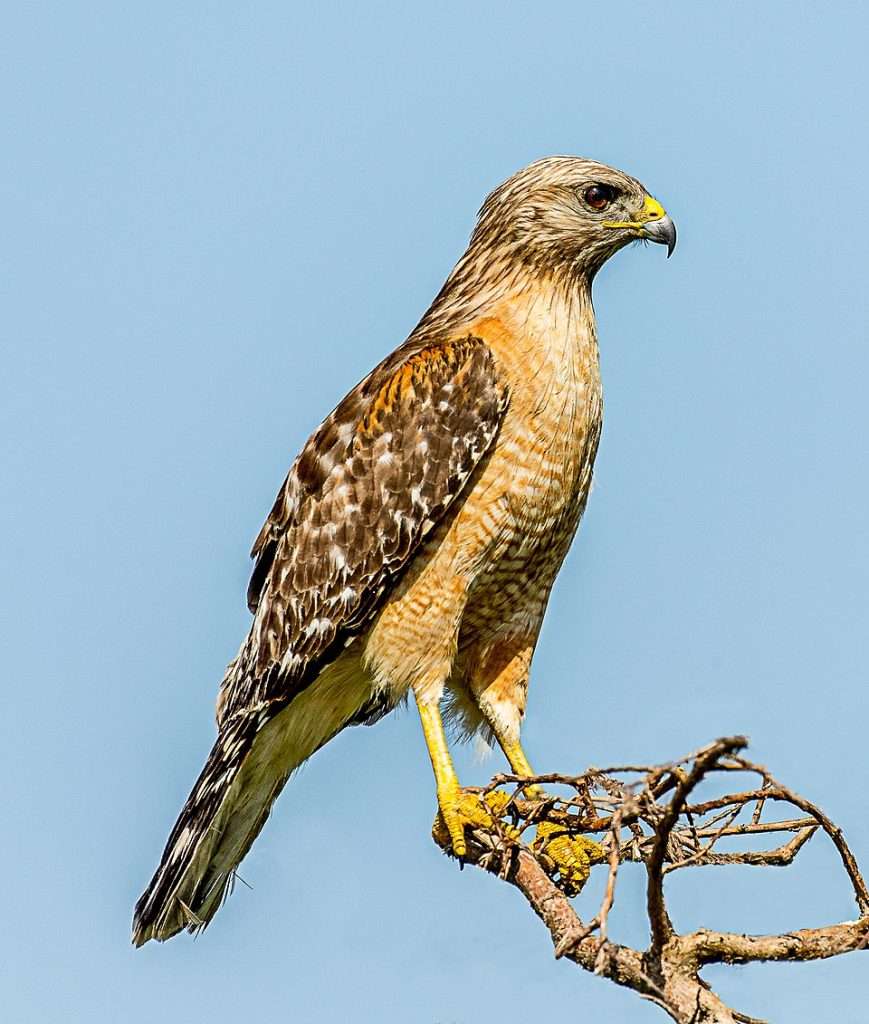
Another common hawk in Georgia, particularly in areas with mature, moist woodlands, is the Red-shouldered Hawk.This medium-sized Buteo is a year-round resident and is often heard before it's seen, thanks to its distinctive call.
Identification: Adults are quite striking with their reddish-brown barring on the breast and belly, and prominent black and white banding on their wings and tail. They do have reddish-orange shoulder patches, but these can be difficult to discern in the field. In flight, a key identification feature is the presence of translucent crescent-shaped "windows" near the tips of their outer wings when seen from below against the light.
Habitat and Behavior: Red-shouldered Hawks show a strong preference for mature deciduous or mixed forests, particularly those near water sources like rivers, swamps, or bottomlands.They build their stick nests high in trees. Their diet is diverse, including small mammals, amphibians (especially frogs), reptiles, and large insects. Their call is a loud, ringing "kee-ah, kee-ah, kee-ah!" often repeated quickly, a sound that is a hallmark of Georgia's forested wetlands.
3. Cooper's Hawk (Accipiter cooperii) – The Agile Backyard Hunter
Cooper's Hawk
The Cooper's Hawk is a medium-sized Accipiter that has become increasingly common in Georgia, not just in woodlands but also in suburban and even urban areas. Known for its incredible agility, it is a formidable hunter of birds.
Identification: Adults have slate-gray upperparts and a contrasting black cap, with warm reddish-orange barring on their underparts. Their long tail is banded with dark and white stripes and has a distinct rounded tip (often appearing somewhat rounded to U-shaped at the end). A crucial distinguishing feature from the very similar Sharp-shinned Hawk is its relatively larger head and thicker neck. Juveniles are brown above with streaking on their white underparts and yellow eyes, which darken to red in adults. Their flight is characterized by a "flap-flap-glide" pattern, allowing them to maneuver through dense foliage.
Habitat and Behavior: Cooper's Hawks historically nested in mature deciduous and mixed forests, but they have readily adapted to human-modified landscapes, including suburban parks and residential areas, especially where there are mature trees for nesting and cover. Their primary diet consists of medium-sized birds, such as robins, jays, and doves, which they pursue with remarkable agility.
4. Northern Harrier (Circus hudsonius) – The Open-Country Glider
Northern Harrier
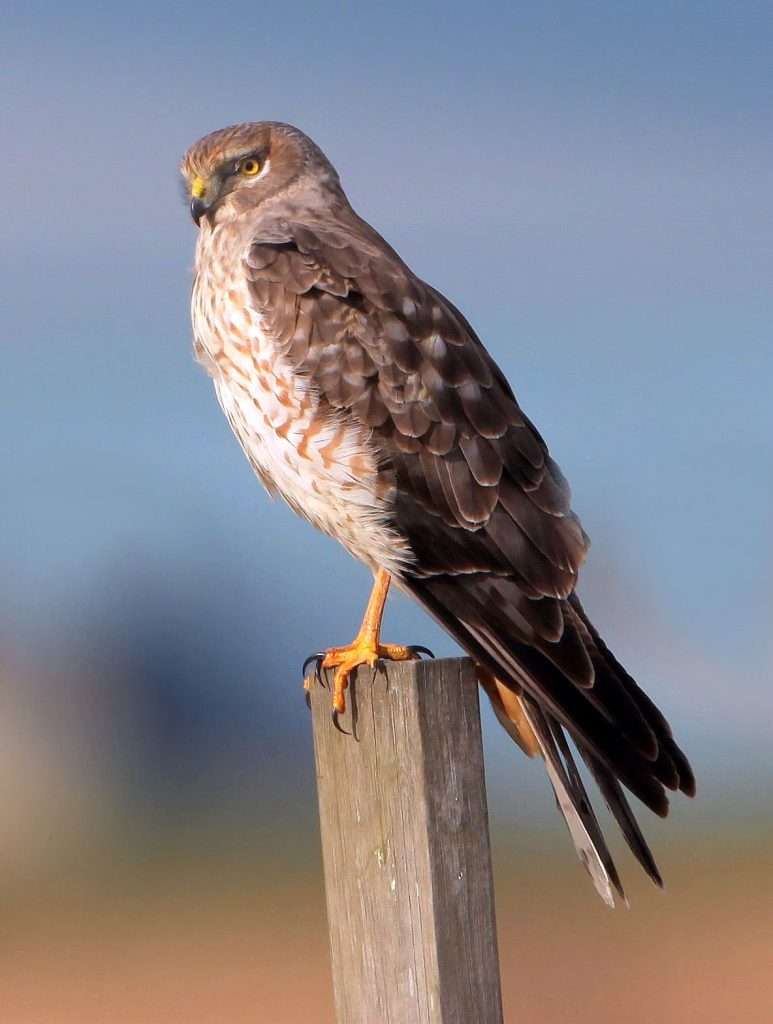
The Northern Harrier is a distinctive hawk that stands out due to its appearance and hunting style. It's a common winter resident and migrant in Georgia, though a small number may breed in suitable wetland habitats.
Identification: Harriers are slender hawks with long wings and a long tail. Their most defining field mark is a conspicuous white rump patch, which is easily visible as they fly. Males are pale gray above with white underparts, often referred to as "Gray Ghosts." Females and juveniles are brown above with streaking on their buffy underparts. They have an owl-like facial disc that aids in sound localization. They fly with a characteristic buoyant, rocking motion, often gliding low over open terrain.
Habitat and Behavior: In Georgia, Northern Harriers are typically found in expansive open habitats such as grasslands, agricultural fields, coastal marshes, and other wetlands. They hunt by flying low, quartering the ground to surprise small mammals (especially voles and mice) and ground-nesting birds, often hovering briefly before dropping on their prey.
5. Sharp-shinned Hawk (Accipiter striatus) – The Smallest Pursuit Predator
Sharp-shinned Hawk
The Sharp-shinned Hawk is the smallest hawk in Georgia and North America. Like the Cooper's Hawk, it is an Accipiter built for speed and agility in forested environments, and it is a common migrant and winter resident, though some may breed in the mountains.
Identification: Noticeably smaller than a Cooper's Hawk (closer to Blue Jay size), adults have blue-gray upperparts and reddish-orange barring on their underparts. Their tail is typically square-tipped (though it can sometimes appear slightly notched) and banded with dark stripes. Key distinguishing features from the Cooper's Hawk include its proportionally smaller head, which can appear almost "hooded," and thinner legs. Juveniles are brown above with streaking on their underparts.
Habitat and Behavior: Sharp-shinned Hawks prefer dense forests for breeding and utilize forest edges, suburban woodlots, and even backyard feeders during migration and winter. Their diet is overwhelmingly composed of small songbirds, which they snatch in mid-air or from dense cover with incredible speed and precision. Their flight involves rapid bursts of wing beats followed by short glides.
Tips For Seeing Hawks in Georgia
Georgia's diverse and beautiful landscapes, from the northern mountains to the coastal plains, make it a fantastic destination for birdwatching, especially when it comes to raptors. Hawks, with their keen eyesight and impressive hunting skills, are a thrilling sight. While spotting them often involves luck, employing some specific strategies can significantly increase your chances.
Know Your Seasons and Migration Times
Year-Round Residents: Red-tailed Hawks, Red-shouldered Hawks, and Cooper's Hawks are present in Georgia throughout the entire year. This means you have a good chance of seeing them regardless of the season.
Winter Visitors: Northern Harriers and Rough-legged Hawks (though Rough-legged are less common) are primarily winter residents in Georgia. Look for them from late fall through early spring, especially in open country.
Migration Spectacles: Fall is arguably the best time to see a large diversity and number of hawks in Georgia. Many species, including Broad-winged Hawks, migrate through the state in huge numbers, often forming large swirling flocks called "kettles."
Peak Fall Migration: Mid-September is typically prime time for Broad-winged Hawk migration through Georgia, particularly along ridge lines in the northern part of the state. Other raptors will also be on the move from August through November.
Spring Migration: While not as concentrated as fall, some raptor migration occurs in spring (March-May) as birds head north to their breeding grounds.
Cooper's Hawk
Choose the Right Habitat
Open Country/Edges: For Red-tailed Hawks, Northern Harriers, and wintering Rough-legged Hawks, focus on open fields, agricultural lands, grasslands, and marshes. Power lines and isolated tall trees bordering these areas are often favored perches.
Woodlands/Forests (especially near water):Red-shouldered Hawks are particularly fond of mature, moist deciduous or mixed forests, especially those near rivers, swamps, and lakes.
Mixed Woodlands & Suburban Areas:Cooper's Hawks and Sharp-shinned Hawks can be found in a variety of wooded habitats, including suburban parks and backyards with mature trees. They often use the cover to ambush smaller birds.
Learn Their Calls
Often, you'll hear a hawk before you see it. Becoming familiar with their distinctive vocalizations is a huge advantage.
Red-tailed Hawk: A loud, descending "kee-eeeee-arr."
Red-shouldered Hawk: A ringing "kee-ah, kee-ah, kee-ah!"
Cooper's Hawk: Various sharp "kak-kak-kak" alarm calls.
Northern Harrier: More often silent, but may give quiet barks or chirps.
Look for Specific Behaviors
Soaring: Hawks, especially Buteos like Red-tailed Hawks, spend a lot of time soaring high on thermals. Look up!
Perching: Many hawks hunt from a perch. Scan utility poles, dead trees, fence posts, and prominent branches at the edges of open areas.
Hovering:Northern Harriers often fly low over fields with a distinctive rocking motion, occasionally hovering briefly before dropping on prey. Some Buteos like Rough-legged Hawks also hover.
Darting/Ambushing: Accipiters (Cooper's and Sharp-shinned Hawks) are often seen making quick, agile flights through dense trees as they pursue smaller birds.
"Kettling": During fall migration, especially in September, look for large groups of Broad-winged Hawks forming swirling "kettles" as they gain altitude on thermals before continuing their journey south. This is a spectacular sight!
Visit Known Hawk-Watching Locations
Kennesaw Mountain National Battlefield Park: Located near Atlanta, this is an Audubon-designated Important Bird Area and is particularly excellent for observing fall raptor migration, as birds are funneled along the ridge.
Piedmont National Wildlife Refuge: This refuge offers diverse habitats and good chances to see resident hawks.
Okefenokee National Wildlife Refuge: While known for owls, the extensive wetlands and forests are also home to Red-tailed and Red-shouldered Hawks, and Northern Harriers in open areas.
Various State Parks and Wildlife Management Areas: Many of Georgia's state parks and WMAs, especially those with good tree cover and open fields, will host hawks. Areas along the Blue Ridge Mountains (like Tallulah Gorge State Park) can be good for observing migrating raptors.
Northern Harrier
Frequently Asked Questions
What Do Hawks Eat In Georgia?
The preferred food for Georgia hawks may vary from one type to another. However, in general, they like to feed on rodents and other small mammals in this category. Occasionally, they like to take other reptiles and birds alongside other food items they can find around.
In some cases, the diet of Georgia hawks may consist of small reptiles, other birds, their eggs, or amphibians.
Are Hawks Protected In Georgia?
Yes, along with a wide range of birds and animals, the hawks in Georgia are also protected under Federal Law in Georgia. According to the law, it is not allowed to trap, take, possess, or transport hawks for personal benefits.
Likewise, you cannot kill these endangered Georgia hawk species. However, you need to follow legally acclaimed methods for your protection or look for a license to take measurements for your safety if you live in Georgia.
It is also illegal for anybody to take, trap and kill these birds.
What Is The Largest Hawk In Georgia?
The Red-tailed Hawks are the largest living species of hawks living in Georgia. You can easily see them all year round as compared to other types of hawks in Georgia. This way, they make up about 12% of the total sight of hawks in Georgia.
Hence this species is easier to spot on a long car journey. These hawks circle over open fields. They do so in search of prey. You can easily spot them among the pictures of hawks in Georgia on telephone poles.
A male Red-tailed Hawk is about 17.7-22.1 inches or 45-56 cm in length while weighing about 24.3-45.9 oz. or 690-1300 g. Their wingspan is usually about 44.9-52.4 inches or 114-133 cm.
Likewise, when we look for female Red-tailed Hawk identification, the average specifications are 19.7-25.6 in length; 31.8-51.5 oz. The weight and a wingspan of 44.9-52.4 inches. With the stated size and weight specifications, the Red-tailed Hawk is the biggest hawk native to Georgia.
Before wrapping things up, here’s an amazing video featuring the Red-shouldered Hawk:
Georgia's diverse environments provide exceptional opportunities to observe these five fascinating hawk species.
By learning their unique markings, calls, and preferred habitats, you can enhance your birdwatching experiences and gain a deeper appreciation for these majestic birds of prey that enrich the state's natural landscape.
So, what are you waiting for?
About The Author
Palmer Howell
Palmer is a bird watcher and writer with 20 years experience of documenting the birds he has seen and the places he has visited. He has traveled all over the world to find the beauty of common birds and photograph rare and exotic species. Now he is sharing his knowledge about bird watching, bird species and all the gear needed to care and photograph our feathered friends.
Read more about Love The Birds on our About page.