Love The Birds is reader-supported. When you purchase through one of our links we may earn an affiliate commission (at no cost to you).
Texas Hawk Species: Appearances & Local Habitats
Share your love
Many bird watchers have a keen eye for a variety of birds as well as their defining characteristics.
You are probably familiar with the birds of your locality, even if it is not at the expert level.
That said…
The hawks in Texas are interesting species that offer a unique viewing experience. Texas has plenty of ideal environments for hawks to thrive in, and today, we’ll be discussing what exactly makes their species one of a kind.
Although about 200 different hawk species are widespread globally, 25 species currently live in the United States of America. Texas, a state of vast and varied landscapes, from the dense pine forests of the East to the arid deserts of the West, the rugged mountains of the Trans-Pecos, and the expansive prairies and coastal plains, offers an incredibly diverse environment for avian life.
In this article we profile the 8 most common hawks seen in the Texas skies.
Among the most awe-inspiring residents of these skies are the hawks – powerful, keen-eyed raptors that command attention whether soaring effortlessly on thermals or diving with incredible precision.
Texas is a crossroads for many bird species, including numerous hawks. Its geographical position, straddling temperate and subtropical zones, and its sheer size contribute to an exceptional array of raptors.
These birds play a crucial ecological role as apex predators, helping to maintain healthy ecosystems by regulating populations of rodents, insects, and other small animals.
For birdwatchers, photographers, and nature enthusiasts, identifying Texas's various hawk species is a rewarding challenge, as each possesses unique field marks, flight patterns, and preferred habitats.
Understanding Hawks: A Brief Overview
Before diving into individual species, it's helpful to understand the general categories of hawks. In North America, 'hawks' typically refers to two main groups:
Buteos (Soaring Hawks): These are large, broad-winged, and short-tailed hawks built for soaring on thermals. They are often seen circling high in the sky or perched on prominent snags or utility poles. Examples include the Red-tailed Hawk and Swainson's Hawk.
Accipiters (Forest Hawks): These are smaller to medium-sized hawks with short, rounded wings and long tails. They are agile fliers, adapted for maneuvering through dense forest canopy in pursuit of birds. Examples include the Cooper's Hawk and Sharp-shinned Hawk.
Texas also hosts species that don't neatly fit these categories, such as the slender kites, the powerful eagles (though eagles are typically discussed separately from 'hawks'), and falcons (which are a distinct family, Falconidae, not true hawks, but often grouped with them by casual observers). For this article, we'll focus on the true hawks and some closely associated species commonly recognized as such.
Common Texas Hawk Species
1. Red-tailed Hawk (Buteo jamaicensis)
Red-tailed Hawk
Status in Texas
Very Common Year-Round Resident
The quintessential hawk of North America, the Red-tailed Hawk is perhaps the most frequently seen raptor across Texas. Its broad, reddish-brown tail (in adults) is its most distinctive feature, often visible even from a distance. Adults typically have a dark brown back, pale underparts, and a dark "patagial" bar along the leading edge of the underwing. Juveniles have a banded tail, often yellowish-brown, which can cause confusion.
Habitat and Diet
Red-tailed Hawks are incredibly adaptable, inhabiting almost every open and semi-open habitat in Texas, from deserts and prairies to agricultural lands, suburban areas, and even urban parks. They prefer areas with scattered tall trees or utility poles for perching and hunting. Their diet is diverse but primarily consists of small mammals like rodents, rabbits, and squirrels, as well as some birds and reptiles.
Behavior
Red-tails are often seen perched stoically on high vantage points, patiently scanning the ground for prey. They are also masters of soaring, riding thermals for hours with minimal effort. Their harsh, screaming call, often rendered as "kree-eeee-ar," is widely recognized.
2. Cooper's Hawk (Accipiter cooperii)
Cooper's Hawk
Status in Texas
Common Year-Round Resident; also a common migrant
The Cooper's Hawk is the classic "bird hawk," a medium-sized accipiter known for its agility and pursuit of avian prey. Adults have a blue-gray back, rufous barring on the underparts, and a long, rounded tail with dark bands. Their head appears relatively large compared to their body. Juveniles are brown-backed with heavy vertical streaking on the breast.
Habitat and Diet
Cooper's Hawks prefer woodlands, forests, and increasingly, suburban areas with mature trees where they can effectively hunt. Their primary diet consists of medium-sized birds (like jays, doves, and robins) and small mammals (especially squirrels). They hunt by making quick, powerful dashes through vegetation.
Behavior
These hawks are stealthy and often go unnoticed until they burst into action in pursuit of prey. They are known for their distinctive "flap-flap-glide" flight pattern. During nesting season, they can be quite vocal, with a sharp "kek-kek-kek" call.
3. Sharp-shinned Hawk (Accipiter striatus)
Sharp-shinned Hawk
Status in Texas
Uncommon Migrant and Winter Resident; rare local breeder in some northern and western areas.
The Sharp-shinned Hawk is the smallest accipiter in North America, often confused with the Cooper's Hawk. Key identification features include its smaller size, a relatively small head that appears "headless" in flight (projecting less beyond the wings than a Cooper's), and a square-tipped tail (though sometimes slightly notched). Adults are blue-gray above with rufous barring below; juveniles are brown above with vertical brown streaking below.
Habitat and Diet
Sharp-shinned Hawks favor dense coniferous or mixed forests for breeding but can be found in a variety of wooded habitats, including suburban areas, during migration and winter. They primarily prey on small birds, ambushing them from cover.
Behavior
Like Cooper's Hawks, Sharp-shins are incredibly agile fliers, using their long tails to navigate tight spaces. They are stealthy hunters, often perching inconspicuously before launching a quick attack.
4. Broad-winged Hawk (Buteo platypterus)
Broad-winged Hawk
Status in Texas
Common Migrant; Uncommon Summer Resident (breeds in eastern Texas).
The Broad-winged Hawk is a small buteo, distinctive for its broad, pointed wings and the prominent black-and-white bands on its tail (usually 2-3 broad black bands with narrower white bands). Adults have a brown back and barred underparts. Juveniles are more streaky below with a less distinct tail banding.
Habitat and Diet
Broad-winged Hawks breed in deciduous or mixed forests, particularly in eastern Texas. During migration, they can be seen over almost any habitat. Their diet consists of insects, small mammals, amphibians, and reptiles.
Behavior
These hawks are famous for their spectacular fall migration, forming massive flocks called "kettles" as they ride thermals southward. Thousands, even tens of thousands, can be seen spiraling upwards together. Their call is a high-pitched, drawn-out whistle, "pee-weee."
5. Swainson's Hawk (Buteo swainsoni)
Swainson's Hawk
Status in Texas
Common Migrant; Local Summer Resident (breeds in western and northern Texas).
Swainson's Hawks are medium-sized buteos with a slender profile and long, narrow wings that come to a point.They exhibit significant color variation, from light morphs (pale underparts with a dark rufous "bib" across the breast in adults) to dark morphs (entirely dark brown). Their tail is pale with a narrow subterminal band.
Habitat and Diet
Swainson's Hawks prefer open grasslands, prairies, and agricultural areas. They are highly insectivorous during certain times of the year, especially consuming grasshoppers and crickets, often walking on the ground to hunt them. They also eat small mammals.
Behavior
Like Broad-winged Hawks, Swainson's Hawks are renowned for their long-distance migrations, with most of the North American population wintering in South America. They also form large migratory kettles.
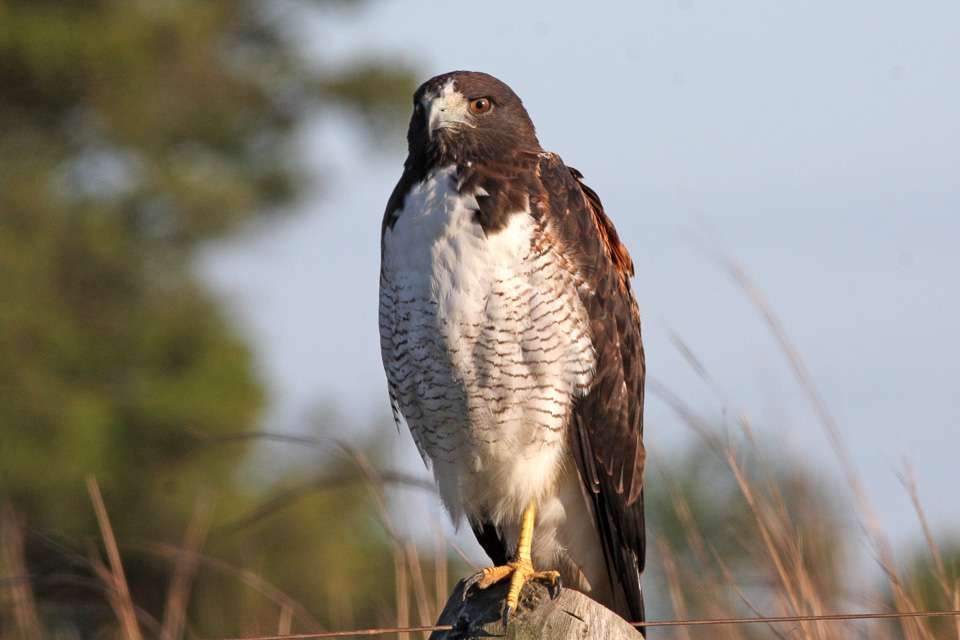
6. White-tailed Hawk (Geranoaetus albicaudatus)
White-tailed Hawk
Status in Texas
Common Year-Round Resident (South Texas)
A striking and unmistakable hawk of southern Texas, the White-tailed Hawk is a medium-large buteo. Adults are easily identified by their white tail with a narrow black band at the tip, bright white underparts, and a dark, slate-gray back and upperwings. Juveniles are brownish overall, with a banded tail that gradually whitens with age.
Habitat and Diet
White-tailed Hawks are typically found in open or semi-open habitats of coastal prairies, brushlands, and grasslands of South Texas. They prey on a wide variety of animals, including reptiles (especially snakes), small mammals, and large insects.
Behavior
They are often seen soaring high over open country or perched on fence posts, utility poles, or isolated trees. Their graceful flight and distinctive tail make them a joy to watch.
7. Harris's Hawk (Parabuteo unicinctus)
Harris's Hawk
Status in Texas
Common Year-Round Resident (South and West Texas)
The Harris's Hawk is a unique and charismatic raptor, known for its striking chestnut "shoulders" (wing linings), thighs, and underwing coverts, contrasting with a dark brown body and a white-tipped tail. Juveniles are mottled brown and white. They are famous for their social hunting behavior.
Habitat and Diet
Harris's Hawks inhabit arid and semi-arid brushlands, mesquite bosques, and riparian woodlands, primarily in South and West Texas. Their diet consists of medium-sized mammals (like rabbits), birds, and reptiles.
Behavior
Unlike most other North American raptors, Harris's Hawks hunt cooperatively in family groups, which allows them to pursue and capture larger or more elusive prey. This social behavior makes them incredibly fascinating to observe. They often perch on cacti, telephone poles, or low trees.
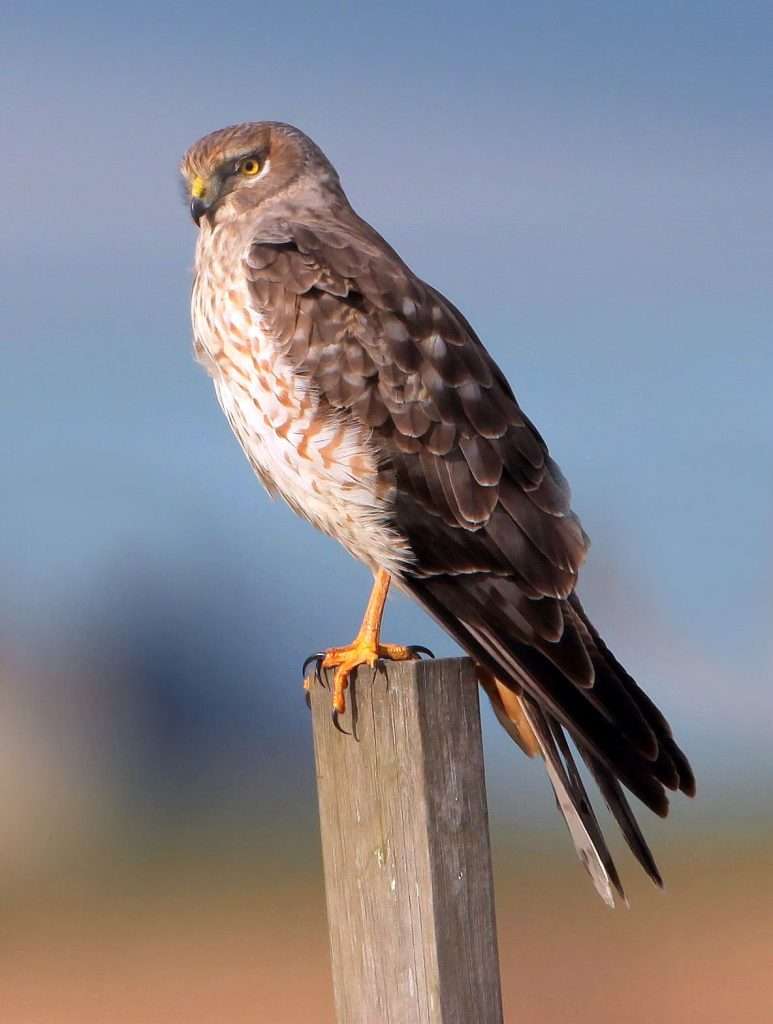
8. Northern Harrier (Circus hudsonius)
Northern Harrier
Status in Texas
Common Winter Resident; Local Breeder (north and east Texas).
The Northern Harrier is a distinctive raptor, unique for its owl-like facial disk (which helps with hearing) and its low, "harrying" flight over open fields. Males are pale gray above with white underparts; females and juveniles are brown above with streaky buff underparts. All ages and sexes have a prominent white rump patch, easily seen in flight, and a long tail.
Habitat and Diet
Harriers are specialists of open habitats, including grasslands, marshes, prairies, and agricultural fields. They hunt by flying low, quartering back and forth over the ground, listening and watching for prey. Their diet consists primarily of small mammals (especially voles and mice) and small birds.
Behavior
Their distinctive buoyant, rocking flight is a key identification feature. They often perform a "sky dance" during courtship, a spectacular aerial display.
Where to Find Hawks in Texas
Given their widespread distribution, finding hawks in Texas is often a matter of looking up.
Roadsides
Utility poles, fence posts, and lone trees along highways and rural roads are common perching spots for Red-tailed Hawks, White-tailed Hawks, and sometimes Harris's Hawks.
National and State Parks
Texas boasts numerous parks with diverse habitats.Big Bend National Park (Trans-Pecos) and Brazos Bend State Park (near Houston) are excellent for their respective regional specialties.
Wildlife Refuges
Aransas National Wildlife Refuge (coastal), Laguna Atascosa National Wildlife Refuge (Lower Rio Grande Valley), and Santa Ana National Wildlife Refuge (Lower Rio Grande Valley) are renowned for migratory and resident raptors, including specialties like White-tailed and Harris's Hawks.
Hawk Migration Sites
During spring and especially fall migration, coastal sites like Hazel Bazemore Park near Corpus Christi and inland sites along the Central Flyway can witness massive movements of Broad-winged, Swainson's, and other migratory hawks.
Frequently Asked Questions
Can I shoot a hawk in Texas if it tries to attack humans or animals?
The Federal Migratory Bird Treaty act of 1918 protects all the hawks in the United States. This law includes harming, caging, and especially killing these birds of prey. However, the next best thing to do is watch your pets and stay away from these predator birds.
How often do you see hawks around neighborhoods in Texas?
You actually see hawks around neighborhoods in Texas quite frequently, especially certain species that have adapted well to human-modified environments. Texas's vastness and varied landscapes mean that even urban and suburban areas often retain enough green spaces, mature trees, and prey to support raptor populations.
Likely species to see in urban areas are the Red-tailed and Red-shouldered Hawk, Coopers and Harris's Hawk and Northern Harrier.
What do Texas hawks eat?
Texas hawks are not picky eaters. They eat anything from road kill to smaller birds, mammals, amphibians, reptiles, and even insects.
Watch as a cooper's hawk hunts for its prey:
How big are the hawks in Texas?
The largest true hawk species you can find in Texas is the Ferruginous Hawk (Buteo regalis).
This impressive raptor is considered the largest of North American buteos, often mistaken for an eagle due to its size and proportions. It typically measures around 22-27 inches in length with a wingspan that can exceed 55 inches. While not a common breeder in Texas today (historically, it was more numerous in the Panhandle), it is a common to locally uncommon winter resident, particularly in the High Plains and Trans-Pecos regions. Ferruginous Hawks are birds of open country, specializing in hunting rabbits, ground squirrels, and prairie dogs.
Ferruginous Hawk
Wrapping Up
Hawks are some of the most beautiful and powerful birds that rule the sky. Luckily, Texas caters to 14 species of these birds of prey year-round. The key to Texas hawk identification is to understand their various behaviors and unique appearances.
Texas's skies are a grand stage for these magnificent birds of prey. Learning to identify its diverse hawk species adds a thrilling dimension to any outdoor excursion in the Lone Star State, offering a glimpse into the wild heart of its expansive and captivating landscapes.
About The Author
Palmer Howell
Palmer is a bird watcher and writer with 20 years experience of documenting the birds he has seen and the places he has visited. He has traveled all over the world to find the beauty of common birds and photograph rare and exotic species. Now he is sharing his knowledge about bird watching, bird species and all the gear needed to care and photograph our feathered friends.
Read more about Love The Birds on our About page.