
Ohio, the Buckeye State, is a surprisingly diverse haven for raptors, especially hawks. From resident birds of prey that grace our skies year-round to spectacular migratory visitors that pass through during spring and fall, observing these magnificent hunters is a rewarding experience for any nature enthusiast.
Understanding the common species and how to identify them can elevate your birdwatching adventures. This guide will introduce you to eight prominent hawk species found in Ohio, offering key identification tips for each.
The World of Hawks: Buteos, Accipiters, and More
Before diving into individual species, it's helpful to understand the general categories of hawks. The two main groups you'll encounter are Buteos and Accipiters.
Buteos
These are typically large, broad-winged, and short-tailed hawks that are often seen soaring high on thermals or perched on prominent overlooks. They are built for soaring and often hunt from a perch, dropping down on unsuspecting prey.
Accipiters
These hawks are characterized by their relatively short, rounded wings and long tails, which allow them to maneuver with incredible agility through dense woodlands. They are pursuit hunters, often darting through trees to catch birds.
Hawks of Ohio
1. Red-tailed Hawk (Buteo jamaicensis)

Overview: The Red-tailed Hawk is Ohio's most common and widespread raptor, a familiar sight perched on utility poles or soaring over open fields. Its adaptability to various habitats has allowed its population to thrive.
Identification:
- Size & Shape: Large, robust hawk with broad, rounded wings and a relatively short, wide tail. Often seen soaring in wide circles.
- Color Pattern: Adults are generally rich brown above and pale below, with a distinctive rusty-red tail (hence the name). A dark "belly band" across the lower breast is often visible, along with dark markings on the underside of the wing between the "shoulder" and "wrist." Juveniles have a brown, banded tail instead of red.
- Behavior: Frequently perches on prominent objects like telephone poles, fence posts, or tall trees overlooking open areas. Their call is a distinctive, raspy "kree-eee-ar!"
- Habitat: Found in almost every type of semi-open habitat, from scrub deserts and grasslands to agricultural fields, urban parks, and patchy woodlands. In Ohio, they prefer drier upland habitats with elevated perches, especially open farmlands.
- Status in Ohio: Permanent resident, with numbers increasing in winter due to migrants from the north.
2. Cooper's Hawk (Accipiter cooperii)

Overview: A highly agile and increasingly common woodland hawk, the Cooper's Hawk has adapted well to suburban environments where it preys on smaller birds.
Identification:
- Size & Shape: Medium-sized accipiter with short, rounded wings and a long tail. Slightly larger than a Sharp-shinned Hawk.
- Color Pattern: Adults have a blue-gray back and cap (often appearing like a "hood"), with rufous (reddish-brown) barring on their white undersides. Juveniles are brown above with heavy brown streaking on their white breasts.
- Behavior: Known for fast, darting flights through trees as they pursue prey. Often seen near bird feeders. Their flight often involves a few flaps followed by a glide.
- Habitat: Inhabits deciduous, coniferous, and mixed forests, woodlands, farmlands, and even suburban areas with mature trees.
- Status in Ohio: Resident and migratory, with increased sightings during migration.
3. Sharp-shinned Hawk (Accipiter striatus)

Overview: The smallest hawk in North America, the Sharp-shinned Hawk is a fierce predator despite its size, often preying on small birds. It can be easily confused with the Cooper's Hawk.
Identification:
- Size & Shape: Smallest accipiter, crow-sized or smaller, with short, rounded wings and a long, square-tipped tail (or slightly notched).
- Color Pattern: Adults are blue-gray above with rufous barring on the underside. Juveniles are brown above with fine brown streaking on the breast. A key distinction from Cooper's is often a "dark hood" that contrasts with a lighter nape, and a smaller, rounder head that doesn't extend much beyond the wing joint when perched.
- Behavior: Agile and quick, often making rapid dives and turns through vegetation.
- Habitat: Primarily found in woodlands and forests, though also seen in suburban areas during migration.
- Status in Ohio: Migratory and winter visitor, with some local breeding populations.
4. Broad-winged Hawk (Buteo platypterus)

Overview: This small to medium-sized buteo is famous for its massive migratory "kettles" – spiraling flocks of thousands of hawks that utilize thermals to conserve energy during their long journeys to Central and South America.
Identification:
- Size & Shape: Small, stocky buteo, about the size of a crow, with short, broad wings that taper to a pointed tip.
- Color Pattern: Adults are dark brown above and pale below, with a distinct, broad black-and-white banded tail. When soaring, the underside of their wings shows a dark trailing edge.
- Behavior: While not always conspicuous during the breeding season in Ohio's woodlands, their migratory behavior is spectacular. Look for kettles in late April and especially in mid to late September.
- Habitat: Breeds in deciduous or mixed coniferous-deciduous forests, often near water and clearings. Migrants can be seen over any open country.
- Status in Ohio: Primarily a migratory species, with some breeding in the state.
5. Northern Harrier (Circus hudsonius)

Overview: Formerly known as the Marsh Hawk, the Northern Harrier is a graceful raptor known for its low, buoyant flight over open grasslands and marshes.
Identification:
- Size & Shape: Medium-sized, slender hawk with long wings held in a distinct "V" shape (dihedral) while flying.
- Color Pattern: Males are pale gray above and white below, with black wingtips. Females and juveniles are brown above with streaking on their underside. All harriers have a prominent white rump patch, visible in flight. They also possess an owl-like facial disk that aids their hearing.
- Behavior: Hunts by flying low over fields, often quartering back and forth, listening for prey.
- Habitat: Prefers wide open spaces, including marshes, prairies, grasslands, and agricultural fields.
- Status in Ohio: Primarily a winter resident and migratory visitor, with limited breeding.
6. Red-shouldered Hawk (Buteo lineatus)
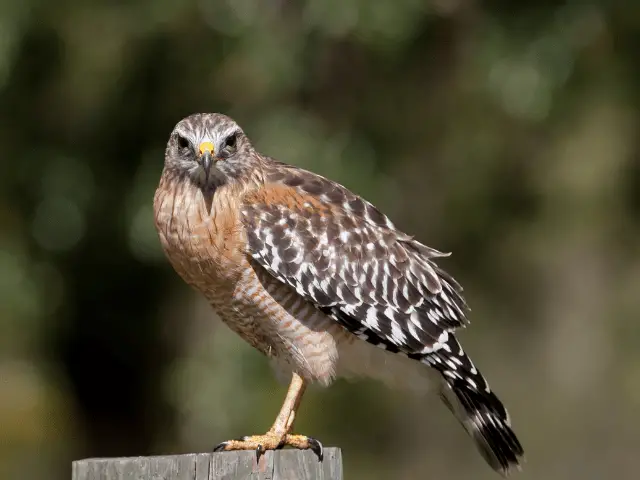
Overview: An attractive woodland raptor, the Red-shouldered Hawk is a vocal bird with a distinctive call. It's often found near water.
Identification:
- Size & Shape: Medium-sized buteo with broad, rounded wings and a relatively long tail.
- Color Pattern: Adults have a dark brown back with white spotting, and rich rusty-red barring on their chest and belly (hence the name). The underside of the wings shows prominent crescent-shaped translucent patches near the wingtips. Their tail has narrow black and white bands.
- Behavior: Very vocal, with a loud, repeated "kee-ahh" call. Often perches in trees within forests, scanning for prey.
- Habitat: Found in deciduous woodlands, often near rivers, swamps, and suburban woodlands with large trees.
- Status in Ohio: Resident and migratory, with increased numbers during winter.
7. Rough-legged Hawk (Buteo lagopus)

Overview: A true winter visitor to Ohio, the Rough-legged Hawk breeds in the Arctic tundra and journeys south to find food during the colder months. Its feathered legs give it its name.
Identification:
- Size & Shape: Large, chunky buteo with long wings. Often seen hovering in place against the wind, similar to a Kestrel, but much larger.
- Color Pattern: Highly variable, with light and dark morphs. Key features include a dark belly band, dark carpal patches (at the "wrist" of the wing), and a tail that is white at the base with a broad dark terminal band. Uniquely, their legs are feathered all the way to their toes.
- Behavior: Hunts by hovering over open country or perching on low posts and fence lines.
- Habitat: Found in open country, including agricultural fields, marshes, and pastures, during winter.
- Status in Ohio: Winter visitor, typically from November to March.
8. Osprey (Pandion haliaetus)

Overview: While not a "true hawk" in the same genus as Buteos or Accipiters, the Osprey is a fish-eating raptor that is a spectacular sight. It has made a strong comeback in Ohio thanks to conservation efforts.
Identification:
- Size & Shape: Large, distinctive raptor with long, narrow wings that are often kinked at the "wrist," giving them an M-shape in flight.
- Color Pattern: Dark brown back and white underside. A bold, dark eye stripe extends from the beak across the eye. Their head is white with a dark cap.
- Behavior: Exclusively eats fish, diving feet-first into water to snatch prey with their specialized talons. Often seen nesting on platforms near large bodies of water.
- Habitat: Found near large lakes, reservoirs, and rivers.
- Status in Ohio: Migratory, with a growing breeding population.
Key Identification Tips for All Hawks
Size and Shape
The overall silhouette in flight or while perched can be very telling. Is it bulky with broad wings (buteo) or slender with short, rounded wings and a long tail (accipiter)?
Color Pattern
Look for distinctive markings on the underside of the wings, tail bands, belly bands, and head patterns.
Flight Style
Does it soar in wide circles, flap and glide, hover, or dart through trees?
Habitat and Behavior
Where do you see it? Is it over open fields, in dense woods, or near water? What is it doing?
Call
Many hawks have characteristic calls that can aid in identification.
What About This: You might have come across several articles detailing hawks, their lifespans, habitats, and feeding habits. How about reading on falcon vs hawk and finding out which is the better raptor?
Frequently Asked Questions
Can You Own A Hawk In Ohio?
Yes, with a falconry permit. You sit for a written exam before you get a falconry permit, and you must be 16 years old. They ask about raptor biology, protection laws, pathology, among other topics.
What Is The Most Common Hawk In Ohio?
Like most states, the most commonly seen hawk in Ohio is the Red-tailed Hawk.
Is It Legal To Kill A Hawk In Ohio?
No, you CANNOT kill a hawk unless in permitted cases of public health or safety. To get such a permit, you must exhaust all other methods of controlling them.
Wrapping Up
Observing hawks in Ohio is a dynamic and rewarding experience. With patience and a keen eye for these distinguishing features, you'll soon be identifying these magnificent birds of prey with confidence, enriching your connection to Ohio's incredible natural world.
Good Luck!
