
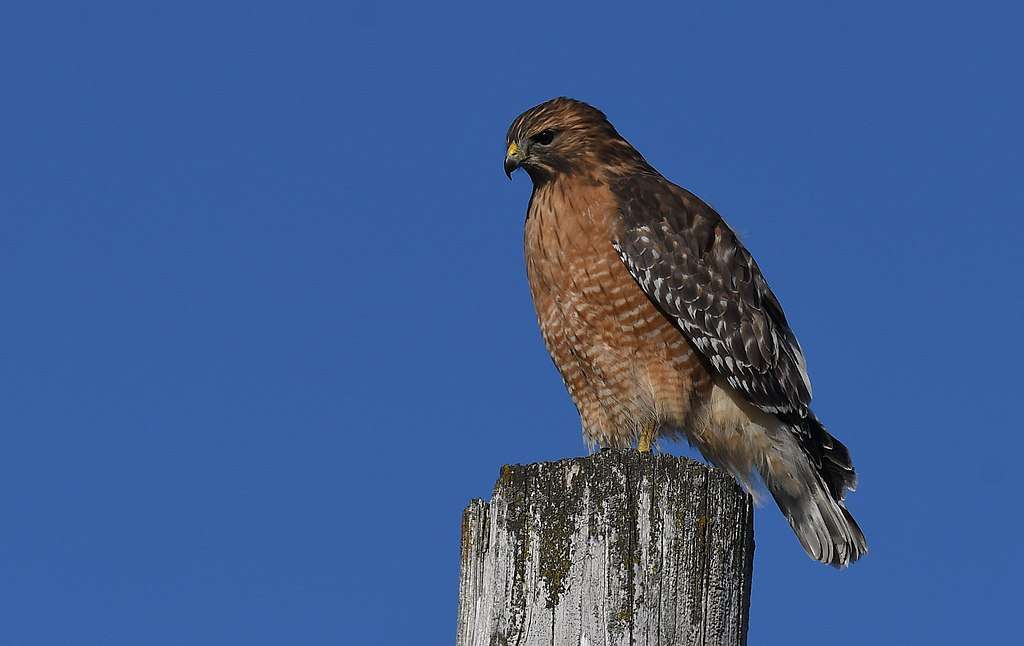
Florida, the Sunshine State, is a birder's paradise, offering an incredible diversity of avian life, including a captivating array of hawk species. From resident raptors that patrol the skies year-round to long-distance migrants making their epic journeys, understanding the different types of hawks found in Florida provides a deeper appreciation for the state's vibrant ecosystems.
This article will explore seven prominent hawk species you can encounter in Florida, highlighting their key identification features and their status as native residents or migratory visitors.
The World of Hawks in Florida: Residents and Travelers
Hawks, like all raptors, are birds of prey characterized by their sharp talons, hooked beaks, and keen eyesight, essential tools for hunting. In Florida, you'll encounter two main groups of hawks:
Buteos
These are typically robust, broad-winged, and relatively short-tailed hawks, adept at soaring high on thermals. They often hunt from a perch, patiently waiting for prey.
Accipiters
Characterized by their shorter, rounded wings and long tails, accipiters are built for agile pursuit through dense vegetation, making them effective hunters of other birds.
Florida's unique geographical position at the southeastern tip of the North American migration flyway makes it a crucial stopover and wintering ground for many migratory raptors.
1. Red-tailed Hawk (Buteo jamaicensis)

Overview: The Red-tailed Hawk is perhaps the most widespread and recognizable hawk in North America, and Florida is no exception. It's a common sight throughout the state, often seen perched on utility poles, fence posts, or soaring over open fields. A distinct subspecies, the Florida Red-tailed Hawk (Buteo jamaicensis umbrinus), is a large, year-round resident in peninsular Florida, known for its darker back and chestnut to rufous side patches compared to other Red-tailed Hawks.
Identification:
- Size & Shape: Large, robust hawk with broad, rounded wings and a relatively short, wide tail. Often seen soaring in wide circles.
- Color Pattern: Adults generally have a rich brown back and pale underparts, with the namesake rusty-red tail being a key identifier. A dark "belly band" across the lower breast is often visible, along with dark markings on the underside of the wing between the "shoulder" and "wrist." Juveniles have a brown, banded tail instead of red. Florida's resident subspecies may appear darker overall.
- Behavior: Frequently perches prominently overlooking open areas, scanning for small mammals, reptiles, and large insects. Its call is a distinctive, high-pitched, and raspy "kree-eee-ar!"
- Habitat: Highly adaptable, found in almost every type of semi-open habitat, from agricultural fields and suburban areas to pine forests and woodlands.
- Status in Florida: Abundant year-round resident, with additional migratory individuals passing through.
2. Red-shouldered Hawk (Buteo lineatus)
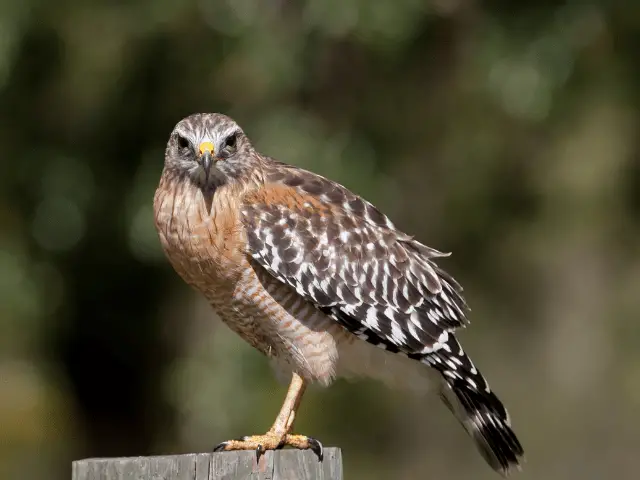
Overview: The Red-shouldered Hawk is another very common and vocal raptor in Florida, often heard before it's seen. Its preference for wooded areas near water makes it a familiar resident in many suburban neighborhoods and natural areas across the state.
Identification:
- Size & Shape: Medium-sized buteo with broad, rounded wings and a relatively long tail. Adults in Florida tend to be paler than those in other regions.
- Color Pattern: Adults have a dark brown back with white spotting, and rich rusty-red barring on their chest and belly (the "shoulders" are also reddish). The underside of their wings shows distinctive crescent-shaped translucent patches near the wingtips. Their tail has narrow black and white bands. Juveniles lack the reddish color, appearing more whitish with brown spot-like patterns.
- Behavior: Very vocal, with a loud, piercing, and repeated "kee-ahh" call. Often soars in circles at high altitude or glides from tree to tree within forests, frequently perching with its head tilted downwards, looking for small mammals, lizards, snakes, and amphibians.
- Habitat: Prefers pine, oak, and cypress forests near water, but also commonly seen in neighborhoods with mature trees and power line easements.
- Status in Florida: Abundant year-round resident throughout the state.
3. Cooper's Hawk (Accipiter cooperii)

Overview: The Cooper's Hawk is a medium-sized, agile accipiter known for its pursuit hunting style, often darting through trees to catch birds. Its adaptability has allowed it to become a common sight even in suburban areas where backyard bird feeders provide a ready food source.
Identification:
- Size & Shape: Medium-sized hawk with relatively short, rounded wings and a long, banded tail that is rounded at the tip. Slightly larger than a Sharp-shinned Hawk.
- Color Pattern: Adults have a blue-gray back and a dark cap (often giving a "hooded" appearance), with rufous (reddish-brown) barring on their white undersides. Juveniles are brown above with heavy brown streaking on their white breasts.
- Behavior: Known for fast, darting flights and incredible maneuverability through dense woodlands and backyards as they pursue prey, primarily medium-sized birds like robins and jays. Their flight often involves a few quick flaps followed by a glide.
- Habitat: Found in various wooded habitats, including mature forests, woodlots, suburban areas with large trees, and riparian zones.
- Status in Florida: Year-round resident, with numbers potentially augmented by migratory birds in winter.
4. Sharp-shinned Hawk (Accipiter striatus)

Overview: The smallest North American hawk, the Sharp-shinned Hawk is a diminutive but fierce predator, primarily preying on small songbirds. Its similarity in appearance to the Cooper's Hawk makes identification challenging but rewarding.
Identification:
- Size & Shape: Smallest accipiter, crow-sized or smaller, with short, rounded wings and a relatively short tail that is square-tipped or slightly notched. Its head appears small and rounded, often not extending much beyond the "shoulder" when perched.
- Color Pattern: Adults are blue-gray above with fine reddish-brown barring on their white underparts. Juveniles are brown above with fine brown streaking on the breast. A key distinction from Cooper's is often a more distinct "dark cap" that contrasts less sharply with the nape, and often appearing less "hooded."
- Behavior: Extremely agile and quick, often making rapid dives and turns through vegetation. Frequently seen near bird feeders, a common hunting ground.
- Habitat: Primarily found in coniferous and mixed woodlands, forest edges, and suburban areas during migration.
- Status in Florida: Common winter visitor, usually from October to April, with some local breeding populations, mainly in northern Florida.
5. Northern Harrier (Circus hudsonius)
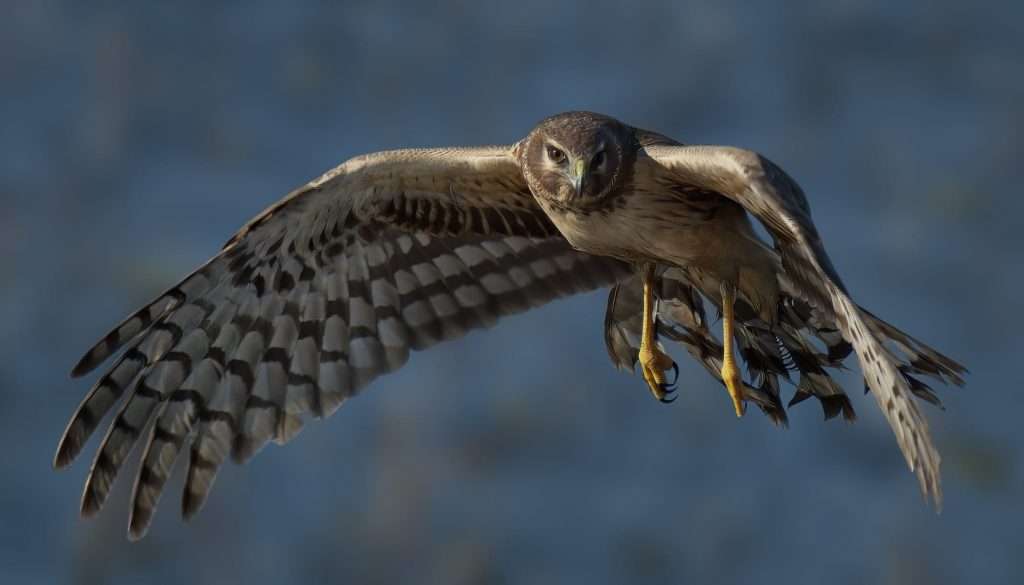
Overview: A distinctive and graceful raptor, the Northern Harrier is unique among North American hawks for its owl-like facial disk and low, buoyant flight over open landscapes. It's often seen silently cruising over wetlands and grasslands.
Identification:
- Size & Shape: Medium-sized, slender hawk with long wings held in a distinct "V" shape (dihedral) while flying.
- Color Pattern: All harriers have a prominent white rump patch, which is a key field mark visible in flight. Males are pale gray above and white below, with black wingtips. Females and juveniles are brown above with streaking on their underparts. They have an owl-like facial disc that helps them locate prey by sound.
- Behavior: Hunts by flying low over fields, often quartering back and forth, using its keen hearing to locate small mammals and birds in dense vegetation.
- Habitat: Prefers wide open spaces, including marshes, prairies, grasslands, and agricultural fields.
- Status in Florida: Common winter resident and migratory visitor, especially in wetland and open field habitats.
6. Broad-winged Hawk (Buteo platypterus)

Overview: This small to medium-sized buteo is celebrated for its spectacular migratory "kettles" – massive spiraling flocks of thousands of hawks that utilize thermals to conserve energy during their long journeys to Central and South America. While some breed in Florida, they are most conspicuous during migration.
Identification:
- Size & Shape: Small, stocky buteo, about the size of a crow, with short, broad wings that taper to a pointed tip.
- Color Pattern: Adults are dark brown above and pale below, with a distinctive, broad black-and-white banded tail. When soaring, the underside of their wings often shows a dark trailing edge. Some individuals can be dark morph, appearing almost entirely dark brown.
- Behavior: During migration, they form impressive "kettles," soaring together on rising columns of warm air. During the breeding season, they are more secretive, nesting in forests.
- Habitat: Breeds in deciduous or mixed coniferous-deciduous forests, often near water and clearings. Migrants can be seen over any open country.
- Status in Florida: Primarily a migratory species, with peak numbers in spring (late April) and fall (mid to late September). A small number may breed in the northern parts of the state.
7. Short-tailed Hawk (Buteo brachyurus)

Overview: A unique and less common hawk in the U.S., the Short-tailed Hawk is found almost exclusively in Florida, where it is a year-round resident in the southern peninsula and a migratory visitor to the Keys. It is known for its graceful, high-soaring hunting technique, specializing in catching small birds.
Identification:
- Size & Shape: A relatively small buteo (around 16 inches long) with broad wings and a comparatively short tail, giving it a somewhat "tailless" appearance in flight.
- Color Pattern: Occurs in two distinct color morphs:
- Light Morph: Dark brown back, clean white underparts, and a black "hooded" effect on the head, with striking dark underwing linings contrasting with pale flight feathers.
- Dark Morph: Uniformly dark sooty-brown plumage overall, with the underside of the flight feathers (primaries and secondaries) appearing silvery-white, creating a two-toned effect in flight. The dark morph is more common in Florida.
- Behavior: Spends most of its time soaring high in the sky, often appearing motionless, scanning for prey. It is a specialist bird hunter, performing spectacular high-altitude dives to snatch unsuspecting birds from tree tops.
- Habitat: Primarily inhabits subtropical woodlands, particularly near wetland edges, bays, mangrove and cypress swamps, and patchy woodlands.
- Status in Florida: Year-round resident in central and southern Florida, with northern Florida populations moving south for the winter. It is considered uncommon, with fewer than 500 individuals in the U.S.
Frequently Asked Questions
What Does A Hawk Look Like In Florida?
Hawks have different plumage colors, eye colors, tail shapes, wingspan, and lengths. Therefore, you'd have to define the characteristics of a specific species, such as Cooper's Hawk.
Overall, dark gray, brown, and bluish-gray are the common upper colors of hawks in Florida. They have white, pale red, or brownish underbellies with streaks. Wings and tail length vary, with the Northern Harrier and the Red-tailed Hawk exhibiting long wingspans.
What Do Florida Hawks Eat?
Generally, they eat birds, fish, reptiles, amphibians, and mammals. Each species has its diet, but the most popular delicacies from the mentioned classes are frogs, songbirds, crayfish, snakes, lizards, insects, rabbits, mice, and voles. Hawks that eat small birds get them from bird feeders.
Watch This!
Can You Own A Hawk In Florida?
Yes, after getting a permit. Since the law protects these birds, you have to apply for a permit to own, import, buy, sell or transport them.
Where Are Some Good Places To See Hawks In Florida?
Florida Keys Hawkwatch (Curry Hammock State Park, Marathon, Middle Keys)
Why it's good: This is arguably the premier hawk-watching site in Florida, and one of the most important in North America, particularly for fall migration. The narrow chain of islands in the Florida Keys concentrates migrating raptors, creating a bottleneck as they prepare to cross the Florida Straits and Gulf of Mexico. The Florida Keys Hawkwatch project has documented incredibly high numbers of peregrine falcons, along with other species like Sharp-shinned Hawks, Cooper's Hawks, and Short-tailed Hawks.
What you'll see: Expect a wide variety of raptors, with Peregrine Falcons being a major highlight. You'll also see abundant Sharp-shinned Hawks, Cooper's Hawks, Broad-winged Hawks, Ospreys, Red-tailed Hawks, and potentially rarer species like Short-tailed Hawks and Mississippi Kites.
Best time to visit: Fall migration, especially from mid-September through October. The project conducts daily counts during this period.
Tips: Check the Florida Keys Hawkwatch website or social media for daily counts and updates. Bring good binoculars and a spotting scope.
St. Joseph Peninsula State Park (Port St. Joe, Florida Panhandle)
Why it's good: Located on the "Forgotten Coast" in Northwest Florida, St. Joseph Peninsula is a narrow barrier island that acts as another significant migration hotspot. Birds moving south along the coast are funneled onto the peninsula before making longer water crossings. This area is particularly well-known for fall migrants.
What you'll see: You can expect a good variety of migrating raptors, including significant numbers of Peregrine Falcons and other hawk species like Broad-winged Hawks, Sharp-shinned Hawks, and Ospreys. Resident Red-tailed Hawks and Red-shouldered Hawks are also present.
Best time to visit: Fall migration (September and October) is prime for concentrated numbers. Look for birds along the dune lines, especially with west winds or after a cold front.
Tips: The peninsula runs north-south, and hawks may fly north (the "wrong" way) along the tip before making their crossing. The very tip of the peninsula is often a gathering point.
Everglades National Park (South Florida)
Why it's good: While not primarily a "hawk migration watch" like the Keys, Everglades National Park offers incredible opportunities to see resident Florida raptors in their natural habitat, and also benefits from being a wintering ground for some species. Its vast, wild landscapes are home to several unique raptors adapted to wetland environments.
What you'll see: This is one of the best places in the US to see the rare Short-tailed Hawk, especially the dark morph. You'll also frequently encounter Red-shouldered Hawks, Ospreys, and Snail Kites (a specialized raptor that feeds almost exclusively on apple snails). In winter, Northern Harriers are common gliding over the sawgrass prairies.
Best time to visit: Winter (November to April) offers excellent birding conditions with lower humidity and fewer mosquitoes. This is when many migratory species are present, and resident birds are active.
Tips: Explore different areas of the park, such as the Anhinga Trail, Shark Valley, and the coastal areas for diverse raptor sightings. Look for Ospreys and Snail Kites near waterways.
Wrapping Up
Florida's diverse ecosystems provide crucial habitats for both resident and migratory hawk species. Whether you're a seasoned birder or a casual observer, keeping an eye on the skies will reveal the fascinating world of these powerful and graceful raptors, each playing a vital role in the Sunshine State's natural heritage.
Birding in Florida will also introduce you to a rare species, the Short-tailed Hawk. Good luck!
Find out more about Florida bird species here.
