
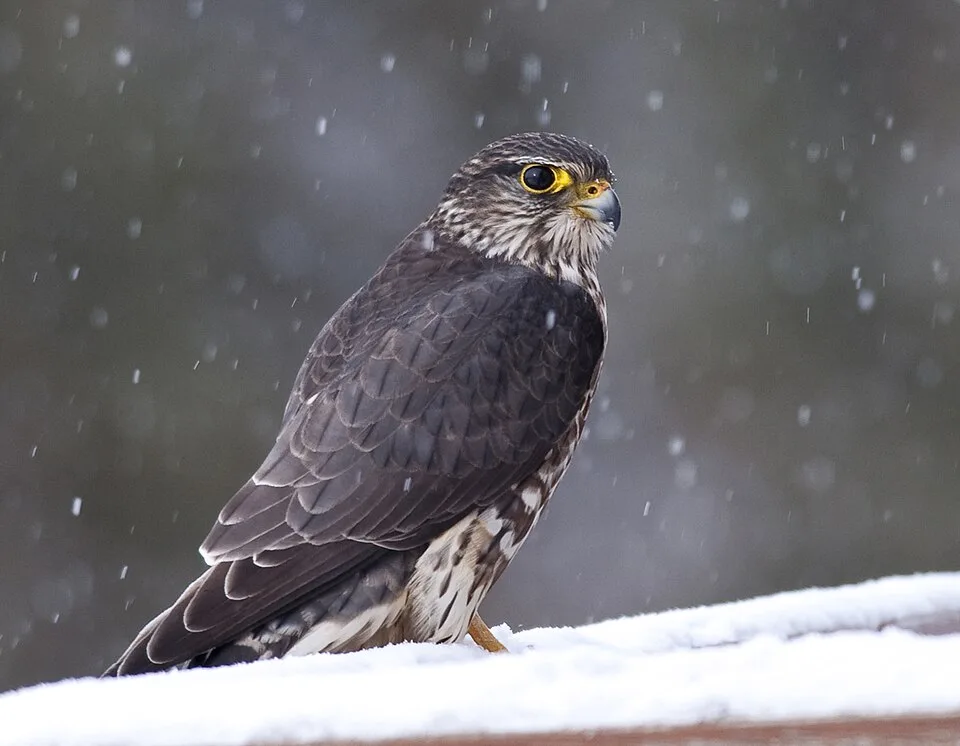
The name "Merlin" evokes images of medieval magic and legend, but the bird that bears this name—Falco columbarius—is a creature of pure, exhilarating reality. It is the smallest of the North American and Eurasian falcons, yet what it lacks in size, it more than compensates for with sheer determination, dazzling speed, and an unshakeable predatory drive. Often overlooked or mistaken for a kestrel, the Merlin is a master of the aerial hunt, a compact dart that specializes in pursuing and capturing other birds in flight.
Identification: A Study in Miniaturization
The Merlin is a stoutly built raptor, slightly larger than an American Kestrel, yet far more robust and powerful. Its plumage varies widely across its vast global range, leading to several recognized subspecies, each with a distinct look:
Adult Males (Taiga/Boreal Form): Typically feature a beautiful slate-gray to bluish-gray back and wings, with a dark-banded tail and streaked, rusty-tinged underparts.
Females and Immatures: Are generally browner overall, with dark-brown backs and heavier streaking on the buffy underparts.
Subspecies Variation:
Black Merlins (F. c. suckleyi) of the Pacific Northwest are the darkest, appearing almost black above.
Prairie Merlins (F. c. richardsonii) of the Great Plains are the palest, with light streaking and a conspicuous light eyebrow.

Unlike the larger Peregrine and Kestrel, the Merlin typically lacks a prominent dark malar (mustache) stripe on its face, giving it a less defined facial pattern. In flight, its wingbeats are famously rapid, stiff, and powerful—a piston-like action that fuels its high-speed chases.
The Aerial Hunter: Speed and Strategy
The Merlin's former common name, the "Pigeon Hawk," hints at its primary prey—small-to-medium-sized birds. Merlins are highly specialized aerial hunters, capable of consuming over 900 birds in a single year. Their hunting style is a stark contrast to the Peregrine’s dizzying stoop (dive) from great height, or the Kestrel’s sustained hovering.
Low and Fast Pursuit: The most characteristic Merlin hunting technique is to fly fast and low over the ground, using cover and the element of surprise to flush flocks of small songbirds or shorebirds. Once prey is in the air, the Merlin engages in a relentless, high-speed tail-chase, relying on its agility and raw speed to wear down the victim.
Ringing Flights: They sometimes employ what are called "ringing flights," where the falcon and its prey climb higher and higher in a desperate, spiraling aerial battle until the prey is exhausted.
Cooperative Hunting: Breeding pairs are known to hunt collaboratively, with one bird flushing a flock of prey (such as waxwings or sandpipers) while the other swoops in to capitalize on the resulting chaos and confusion.
Diet Flexibility: While birds are the staple, Merlins are opportunistic. They will also hunt large insects (especially dragonflies, which are an important food for fledglings), small rodents, and even bats caught at cave openings.

Merlin
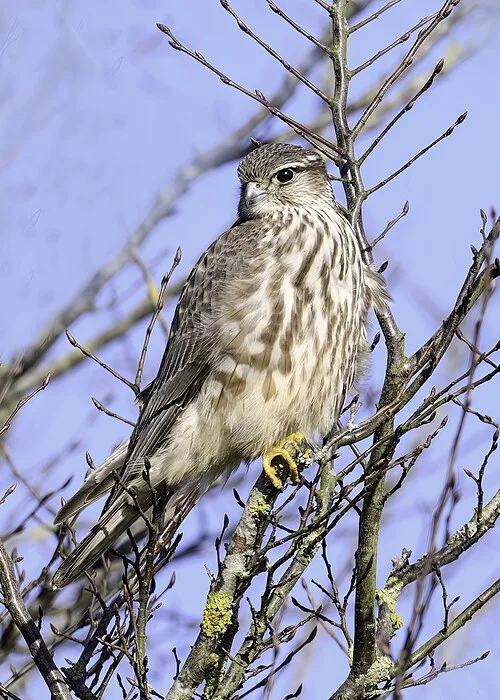
Range and Migration: The Global Traveler
The Merlin is a Holarctic species, boasting one of the widest ranges of any raptor. It breeds across the northern latitudes of both North America and Eurasia.
Breeding Habitat: Merlins favor open country with scattered trees, such as boreal forest edges, parklands, prairies, and open moorlands, which provide both nesting sites and clear airspace for hunting.
Migration: Most populations are strongly migratory. Birds breeding in the far north of Canada, for example, will travel enormous distances to wintering grounds extending through the southern United States, Central America, and even down to northern South America (Ecuador). In contrast, subspecies in milder, maritime regions, like the Pacific Northwest or the British Isles, may be largely resident or undertake only short, local movements to coastal lowlands in winter.
Urban Adaptability: In a significant shift over recent decades, Merlins have demonstrated a remarkable ability to move into urban and suburban areas, particularly in the winter. They are often drawn by the abundant, readily available prey found at bird feeders, frequently adopting abandoned nests of crows or magpies in tall city trees.

The Falconry Legacy
Throughout history, the Merlin was a revered bird in the sport of falconry. Its speed, courage, and size made it the preferred falcon for the nobility, particularly ladies of the court, earning it a special place in the medieval social hierarchy of falconry. It was most famously used to fly after small, fast birds like larks and pipits—a tradition that underlines the Merlin’s fierce spirit and flawless athleticism, a true testament to the power packed into this small bird of prey.
