

The Hawaiian Islands are not just a paradise of white sands and volcanic peaks; they are a living, open-air laboratory for evolution. Nowhere is this biological spectacle more vividly demonstrated than in the story of the Hawaiian Honeycreepers (subfamily Carduelinae), a diverse group of endemic finches whose adaptive journey is considered one of the most compelling examples of adaptive radiation on Earth.
Once numbering over fifty distinct species and subspecies, these birds evolved from a single founding ancestor into an array of forms that mimic the specialized roles of several mainland bird families—from warblers and woodpeckers to parrots and finches. Their history is a chronicle of evolutionary success, followed tragically by human-driven decline, making them the poignant face of conservation in the islands.
A Single Colonist: The Genesis of Diversity
The story of the Honeycreepers begins millions of years ago, when a single species of finch, likely a relative of the modern Eurasian Rosefinch or an ancestral Asian finch, somehow crossed the vast Pacific Ocean and successfully colonized the islands of Hawaiʻi. This single event, known as the founder effect, provided the raw material for an astonishing burst of evolution.
The new colonists arrived in an environment devoid of competitors. There were no woodpeckers to drill for insects, no nectar-feeding hummingbirds, and very few specialized seed-cracking species. The abundance of ecological niches—from dry coastal scrub and open lava flows to dense, high-altitude rainforests—was the engine that drove the evolutionary explosion.
Over millions of years, as the birds spread across the archipelago, they adapted to utilize every available food source: insects, seeds, fruits, and, critically, the nectar of flowering native plants like the ʻŌhiʻa lehua. The result was a stunning transformation, creating the unique lineages we call the Hawaiian Honeycreepers.
Adaptive Radiation: The Beak as the Blueprint
The most striking evidence of this adaptive radiation is found in the incredible diversity of the Honeycreepers’ beaks. The shape, length, and curvature of the bill became the blueprint for each species’ lifestyle, allowing them to exploit different resources and avoid competition. Scientists often group these species by their bill morphology:
1. The Nectar-Feeders (Hummingbird Mimics)
These species developed long, thin, curved bills perfectly shaped to reach nectar deep within tubular flowers. Their bills are a classic example of co-evolution with native Hawaiian flora.
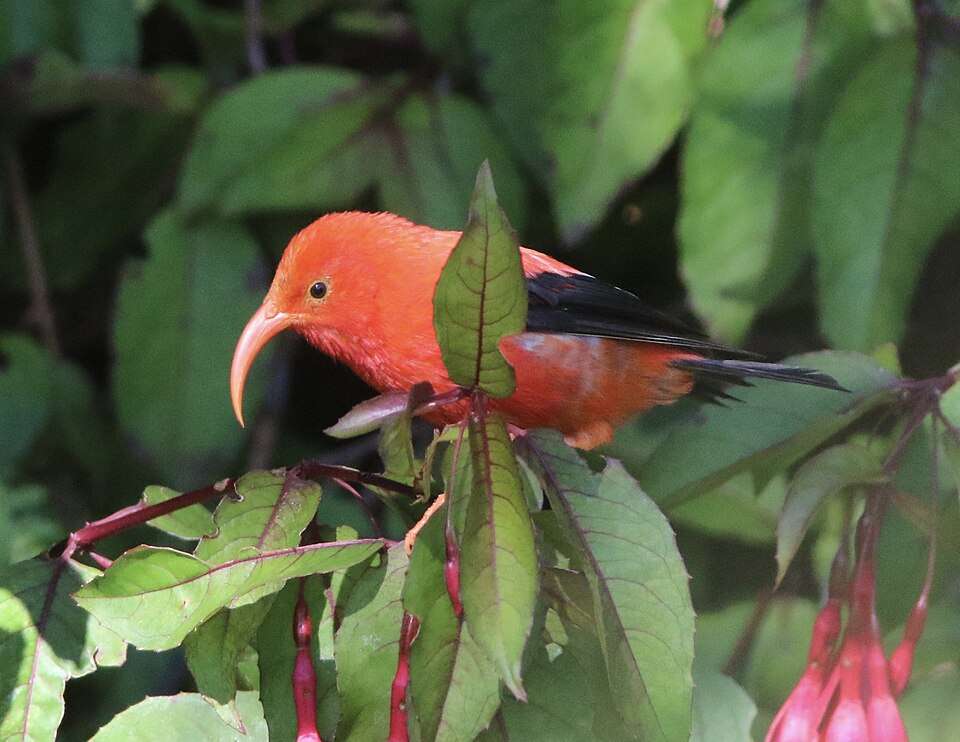
- ʻIʻiwi (Drepanis coccinea): Perhaps the most famous honeycreeper, the male is a dazzling scarlet with black wings and a remarkably long, sickle-shaped, salmon-colored bill. It acts as a primary pollinator for many native Hawaiian plants.
- ʻApapane (Himatione sanguinea): Smaller than the ʻIʻiwi, this bird is crimson-red with black wings and a relatively short, curved bill. It is the most widespread and abundant of the surviving honeycreepers, often found feeding high in the canopy of the ʻŌhiʻa lehua tree.

2. The Insect-Probers and Woodpecker-Mimics
These birds evolved bills specialized for foraging for insects hidden beneath bark or in crevices.
- ʻAkiapōlāʻau (Hemignathus wilsoni): Found only on the Big Island, this species has one of the most bizarre and specialized beaks in the bird world. The lower mandible is thick and straight, used like a chisel to chip away bark, while the upper mandible is long and curved, used like a probe to extract grubs. It fills the ecological role of a woodpecker.

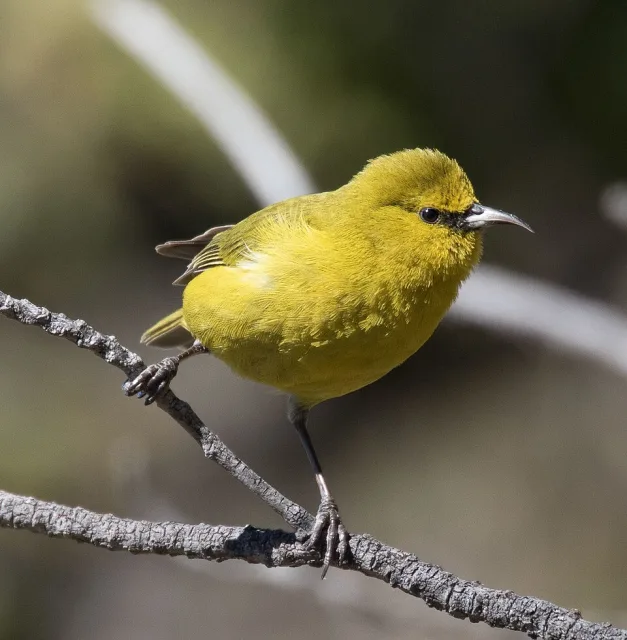
- ʻAmakihi (Loxops virens) (ʻAmakihi): This small, greenish-yellow bird is highly adaptable and has a moderately curved bill used to probe flowers, glean insects from leaves, and eat fruit. Its versatility is likely why it is one of the few species still found at lower elevations.
The Chameleons of Illumination: How Light Transforms Bird Plumage
3. The Seed and Nut Crackers (Finches Proper)
Returning to their finch ancestry, some species retained or evolved the powerful, conical bills necessary for cracking hard seeds and nuts.
- (Loxioides bailleui): The Palila is the quintessential Hawaiian finch. It possesses a thick, parrot-like beak specialized for feeding on the tough, green seed pods of the māmane tree, a foundational plant in its dry, high-elevation habitat. The Palila is highly endangered and restricted to the slopes of Mauna Kea on the Big Island.

- Grosbeak Finches (Extinct): Species like the Koa finch and the Greater Koa finch had massive, parrot-like beaks, capable of crushing the seeds of the large koa tree. These birds became extinct soon after European contact, likely due to habitat loss.
A Catastrophic Decline: The Human Impact
Despite their ingenious adaptations, the Honeycreepers were exquisitely vulnerable to the changes brought by human colonization. Their history of decline, beginning with the arrival of Polynesians and accelerating with European settlement, is considered the most rapid mass extinction of birds in modern times.
The primary drivers of this crisis fall into three major categories:
1. Habitat Loss and Degradation
The massive deforestation of the lowlands for agriculture and grazing destroyed the birds' primary habitats. The surviving populations were pushed into the higher, wetter elevation forests, creating fragmented and isolated populations.
2. Introduced Species and Predators
The introduction of non-native species had a devastating effect:
- Rats, Mongooses, and Feral Cats: These introduced mammals were highly effective nest predators against which the native birds had no defense.
- Feral Pigs and Goats: These ungulates degrade the forest understory, destroying native plants and creating stagnant water pools that serve as breeding grounds for disease vectors.
3. Avian Malaria and Mosquitoes
This is the single greatest threat to the survival of the remaining species. Avian malaria, a parasitic protozoan carried by the introduced Southern House Mosquito (Culex quinquefasciatus), is lethal to most honeycreepers.
The mosquitoes cannot survive the cold temperatures above approximately 4,500 to 5,000 feet in elevation. This has forced the remaining honeycreeper populations into small, high-altitude refugia (safe havens), creating "mosquito-free zones" where they can still breed and survive. Below this "avian malaria line," the forests are eerily silent.
The Conservation Imperative
Of the over 50 original honeycreeper species, nearly 30 are now extinct. Today, approximately 17 species survive, with many of them listed as critically endangered.
Conservation efforts are intense and multi-faceted:
- Habitat Protection: Protecting the remaining high-elevation native forests from invasive species, primarily through fencing to exclude feral pigs and goats.
- Captive Breeding: Programs are underway for critically endangered species, such as the ʻAkikiki and the ʻAlalā (Hawaiian Crow, a related but non-finch species), to prevent their complete disappearance in the wild.
- Mosquito Control: Scientists are exploring groundbreaking solutions, including the use of incompatible insect technique (IIT)—releasing male mosquitoes infected with the Wolbachia bacterium that prevents successful reproduction—to control the mosquito population without using harmful insecticides.
The Hawaiian Honeycreepers stand as a powerful symbol: a testament to the explosive creativity of evolution on isolated islands, and a dire warning about the fragility of life when faced with rapid environmental change. Their survival hinges on the success of human intervention in mitigating the threats that pushed these beautiful, specialized finches to the very brink.
