

The finch family, specifically the true finches (members of the family Fringillidae), represents some of the most charming, colorful, and popular birds found across the North American mainland. These are the birds that enliven winter feeders, dot backyard trees with flashes of color, and inspire awe with their nomadic movements. Adapted almost exclusively to a seed-based diet, their powerful, conical bills are the defining tools of their survival, equipping them to crack the toughest shells and exploit abundant seed resources across diverse habitats, from high mountain forests to suburban parks.
In the United States, the finch population is a diverse assembly, ranging from the familiar year-round residents that grace feeders to the irruptive boreal visitors whose appearances are governed by the scarcity of northern cone crops. Studying these birds offers a fascinating look into avian adaptation, survival strategies, and the compelling science of bird-feeder ecology.
The Core Residents: Common and Widespread Finches
Three species stand out as the most ubiquitous and familiar finches across the majority of the lower 48 states, adapting well to human-modified landscapes.
The American Goldfinch (Spinus tristis)
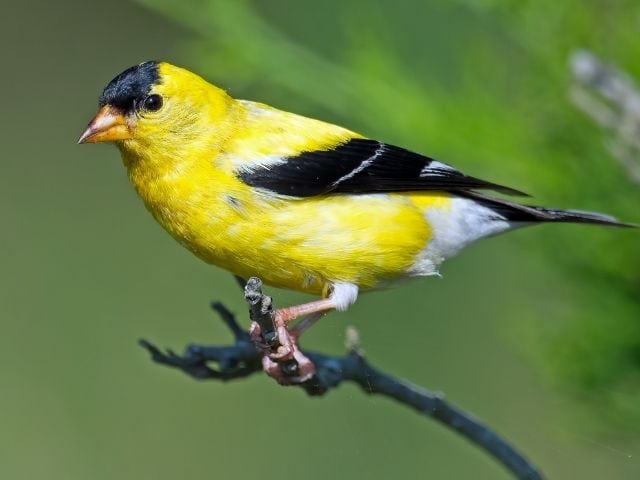
The American Goldfinch is arguably the best-known finch in the United States and the undisputed master of seasonal color.
- Summer Spectacle: During the breeding season, the male transforms into a brilliant lemon-yellow with a contrasting black cap, wings, and tail. This plumage is so striking it often earns the bird the nickname "wild canary."
- Winter Shift: Uniquely, the Goldfinch undergoes a complete molt in autumn, trading its flashy summer coat for a drab olive-brown or tan plumage, making winter identification more challenging, though the males retain some yellow on their wings.
- Diet and Breeding: Unlike most other North American passerines, Goldfinches delay nesting until late summer (July and August). This timing aligns with the peak availability of thistle and milkweed seeds, their preferred food. Their reliance on these soft, downy seeds also provides the nesting material for their tightly woven nests. Their call is a distinctive, cheerful, and often described "po-ta-to-chip" flight call.
- Distribution: Found year-round across most of the eastern and central U.S., migrating only from the far northern edges of its range.
The House Finch (Haemorhous mexicanus)
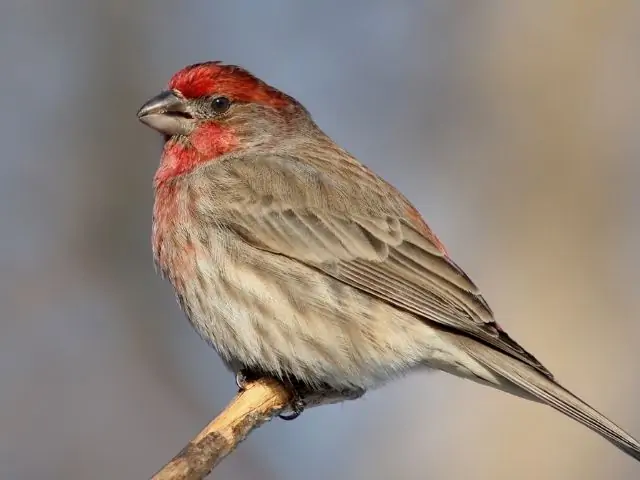
The House Finch is a story of successful relocation and urbanization, making it a staple of backyards everywhere.
- Origin and Spread: Originally a resident of the western U.S. and Mexico, it was illegally introduced to Long Island, New York, in the 1940s by pet traders. The population quickly established itself and spread rapidly westward across the continent, meeting and largely supplanting the Purple Finch in many eastern suburban areas.
- Identification: The male features a rosy red or reddish-orange wash that covers the brow, chest, and rump, contrasting with its streaky brown back and flanks. The female is uniformly streaky brown, which can be easily confused with a female House Sparrow.
- Adaptability: They are highly opportunistic and thrive in city parks, suburbs, and agricultural areas, where they readily consume seeds from feeders, especially sunflower and nyjer. Their nesting is similarly flexible, utilizing everything from cavities to dense shrubbery and even hanging planters.
- Disease Vulnerability: A key challenge for House Finches is their susceptibility to Mycoplasmal conjunctivitis (House Finch eye disease), a bacterial infection that can cause swollen, crusty eyes and blindness, highlighting the unique disease pressures faced by highly concentrated urban bird populations.
The Purple Finch (Haemorhous purpureus)

The Purple Finch is often confused with the House Finch, but it holds a distinct, often more northern and wooded, niche.
- The "Washed in Wine" Look: The male is best distinguished by its coloration, which is more of a deep, rosy raspberry or wine-stain color, distributed more uniformly across the head and back compared to the House Finch's limited patches of bright red. Furthermore, the male Purple Finch appears less streaky on the flanks, and its profile is more "bull-headed."
- Habitat and Diet: Preferring coniferous and mixed forests, the Purple Finch is generally less tied to human dwellings than the House Finch. Its diet includes soft seeds, buds, and nectar, often feeding high in trees.
- Irruptive Tendencies: While some populations are sedentary, many northern populations are irruptive, moving south irregularly during winter when natural food sources (especially the cones of northern spruce and fir) are scarce. This makes its presence at a backyard feeder unpredictable and exciting.
The Boreal Visitors: Finches of the Northern Forests
The finches with the most dramatic and unpredictable presence are those tied to the vast coniferous forests of Canada and the mountainous regions of the U.S. Their movements are dictated by the success or failure of the annual cone crops—a phenomenon called irruption.
The Pine Siskin (Spinus pinus)
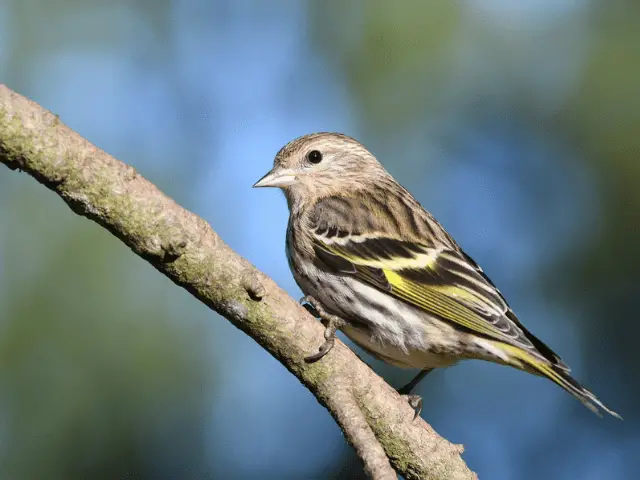
A small, streaky, brown finch that could easily be mistaken for a common sparrow, the Pine Siskin is a highly social and erratic species.
- Subtle Coloration: While generally brown and heavily streaked, Siskins flash subtle yellow patches on their wings and tail, especially in flight. Their most distinctive feature is their needle-like, pointed bill, adapted for extracting tiny seeds from pine and spruce cones.
- Highly Nomadic: The Siskin is perhaps the most famous irruptive finch. In a poor cone year in the boreal forest, massive flocks will stream south, sometimes reaching the Gulf Coast states. These irruptions bring large numbers to backyard thistle feeders, where their nervous, chattering calls are instantly recognizable.
- Behavior: They are famously aggressive at feeders, often dominating much larger species. They are also highly social, moving in tight, fast-moving flocks.
The Red Crossbill (Loxia curvirostra) and White-winged Crossbill (Loxia leucoptera)

These are the most specialized and unique finches, named for their bizarre, crossed mandibles.
- Bill Specialization: The unique crossed bill is a perfect tool for prying open the scales of conifer cones to extract the seeds inside. Their diet is so specialized that the species is often categorized into different "types" based on bill size and vocalizations, with each type adapted to feed on the cones of a different specific tree (e.g., Douglas-fir, Hemlock, or Spruce).
- Erratic Presence: Crossbills are highly dependent on heavy cone crops. A large number of Type 2 Red Crossbills, for instance, might suddenly show up in the mountains of the Southwest one year and be completely absent the next. This makes them a challenging and sought-after sighting.
- White-winged Distinction: The White-winged Crossbill is visually distinct, with two prominent white wing bars. It is generally restricted to the spruce forests of the far Northeast and Alaska, rarely irrupting into the lower 48.

White-winged Crossbill

The Evening Grosbeak (Coccothraustes vespertinus)
New England: The Birds You Need to Be Watching for During the Winter Finch Forecast
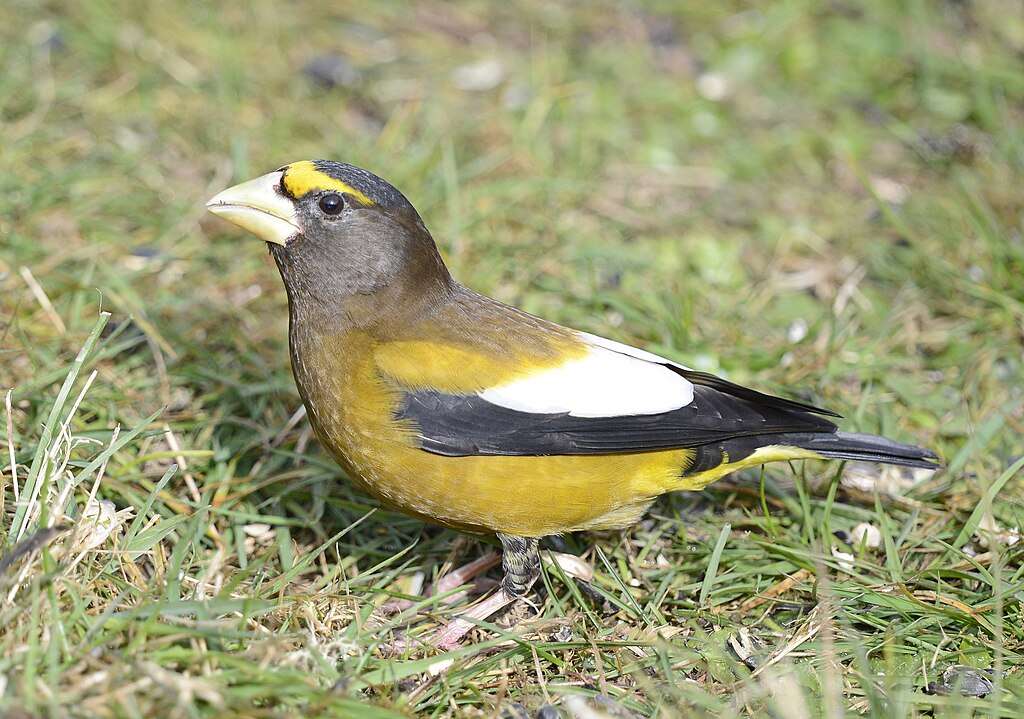
With its immense, ivory-colored bill, the Evening Grosbeak is a striking, stocky species whose appearances are celebrated.
- Appearance: Males are unmistakable: a large, chunky bird with a brilliant yellow body, black wings, and a bold white wing patch. The female is duller, but still recognizable by the massive bill and gray-and-yellow plumage.
- Historical Range Shift: Once largely confined to the western mountains, the Evening Grosbeak expanded its range eastward in the early 20th century, following the introduction and spread of the box-elder tree (which provides a reliable food source) and the widespread use of bird feeders.
- Current Decline: Despite this past success, the Evening Grosbeak has seen a serious, documented decline in recent decades, particularly in the East, making their visits—once common in many northern states—increasingly rare. The exact causes of this decline are still under investigation, potentially linked to logging practices or insect outbreaks that affect their food supply.
The Mountain Specialists: Finches of the Western Peaks
The American West, particularly the mountainous regions, hosts finches adapted to high-altitude, cold climates.
The Pine Grosbeak (Pinicola enucleator)
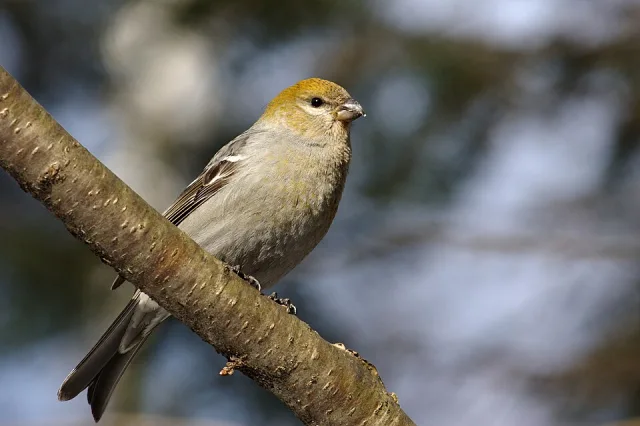
The Pine Grosbeak is the largest and most stately of the finches.
- Size and Color: It is a hefty bird, noticeably larger than the other finches. The male is a soft rose-red, while the female is a dull yellow or orange. Their large size and slow, deliberate movements often give them a quiet, almost tame demeanor.
- Habitat: They are generally confined to high-elevation spruce and fir forests in the western mountains (Rockies and Sierra Nevada) and the northern boreal forests. Like other northern finches, they engage in minor irruptions, but typically do not wander as far south as Siskins or Redpolls.
The Cassin's Finch (Haemorhous cassinii)

A close relative of the House and Purple Finches, the Cassin's Finch is primarily a bird of the mountain West.
- Separation: Distinguishing the male Cassin's from the Purple Finch is a classic birding challenge. Cassin's is typically paler, with a more defined, squared-off red crown and a conical, straighter bill. Crucially, the Cassin's Finch generally breeds at higher elevations than the Purple Finch.
- Ecology: They are highly reliant on conifer seeds and fruit crops in the mountain meadows and open forests of the West.
The Significance of Finches
The finches of the mainland U.S. are more than just a colorful part of the avifauna. They serve as valuable models for studying irruptive migration, showing how food availability (rather than just temperature) drives large-scale avian movements. Their specialized bills are a textbook example of adaptive radiation, demonstrating how a simple, powerful tool can be refined to exploit countless ecological niches.
For the average American, the flash of a Goldfinch in summer or the unexpected appearance of a flock of Pine Siskins in winter is a direct, vibrant connection to the wildness of the continent. They are a constant, colorful reminder of nature's dynamism, thriving in environments both wild and urban.
