

The Cooper's Hawk (Accipiter cooperii) is a mid-sized raptor that embodies the wild, fierce spirit of North American woodlands, yet is increasingly becoming a familiar, if stealthy, presence in urban backyards. Known for its incredible agility and mastery of the surprise attack, this "blue darter" or "swift hawk" is a captivating predator whose life history is a testament to resilience and adaptability. Named for the naturalist William Cooper, this species belongs to the Accipiter genus, or "true hawks," which are characterized by short, rounded wings and long tails—features that make them unparalleled navigators through dense forest canopy.
Identification and Physical Marvels
The Cooper's Hawk is roughly the size of a crow, with an average length of 14 to 20 inches and a wingspan that can reach nearly three feet. Sexual dimorphism is pronounced, with the female being noticeably larger than the male—sometimes by as much as one-third. This difference in size is a crucial ecological factor, allowing the sexes to specialize in slightly different prey sizes and reduce competition.
Adult plumage is striking. They feature a slate-gray to blue-gray back and a distinct black cap on the head. The underparts are white, barred horizontally with rufous (reddish-brown) streaks. A key field mark is their long tail, which is banded with broad, dark bands and appears rounded at the tip, a trait that helps distinguish it from its smaller, look-alike cousin, the Sharp-shinned Hawk, which has a squarer tail.
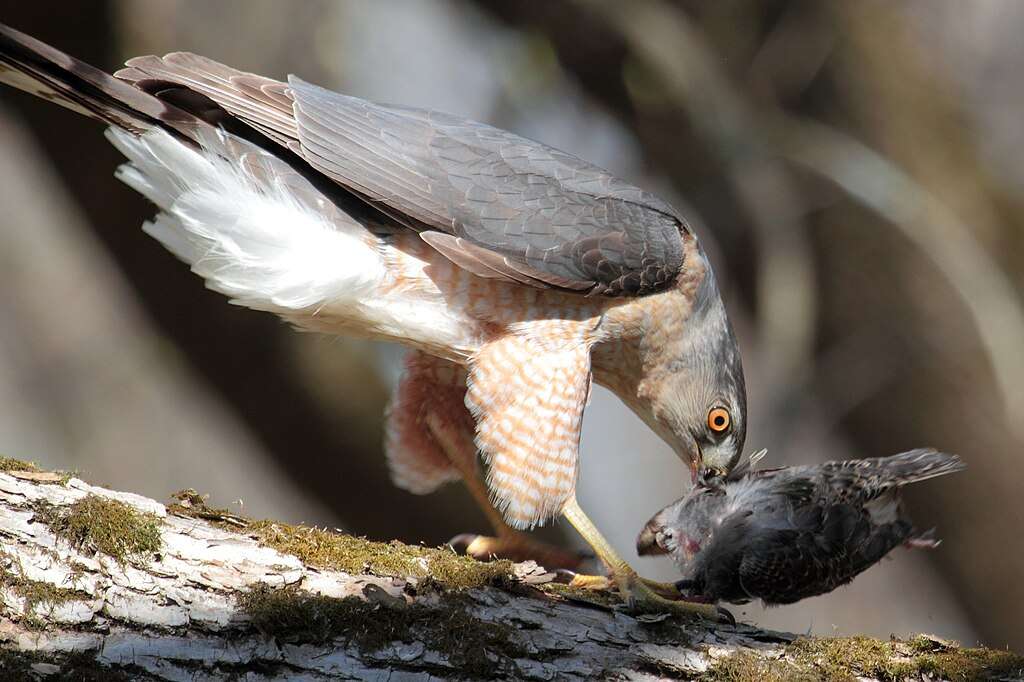
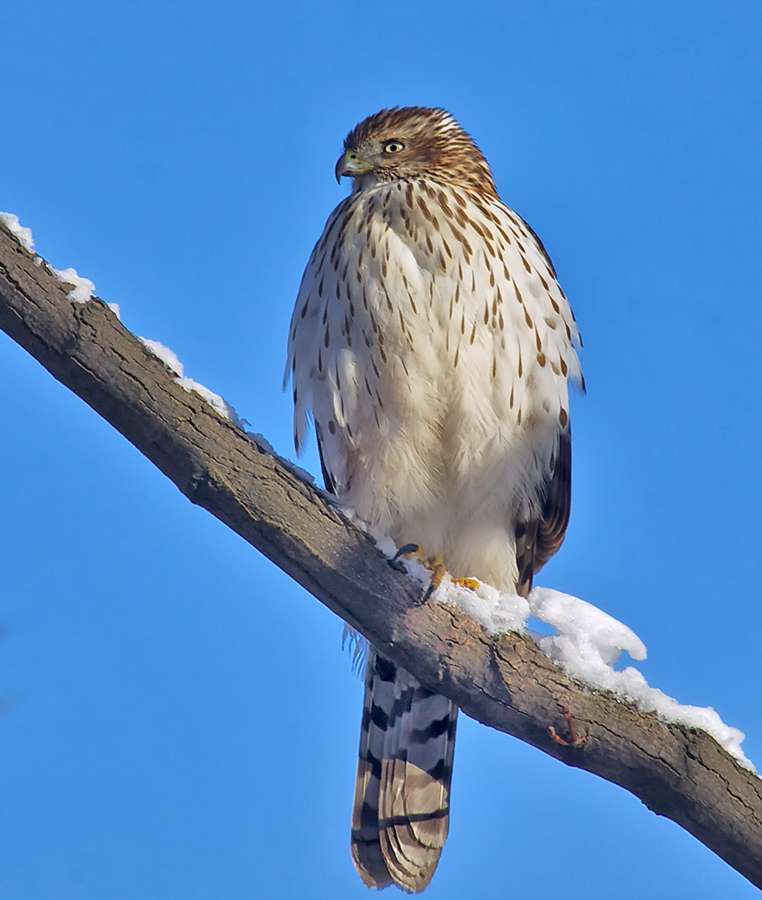
Another remarkable identifying characteristic is the change in eye color as they mature. Juveniles sport bright yellow eyes and are brown on the back with vertical brown streaking on their pale underparts. As they age, their eyes transition from yellow to orange, finally settling on a vivid red in fully mature adults, lending them a particularly fierce expression. The combination of its long tail and relatively short wings gives it a unique flight profile, which some observers describe as a "flying cross."
The Art of the Hunt: Stealth and Agility
As an Accipiter, the Cooper's Hawk is built for speed and maneuverability within dense vegetation. Its hunting strategy relies on stealth and surprise. It is an "attacking" raptor, preferring a demanding, high-energy chase over prolonged searching.
The hawk typically hunts from a concealed perch, patiently watching for prey. Once a target is sighted—usually a small-to-medium-sized bird like a Robin, Dove, Starling, or Jay—it bursts from cover, flying low to the ground and weaving expertly through branches and underbrush. Its short, rounded wings are an adaptation for quick, powerful bursts and sharp turns, while the long tail acts as a crucial rudder for navigating cluttered environments at high speeds. This lifestyle is so physically demanding that a significant percentage of Cooper's Hawk skeletons show evidence of old, healed fractures in the chest bones, a testament to the risks of a high-velocity forest chase.
The Cooper's Hawk is primarily an avian predator, with birds making up the majority of its diet. However, it is also opportunistic, taking small mammals like chipmunks and squirrels, especially when bird prey is scarce. A particularly brutal, though rare, hunting technique involves drowning its prey, holding a captured bird underwater until it stops struggling.
In urban areas, the hawk's hunting has become closely linked to human activity. Backyard bird feeders, which concentrate songbirds, essentially act as a lure for the Cooper's Hawk, allowing it to efficiently hunt doves and pigeons—a phenomenon that has helped its numbers thrive in suburban environments.
Life Cycle and Family Dynamics
The Cooper's Hawk is generally a solitary bird outside of the breeding season. Pairs are typically monogamous and may maintain a long-term bond, often returning to the same general area year after year. Courtship involves dramatic aerial displays where the pair chases each other, showcasing their phenomenal flying skills.
The breeding season begins in early spring. The male selects the nest site and does most of the construction, building a bulky, stick platform high in a tall deciduous or coniferous tree, often in a crotch or on a horizontal branch. The nest is lined with bark flakes and fresh greenery.
The female lays a clutch of three to five pale, bluish-white eggs, which she primarily incubates for about 34 to 36 days. During this period, the smaller male is responsible for provisioning all the food to the female, delivering prey to a nearby branch for her to eat. After the altricial, white-down-covered young hatch, the female feeds them, tearing off small bits of prey that the male continues to deliver to the nest area. The young fledge, or leave the nest, at about four to five weeks of age but remain dependent on their parents for food for several more weeks while they develop their own hunting prowess.

Conservation Status and Urban Adaptation
The story of the Cooper's Hawk is one of a dramatic decline and remarkable recovery. Like many North American raptors, its populations suffered greatly in the mid-20th century due to two primary threats: persecution (being shot as a "chicken hawk") and the widespread use of the pesticide DDT. The pesticide caused females to lay thin-shelled eggs that often broke during incubation, severely crippling reproductive success.
Following the ban of DDT and increased legal protections, the Cooper's Hawk population has rebounded significantly. Today, its global conservation status is listed as Least Concern by the IUCN, and its population trend is generally increasing across its North American range, which extends from southern Canada to northern Mexico.
The key to this recovery is the hawk's astonishing adaptability to human-altered landscapes. Initially seen as a bird averse to cities, it has now become a successful urban and suburban breeder, drawn by the abundance of prey (pigeons, doves, and feeder birds) and the tall trees in parks and residential areas that offer suitable nesting and perching spots.

Despite its success, the Cooper's Hawk still faces localized threats, including collisions with cars and power lines, habitat fragmentation, and exposure to diseases like trichomoniasis, which can be contracted from infected doves and pigeons concentrated at bird feeders.
The Cooper's Hawk stands as a powerful symbol of nature's resilience. It is a brilliant, agile hunter that has traded the deep woods for the urban canopy, now a ubiquitous and silent predator watching from the familiar trees above our parks and neighborhoods. Observing its powerful, yet secretive, existence is a reminder that wild, intricate dramas play out every day, even in the most domesticated of environments.
