
In the vast, towering forests of North America, it is often the smallest inhabitants that possess the most oversized personalities. Among these, the Kinglets—belonging to the family Regulidae—stand out as masterpieces of avian engineering. Weighing roughly the same as two nickels, these hyperactive balls of feathers are among the smallest songbirds in the United States, yet they endure some of the harshest winters on the continent.
In the U.S., we are home to two primary species: the Golden-crowned Kinglet (Regulus satrapa) and the Ruby-crowned Kinglet (Corthylio calendula). Despite their tiny stature, they are essential players in our forest ecosystems, acting as tireless pest controllers and providing a splash of color and song to the winter landscape.
The Golden-crowned Kinglet: The Winter Warrior

The Golden-crowned Kinglet is a marvel of survival. While many birds of their size migrate to the tropics at the first hint of frost, the Golden-crowned is famously hardy. They breed in the spruce-fir forests of the North and the mountainous West, but during the winter, they can be found across nearly the entire lower 48 states.
Appearance and Identification
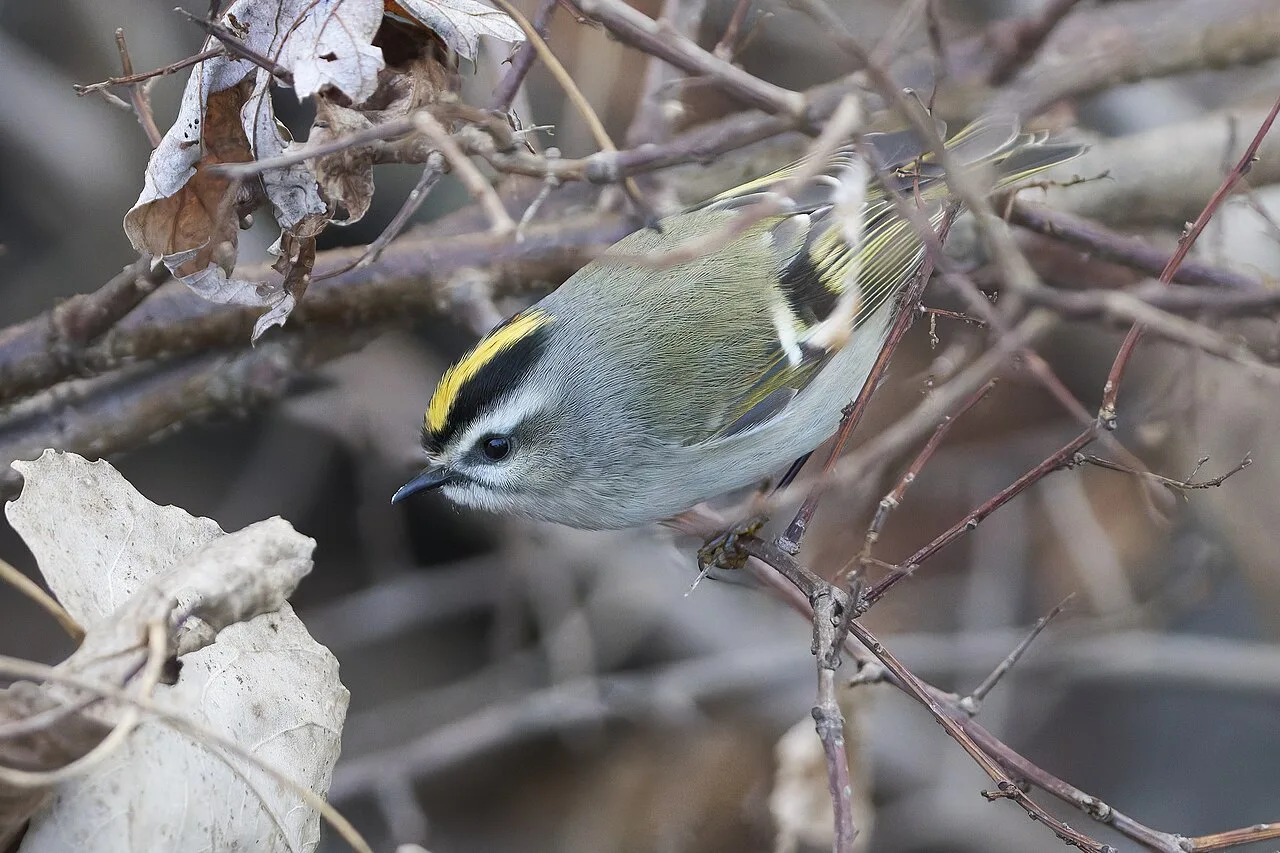
The Golden-crowned is a study in subtle patterns. It has a pale olive-gray body, two white wing bars, and a striking "striped" face. The hallmark of the species, however, is the crown:
The Male: Features a brilliant orange patch bordered by bright yellow and a thick black stripe.
The Female: Possesses a solid yellow crown patch without the orange center.

Behavior: Life on the Edge
Because they are so small, Golden-crowned Kinglets have an incredibly high metabolic rate. To survive freezing winter nights, they have developed a unique behavior called huddling. They will cluster together in groups of two or three on a branch, pressing their bodies together to conserve heat. During the day, they are almost never still, constantly flicking their wings as they hover at the tips of evergreen needles to glean tiny insects and eggs that other birds miss.
The Ruby-crowned Kinglet: The Hidden Fire

If the Golden-crowned is the "winter warrior," the Ruby-crowned Kinglet is the "vocal powerhouse." Slightly larger than its cousin, the Ruby-crowned is famous for its "hidden" feature and a song that seems physically impossible for a bird of its size.
The "Ruby" Surprise
For much of the year, the "ruby crown" of the male is completely invisible. It is a tuft of brilliant red feathers that stays tucked under the olive-green feathers of the head. The male only "flashes" this crown when he is agitated, defending territory, or trying to impress a mate.
Identification Tip: The easiest way to identify a Ruby-crowned Kinglet is the bold white eye-ring, which gives them a perpetually surprised, wide-eyed expression. Unlike the Golden-crowned, they lack the black facial stripes.

A Voice Like No Other
The Ruby-crowned Kinglet’s song is one of the great wonders of the birding world. It begins with a series of high-pitched whistles, followed by a low "turr" sound, and culminates in a loud, galloping "liberty-liberty-liberty" chatter. The volume is astounding—a bird weighing ten grams producing a sound that can be heard from several hundred yards away.
3. Comparing the Two: Kinglet Cheat Sheet
When you see a tiny, olive bird flitting through the branches, it can be hard to tell which species you’re looking at. Use this table for a quick field ID:
| Feature | Golden-crowned Kinglet | Ruby-crowned Kinglet |
| Face Pattern | Bold black and white stripes | Plain face with bold white eye-ring |
| Crown | Yellow/Orange (Always visible) | Red (Usually hidden) |
| Wing Action | Constant flicking (often double-flick) | Constant flicking (nervous habit) |
| Winter Habitat | Mostly Conifers (Evergreens) | Deciduous woods, brush, and thickets |
| Migration | Short-distance (hardy) | Medium-distance (to Southern US/Mexico) |
4. The Challenges of Being Small
Despite their resilience, Kinglets face significant threats. Because they rely almost exclusively on insects, they are highly susceptible to sudden cold snaps that kill off their food supply. They are also frequent victims of window strikes and cat predation. Due to their habit of foraging in the lower canopy and thickets, they are easily caught by outdoor cats.
Furthermore, the Golden-crowned Kinglet is heavily dependent on old-growth coniferous forests. Habitat loss through logging and the spread of invasive pests like the Hemlock Woolly Adelgid (which kills the hemlock trees they nest in) has led to localized population declines.
5. Birding Tips: How to Find Them
Finding Kinglets requires patience and a good pair of ears. Because they are so small, they often go unnoticed until they move.
Listen for the "Tsee": Both species have very high-pitched calls. The Golden-crowned makes a three-note "tsee-tsee-tsee" that is so high some older birders lose the ability to hear it.
Look for the "Nervous Twitch": Kinglets have a unique habit of constantly flicking their wings while they forage. If you see a tiny bird that looks like it’s had too much caffeine, it’s probably a Kinglet.
Check Mixed Flocks: In the winter, Kinglets often travel with Chickadees, Nuthatches, and Brown Creepers. They use the "safety in numbers" approach to watch for hawks while they hunt for food.

The Monarchs of the Micro-World
The names "Golden-crowned" and "Ruby-crowned" were not given by accident. In the world of birds, these tiny creatures are indeed royalty. They represent the incredible adaptability of life—thriving in the freezing temperatures of an Alaskan winter or the dense thickets of a Florida swamp.
Next time you are out in the woods and hear a tiny, high-pitched "tsee," stop and look up. You might just catch a glimpse of a male Ruby-crowned flashing his fire, or a Golden-crowned huddling against the wind. They are proof that in the natural world, you don't have to be big to be significant.
