
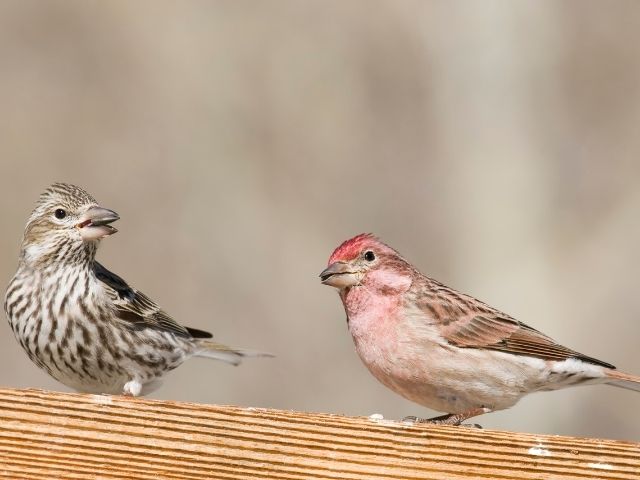
Smart bird feeders with AI identification have revolutionized backyards across North America. Yet, if you check your feeder's activity log, you’ll likely notice a trend: while your feeder effortlessly identifies brilliant red male House Finches, it regularly stumbles over brown, streaky female finches—mislabeling them as Song Sparrows, Purple Finches, Cassin's Finches, or Pine Siskins.
Understanding why computer vision models struggle with female finches requires looking at machine learning limitations, optical challenges, and avian identification marks.

The Sexual Dimorphism Blindspot
Computer vision models rely heavily on high-contrast visual features: vivid color blocks, distinctive facial masks, or sharp wing bars.
Male Finches: Male House Finches, Purple Finches, and Cassin’s Finches carry bold red, raspberry, or strawberry plumage. These vivid colors provide high-contrast features that object-recognition neural networks identify with near-100% confidence.
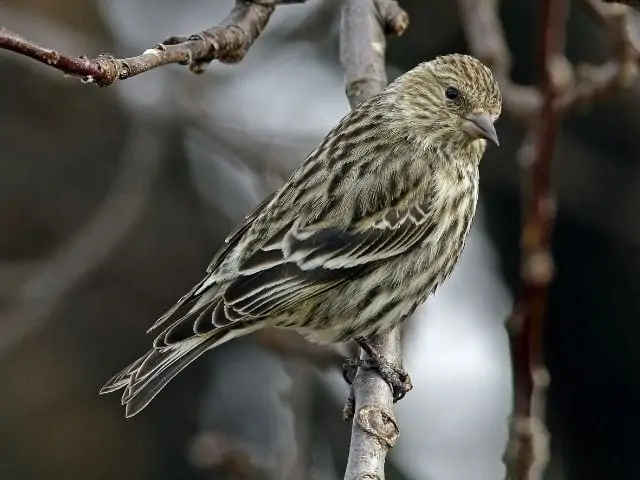
Female Finches: Female Haemorhous finches display sexual dimorphism—they are predominantly greyish-brown with streaked underparts and muted facial patterns.
Because many female finch species share this brown, streaked plumage template, an AI model cannot rely on color alone and must instead evaluate fine structural ratios.

Overlapping "LBJ" (Little Brown Job) Phenotypes
To an AI model, a female House Finch looks remarkably similar to several other widespread North American species visiting feeder perches.
| Species | Primary AI Confusion Point | Distinguishing Human Field Mark |
| Female House Finch | Base baseline for brownish streaked finches | Plain face, blurry breast streaks, curved upper culmen (bill) |
| Female Purple Finch | Often misidentified as House Finch | Bold white eyestripe, dark cheek patch, sharp crisp streaking |
| Pine Siskin | Confused due to heavy streaking | Pointed needle-like bill, subtle yellow patches in wings/tail |
| Song Sparrow | Confused due to breast streaking | Central breast spot, longer tail, pump-action flight behavior |
| Female Cassin's Finch | Confused with House or Purple Finch | Crisp streaks, peaked crown, long pointed bill |

Hardware & Environmental Factors
Smart feeder cameras face several optical real-world constraints:
Extreme Close-Up Distortion: Wide-angle lenses used in smart feeders sit mere inches from the perch. Birds landing near the lens edges experience fisheye barrel distortion, altering bill curvature—the single most critical feature separating a House Finch from a Purple Finch.
Motion & Motion Blur: Finches move erratically. A blurred frame obscures subtle facial patterns like supercillia (eyestripes) or malar streaks.
Lighting & Backlighting: Strong backlighting turns subtle brown-and-white breast patterns into flat silhouettes, stripping away the contrast needed to analyze streak sharpness.
How to Help Your Smart Feeder Improve
Improve Lighting: Position your feeder so sunlight illuminates the landing perch rather than shooting directly into the camera lens.
Submit Corrections: Use your app's "Report Incorrect ID" feature to submit accurate manual labels. Most manufacturers use customer feedback to retrain their neural networks on subtle female plumages.
Focus on Bill Shape: When verifying IDs yourself, check the bill: House Finches have a distinctly curved top ridge (culmen), whereas Purple and Cassin's Finches have straight, conical bills.
