Love The Birds is reader-supported. When you purchase through one of our links we may earn an affiliate commission (at no cost to you).
Living With Humans: How Common Birds Are Successful
Share your love
In the grand tapestry of American wildlife, few figures are as familiar and universally beloved as the triumvirate of the Northern Cardinal, the Blue Jay, and the American Robin. They are the avian A-listers of the suburbs and cities, the first birds we learn to identify, and a constant, colorful presence in our daily lives. Their ubiquity is so profound that we often take it for granted, seeing them as simply "common." But behind their ordinary status lies an extraordinary story of adaptation, intelligence, and survival. These birds are not just common by chance; they are among the most successful creatures on the continent because they have mastered the art of coexisting with humanity. Their success is a brilliant case study in ecological resilience, demonstrating how a few key traits can turn a species from a mere occupant into a true cornerstone of our shared landscape.
The Northern Cardinal: The Red Feathered Pioneer
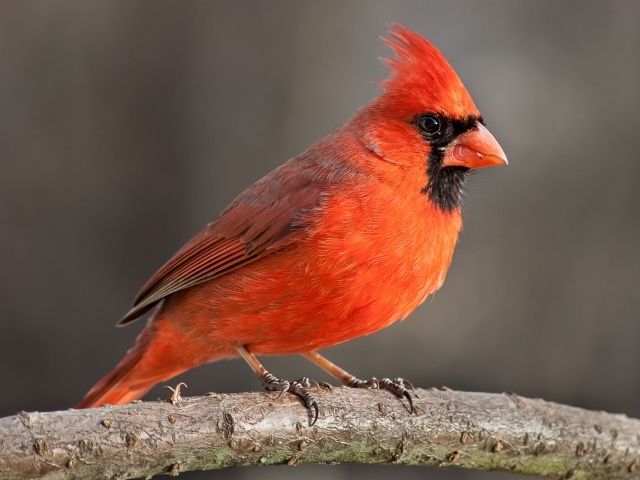
Northern Cardinal
The Northern Cardinal (Cardinalis cardinalis) is arguably the most recognizable bird in the eastern United States, a living jewel in the winter landscape. The male's fire-engine red plumage and the female's subtle, sophisticated hues are a welcome sight at any bird feeder. But the cardinal’s success isn't just about good looks; it's about a genius for adaptation.
First and foremost, the cardinal is a master of the "edge habitat." While many birds require vast, undisturbed forests or grasslands, cardinals thrive in the transitional zones where woods meet open spaces—precisely the kind of environment created by suburban sprawl and urban parkland. They are perfectly content in a tangle of shrubbery, a dense hedge, or a backyard garden, all of which provide both nesting sites and ample food.
Secondly, the cardinal is a dietary generalist. While they are famous for their love of sunflower seeds at feeders, their natural diet is incredibly varied. They consume a wide array of seeds, fruits, berries, and insects. This omnivorous palate makes them incredibly resilient to seasonal changes. When winter snows cover the ground and seeds are scarce, they can switch to eating sumac berries or dogwood fruit.
Female Northern Cardinal
This flexibility ensures a year-round food supply and allows them to be non-migratory, a key factor in their success. By staying put, they don't expend energy on long, perilous journeys and can maintain their territories year-round, solidifying their dominance in a given area.
Finally, their bold, conspicuous nature works in their favor. The male's bright red color and the bird's willingness to visit feeders make them a beloved backyard guest. This leads to a symbiotic relationship with humans: we provide food, and they provide beauty and entertainment. This human support system, a consistent source of calories and water, gives them a significant survival advantage over more reclusive species.
The Blue Jay: The Brains of the Backyard
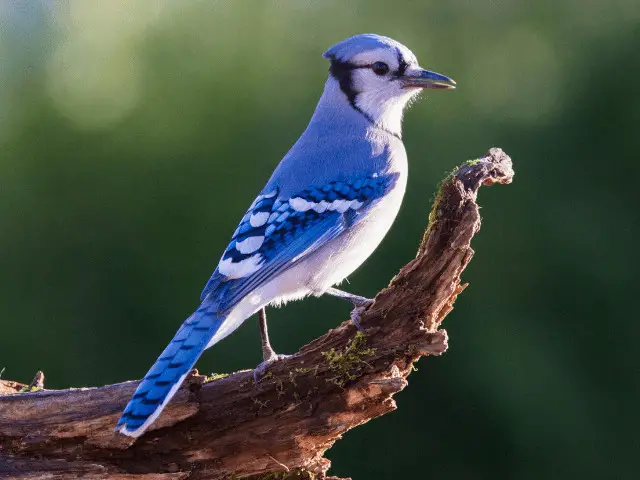
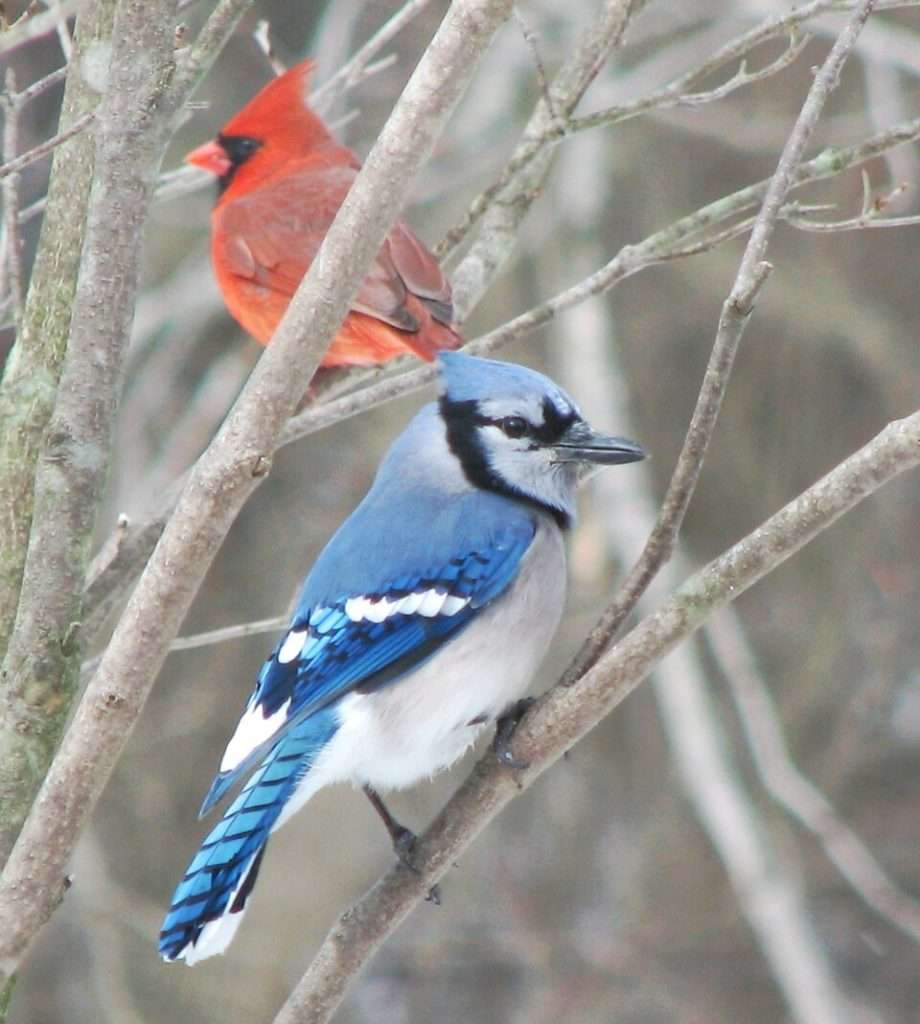
The Blue Jay (Cyanocitta cristata) is a boisterous, intelligent, and fiercely independent bird. Their vivid blue, black, and white plumage, combined with their raucous calls, makes them impossible to ignore. Unlike the cardinal's quiet resilience, the Blue Jay’s success is built on a foundation of sheer brainpower and strategic cunning.
Blue Jays are among the most intelligent of North American birds. This intelligence manifests in their behavioral flexibility and problem-solving abilities. They can learn to exploit new food sources, figure out how to access tricky bird feeders, and even mimic the calls of hawks to scare off rivals. This adaptability allows them to thrive in human-dominated environments, where new challenges and opportunities constantly arise.
Their most impressive trait, however, is their strategic food caching. Blue Jays are masters of storing food for later. A single jay can carry up to five acorns in its gullet and bill at a time, and a family can cache thousands of nuts and seeds in a single fall season. This behavior is not just for survival; it makes them a vital part of the eastern forest ecosystem.
Blue Jay
By forgetting some of their caches, they are directly responsible for the dispersal and growth of oak and beech trees. For the birds themselves, this food-caching strategy provides a critical buffer against winter food shortages, a resource management system that few other species possess.
Like the cardinal, the Blue Jay is a dietary opportunist. Their diet is incredibly broad, including nuts, seeds, fruits, insects, small rodents, and even the eggs and nestlings of other birds. This flexibility allows them to find food no matter the season or environment. Their bold, aggressive nature, while sometimes a nuisance, also serves them well, allowing them to defend resources and dominate feeding areas against smaller, less assertive birds.
The American Robin: The Lawn’s True Master
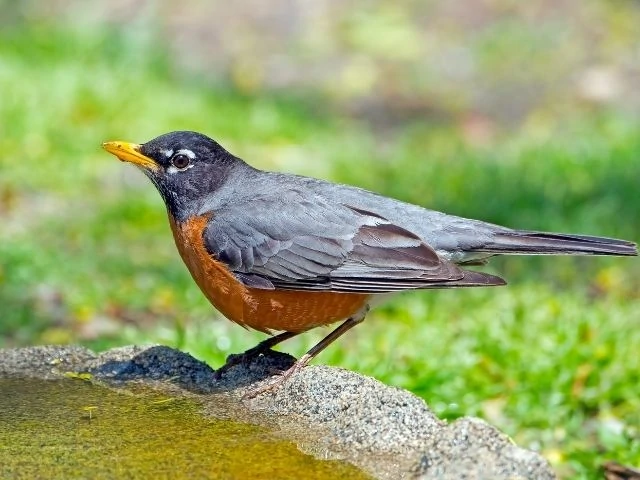
American Robin
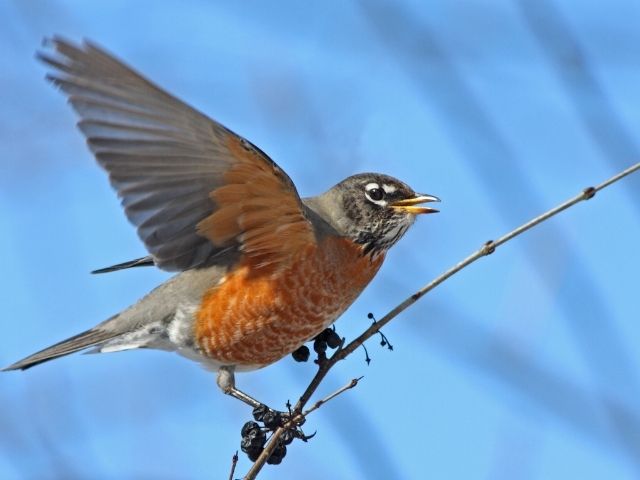
The American Robin (Turdus migratorius) is the quintessential harbinger of spring, with its familiar red breast and cheerful song. The robin’s success story is rooted in a fascinating, almost perfect, alignment with the American way of life—specifically, our love for the manicured lawn.
The robin’s iconic foraging strategy is perfectly suited to the suburban landscape. The classic “run, stop, cock its head, and pounce” move is a highly effective way to find earthworms and other invertebrates in the short grass of a lawn. While many people think they are listening for worms, the head cocking is likely a way for them to use their monocular vision to spot movement on the ground. Regardless of the exact mechanism, this specialized technique makes them the undisputed champions of a foraging habitat that dominates the American landscape.
American Robin
But the robin's diet is far from one-dimensional. While earthworms are a spring delicacy, their overall diet is incredibly diverse. They are voracious insect eaters during the warmer months and switch to a high-sugar diet of fruits and berries in the fall and winter. This dietary flexibility allows them to survive in both rural and urban areas and to adapt to seasonal food availability, which is why a surprising number of robins can be found overwintering in certain areas where berry-bearing trees are plentiful.
Finally, the robin is an incredibly productive breeder. A single pair of robins can raise up to three broods a year. Their nests, often a sturdy cup made of mud and grass, are frequently built in relatively safe, human-adjacent locations like the eaves of houses, on window ledges, or in a shrub near a porch. While this makes the nests vulnerable to some predators, the proximity to human activity can also deter others, creating a kind of symbiotic protection. Their rapid breeding cycle and ability to fledge multiple broods in a season allow their population to rebound quickly and maintain their common status despite predation or other threats.
American Robin
The Common Threads of Success
The success of the cardinal, the blue jay, and the robin reveals a powerful lesson in ecology. They are not common by accident, but by design. All three species share a few critical traits that have allowed them to flourish in a world increasingly shaped by human hands:
* Adaptability to Human-Modified Landscapes: They don't need pristine wilderness. They thrive in the “edge habitats” and green spaces of our cities and suburbs.
* Dietary Generalism: They are not picky eaters. Their omnivorous diets allow them to survive seasonal changes and exploit a wide variety of food sources, including those provided by humans.
* Behavioral Resilience: From the cardinal's year-round residency to the blue jay’s intelligence and the robin’s specialized foraging, their behavioral traits have given them a significant edge in a competitive environment.
Wrapping Up
Ultimately, these three birds are a testament to the fact that even in our concrete jungles and manicured lawns, nature finds a way to not just survive, but to thrive. They are a constant, colorful reminder that our backyards can be vibrant ecosystems, and that the simple act of putting out a bird feeder or planting a berry bush can create a powerful and lasting connection with the natural world.
At the other end of the spectrum, there are rare birds. Read more here.
About The Author
Palmer Howell
Palmer is a bird watcher and writer with 20 years experience of documenting the birds he has seen and the places he has visited. He has traveled all over the world to find the beauty of common birds and photograph rare and exotic species. Now he is sharing his knowledge about bird watching, bird species and all the gear needed to care and photograph our feathered friends.
Read more about Love The Birds on our About page.