

In the quiet, shaded depths of mature woodlands across North America, there lives a bird so unassuming that it is often overlooked, mistaken perhaps for a patch of loose bark or a persistent shadow. This is the Brown Creeper (Certhia americana), a true avian minimalist and a master of camouflage whose unique foraging strategy makes it one of the most specialized and intriguing residents of the temperate forest.
An Adaptation to the Vertical World
The Brown Creeper is a tiny bird, measuring just 5 to 5.5 inches long, but what it lacks in size, it makes up for in structural adaptation. Its entire physique is engineered for a life lived on the vertical plane of tree trunks:
Plumage: Its feathering is a mottled, cryptic blend of browns, grays, and blacks, perfectly matching the texture and color of the bark on which it spends its life. When motionless, it is virtually invisible.
Bill: The bill is long, slender, and distinctly decurved (curved downward). This specialized tool allows it to probe deep into the bark crevices, lichen patches, and moss mats to extract tiny insects, spiders, and insect eggs—its primary diet.

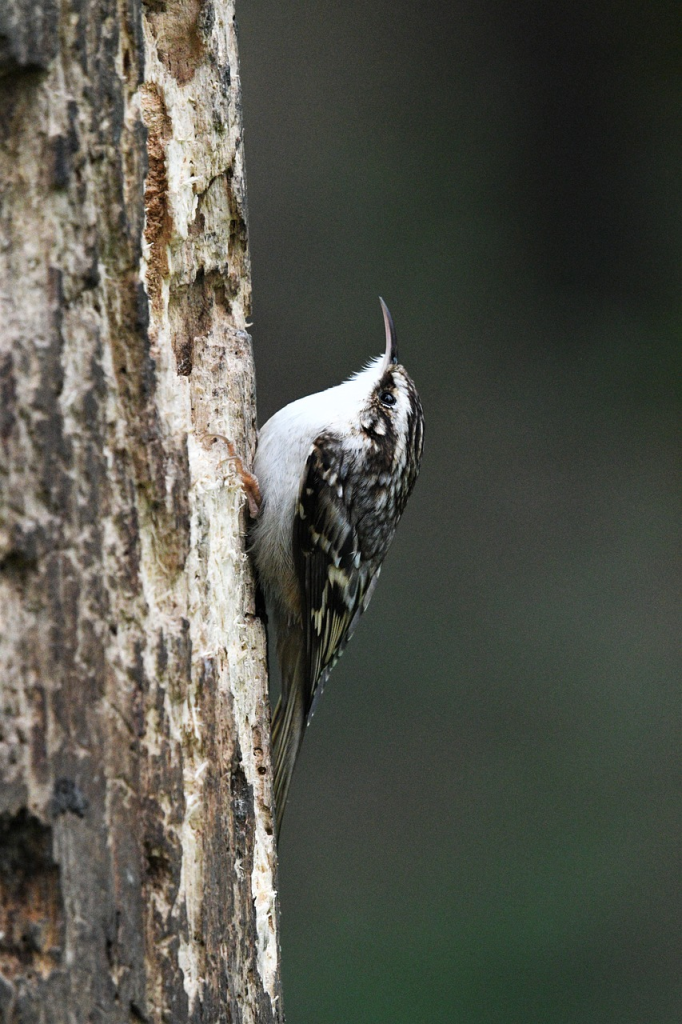
Brown Creeper Tail: Like woodpeckers, the Creeper possesses a stiff, pointed, and elongated tail. It uses this tail as a prop or tripod against the trunk, providing essential stability and leverage as it shuffles and hitches its way upward.
Feet: Its claws are long and needle-sharp, giving it a secure grip on the roughest surfaces.
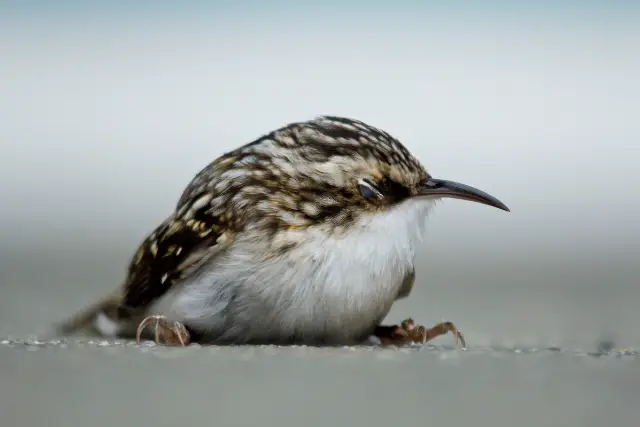
These adaptations define its common name: the Creeper truly creeps, never hopping or flying far during its foraging routine.
The Spiraling Ascent: A Unique Foraging Strategy
The Creeper's feeding behavior is perhaps its most recognizable trait. Unlike nuthatches, which typically move down a trunk headfirst, the Brown Creeper is dedicated to the ascending spiral.
The process is methodical and precise:
Start Low: The bird lands near the base of a tree trunk.

Brown Creeper Hitch Upward: It begins a slow, deliberate movement upward, using its stiff tail for support. It searches every nook and cranny of the bark as it moves, probing with its curved bill.
Spiral Motion: Rather than moving in a straight line, it subtly spirals around the trunk, ensuring it investigates all sides of the tree for hidden prey.
Descend by Air: Once it reaches a certain height—usually the lowest major limb or the point where the tree's diameter is too small for efficient searching—it does not creep back down. Instead, it takes a short, rapid flight to the base of an adjacent tree and immediately begins its upward spiral again.

This continuous cycle of ascending one tree and dropping to the base of the next ensures maximum foraging efficiency and minimizes time wasted on already-searched lower trunks.
Voice and Nesting
The Brown Creeper is a bird more often sensed than heard. Its common call is a very thin, high-pitched, and slightly hesitant "seee" or "tsee" that is easily missed, especially amid wind or the calls of louder species.
Its song is complex for such a simple bird, described as a delicate, high-pitched phrase that rises and falls: “Tee-tee-tiss-sweet-sue.” This soft song, typically heard only during the early spring breeding season, is often the only way to confirm a Creeper's presence in a dense forest.
Its nesting habits are as specialized as its feeding. It builds its unusual, semi-pendulous nest almost exclusively behind a piece of loose, peeling bark—usually on a large dead tree or snag. The birds create a hammock-like structure using spider silk, twigs, and moss, tucked securely between the trunk and the protective layer of bark. This location provides unparalleled concealment and structural integrity.
Range and Habitat
The Brown Creeper is a widespread resident and short-distance migrant across much of North America. Its range extends from the northern Boreal forests of Canada south through the eastern and western forests of the contiguous United States, with populations also found in mountainous areas of Mexico and Central America.
It shows a preference for mature, deciduous, and mixed coniferous/deciduous forests. The crucial habitat requirement is the presence of large, old trees with thick, furrowed bark (like oak, maple, or pine) and snags with loose, peeling bark—the very features essential for both its foraging and nesting needs. Forests managed for timber often lack these old, decaying features, making forest preservation a key issue for the species.
In a world of bright cardinals and boisterous blue jays, the Brown Creeper is a study in quiet competence. It reminds the observant naturalist that some of the most specialized and finely-tuned lives are led not in the open sky, but in the subtle, shaded spaces between the earth and the canopy. It is a vital, vertical cleaner of the forest, a silent presence that adds texture and intrigue to any mature woodland.
