
Hawaii's unique and diverse ecosystems are home to a fascinating array of birdlife. While many native species are sadly facing threats, several introduced and some resilient native birds have adapted and are commonly seen across the islands. Here are 10 of the most frequently observed birds in Hawai'i.
Check out our other article Endemic Birds of Hawai'i.
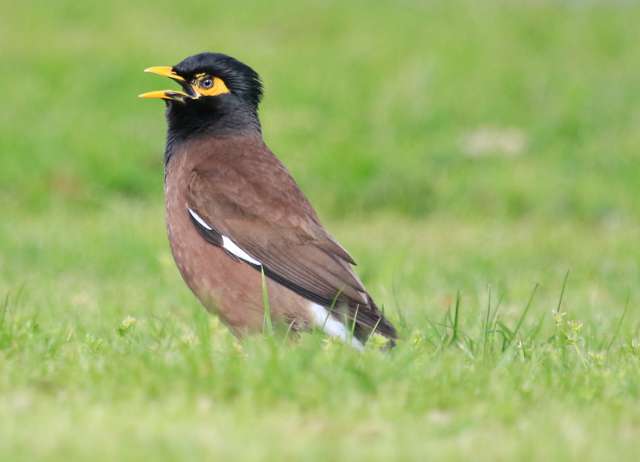
The Common Myna (Acridotheres tristis)
The Zebra Dove (Geopelia striata)

The Red-crested Cardinal (Paroaria coronata)

Instantly recognizable by its brilliant red head and erect crest, the Red-crested Cardinal is a striking introduced species from South America. These medium-sized birds have a white underbelly, a grey back, and a yellow beak. They were introduced to Hawai'i as cage birds and subsequently established wild populations. Red-crested Cardinals are commonly found in gardens, parks, and shrubby areas, where they feed on fruits, seeds, and insects. Their cheerful songs and vibrant colors make them a popular bird to spot.
The House Sparrow (Passer domesticus)
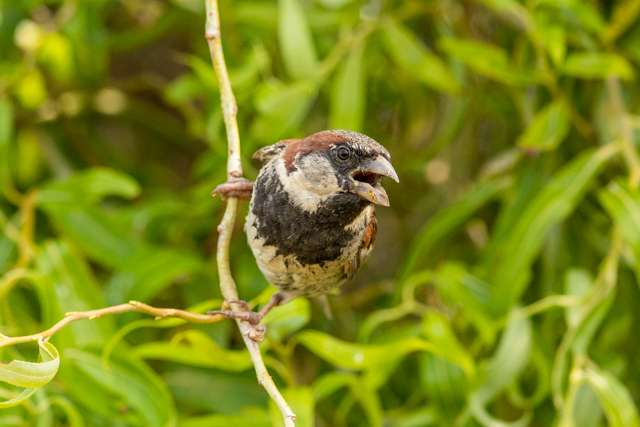
A familiar sight worldwide, the House Sparrow, originally from Eurasia, is abundant in urban and suburban areas of Hawai'i. Introduced in the late 19th century, these small, social birds are characterized by their brown and grey plumage. Males have a black bib and chestnut back, while females are plainer brown. House Sparrows are highly adapted to living alongside humans, often found near buildings, scavenging for seeds, insects, and scraps. Their chirping calls are a common sound in towns and cities across the islands.
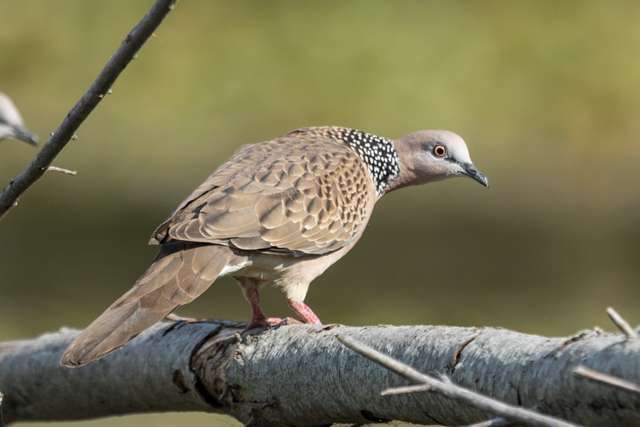
The Spotted Dove (Spilopelia chinensis)
The Japanese White-eye (Zosterops japonicus)

The Nutmeg Mannikin (Lonchura punctulata)

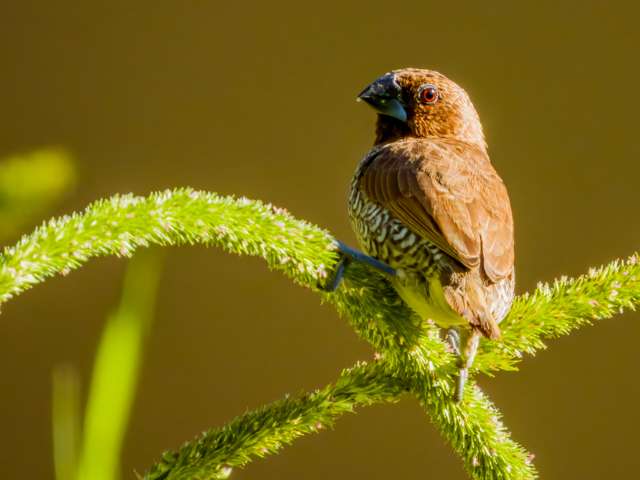
Originally from Asia, the Nutmeg Mannikin (also known as the Scaly-breasted Munia) is a small, gregarious finch introduced to Hawai'i. They are characterized by their brown upperparts, finely scalloped brown and white underparts, and a conical grey beak. These birds are commonly found in open grasslands, agricultural areas, and urban parks, where they feed on seeds. They often gather in flocks and their soft, chirping calls are frequently heard in these open environments.
The Common Waxbill (Estrilda astrild)

The Common Waxbill, a tiny finch native to Africa, has established populations in Hawai'i. These small birds are mostly grey-brown with fine barring on their flanks, a distinctive bright red beak and eye stripe, and a red rump. They are typically found in grassy areas, wetlands, and cultivated lands, where they feed on small seeds. Their soft, high-pitched calls are often heard as they move through the vegetation in small groups.
The Black Francolin (Francolinus francolinus)

Introduced for game hunting, the Black Francolin, native to South Asia, can be commonly heard, though sometimes less frequently seen, on some of the Hawaiian Islands, particularly Kaua'i. Males are striking, with black plumage, a white cheek patch, and a chestnut collar, while females are mottled brown. These ground-dwelling birds inhabit grasslands, agricultural fields, and shrubby areas. Their loud, crowing calls are a characteristic sound in their habitats, especially in the early morning and late afternoon.
The 'Elepaio (Chasiempis sandwichensis)

Among the many introduced species, the 'Elepaio stands out as a native Hawaiian monarch flycatcher. While populations have declined in some areas, they are still relatively common in native forests across several islands. These small, active birds have distinct regional variations in plumage, but generally exhibit brown, white, and grey feathers. They are known for their varied and often loud vocalizations, which have been described as sounding like they are saying "e-le-pai-o". 'Elepaio are insectivores, playing an important role in their native ecosystems. Conservation efforts are crucial to ensure their continued presence in Hawai'i's natural heritage.
Wrapping Up
While these ten birds are frequently encountered, Hawai'i's avian landscape is constantly changing. Introduced species continue to adapt and spread, while native birds face ongoing challenges from habitat loss, introduced predators, and disease. Observing these common birds provides a glimpse into the complex ecological dynamics shaping the birdlife of the Hawaiian Islands.
