

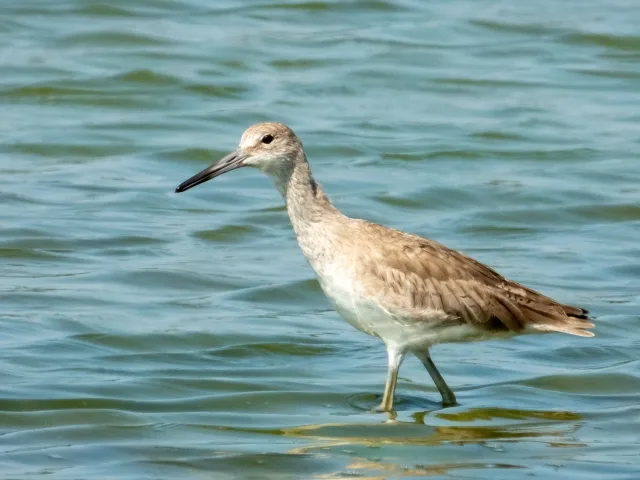
The Willet (Tringa semipalmata) is one of North America's most recognizable and vocally distinct shorebirds. Large, gray, and often found wading in coastal marshes or strutting across muddy tidal flats, this bird might appear unassuming at first glance. However, the Willet transforms into a spectacle when it takes flight, revealing flashing black-and-white wing patches. Its loud, persistent, and eponymous call, "pill-will-willet," is an essential sound of the shoreline, earning it a reputation as a noisy sentinel of the wetlands.
Identification and Appearance
The Willet is a robust, medium-to-large shorebird, measuring about 14 to 17 inches in length, making it significantly larger than many sandpipers. Its bill is long, thick, and straight, and its legs are long and relatively stout, often a dull gray-blue.
Plumage and Distinguishing Features
The Willet exhibits a clear difference between its breeding and non-breeding plumage, reflecting its broad range and migratory habits:
Breeding Plumage (Summer): Birds appear mottled grayish-brown above, with heavily barred and spotted chests and flanks. This camouflage is perfect for nesting in the grassy environments of their breeding grounds.
Non-breeding (Winter) Plumage: In winter, the Willet is a much plainer, uniform pale gray on the back and head, with a clean white underside. This plain look can sometimes cause it to be overlooked or confused with other large, pale waders.
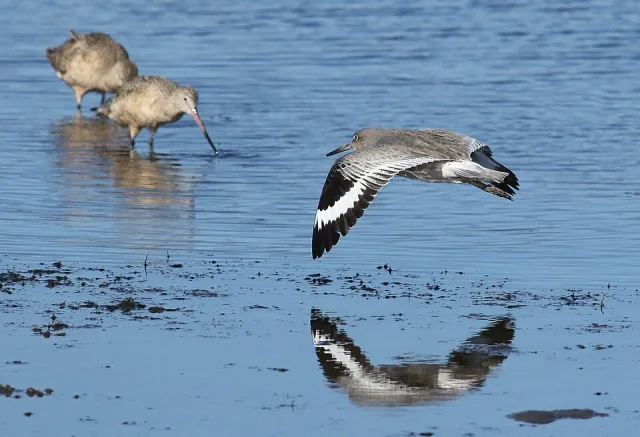
The diagnostic feature, however, is reserved for flight. When the Willet spreads its wings, it reveals a striking pattern of broad black patches bordered by white bands on the primary and secondary feathers. This dramatic black-and-white wing flash is instant confirmation of the species, distinguishing it immediately from other Tringa sandpipers.
The Signature Sound
The Willet's call is arguably its most famous trait. Its common name is an onomatopoeia derived directly from its loud, ringing call: "pill-will-willet!"
This call is typically given in a rapid series of three to five notes. It is especially strident and insistent when the bird is alarmed, often serving as an early warning system for other shorebirds and ducks in the vicinity. Birders often find Willets to be irritable neighbors; they are highly territorial, especially near nests, and will vigorously harass intruders, including humans and other predators, flying overhead and repeating their loud alarm call until the threat passes.
A Divided and Extensive Range
The Willet is unique among North American shorebirds for its distinct, disjunct breeding distribution, which separates the species into two major populations:
Western Willet (T. s. inornata): This population breeds inland, primarily in the prairie wetlands and grasslands of the Great Plains, from the Canadian Prairies south to the Great Basin of the U.S.
Eastern Willet (T. s. semipalmata): This population breeds exclusively along the Atlantic and Gulf Coasts, utilizing saltwater and brackish tidal marshes from Nova Scotia down to the Caribbean.
Despite their separate breeding grounds, both populations mix extensively during the non-breeding season, primarily along the southern coasts of the U.S., Mexico, and the northern coasts of Central and South America. The Western population undertakes a much longer migration, often traveling thousands of miles to reach the coast.
Diet and Foraging Tactics
The Willet is an adaptable and versatile feeder, using its long, strong bill to forage in a variety of ways depending on the habitat.
Coastal Foraging: Along the coast, Willets probe vigorously into the mud and sand of tidal flats for marine worms, small mollusks (like clams and snails), and crustaceans (shrimp and crabs). They often walk with a purposeful, deliberate gait, using tactile senses to locate buried prey.
Inland Foraging: During the breeding season in the freshwater prairies, their diet shifts to focus more on aquatic insects, grasshoppers, and small frogs.
Willets are also known to hunt by sight, sometimes chasing prey in shallow water or catching larger fiddler crabs on the mud surface.
Nesting and Conservation Status
The Willet nests on the ground, typically in dense vegetation where the nest is well-hidden. The inland Western Willets prefer the cover of tall prairie grasses, while the coastal Eastern Willets nest in clumps of spartina grass above the high-tide line in salt marshes.
The female scrapes a shallow depression in the ground, lines it with grass and sometimes small pebbles, and usually lays four olive-colored, heavily spotted eggs. Both parents share the duties of incubation and brood-rearing.
Historically, the Willet faced severe population pressure in the late 19th and early 20th centuries due to market hunting for its meat and eggs. Fortunately, protection under the Migratory Bird Treaty Act allowed the species to recover significantly. Today, the Willet is classified as a species of Least Concern globally.
However, localized threats persist, particularly habitat loss in the Western breeding grounds due to the draining of prairie wetlands for agriculture, and coastal development threatening the fragile salt marshes where the Eastern population nests.
The Willet remains an iconic and vital component of North American coastal and prairie ecosystems. Its flashing wings in flight and its loud, ringing cry ensure that this watchful, resilient shorebird continues to be the bold voice of the wetlands.
