
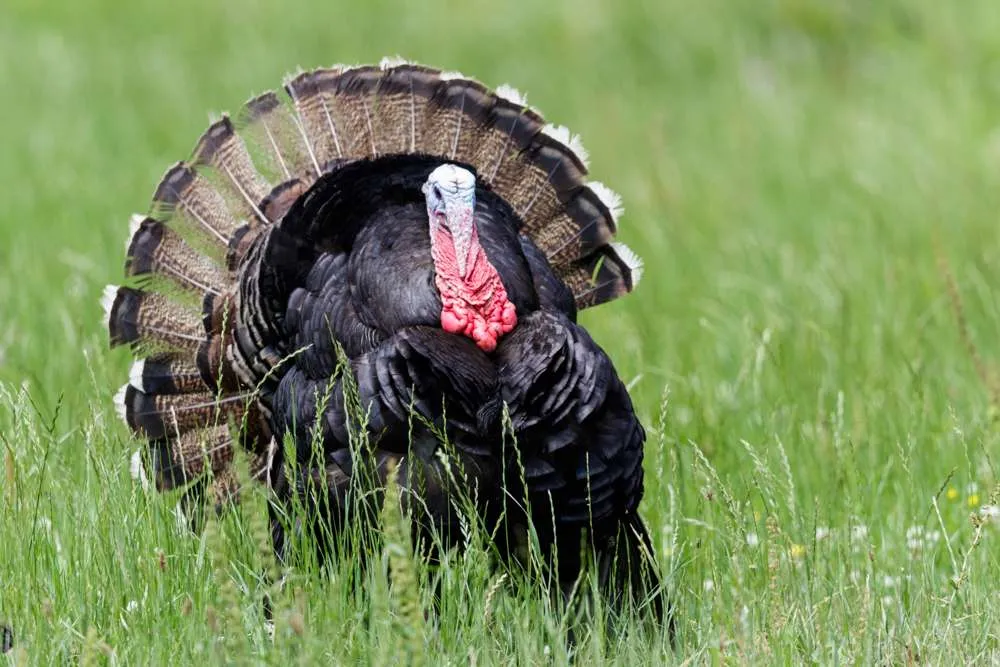
The Wild Turkey (Meleagris gallopavo) is a uniquely American species, a bird of monumental historical and cultural significance that has achieved one of the greatest conservation success stories of the 20th century. Once nearly extirpated from much of its historical range, the turkey's remarkable comeback has cemented its status as a ubiquitous and beloved resident of forests and fields across the United States. Far removed from the clumsy domestic fowl, the wild turkey is an intelligent, wary, and physically impressive bird—a true monarch of the American woods.
Identification: Size, Plumage, and Subspecies
The Wild Turkey is the largest game bird in North America, immediately recognizable by its size and distinctive head features.
Physical Characteristics
Size: Males, or toms (also called gobblers), are significantly larger than females, or hens. A large tom can stand nearly 4 feet tall and weigh between 16 to 24 pounds, while hens typically weigh 8 to 12 pounds.
Plumage: The body plumage is a rich, shimmering bronze and black. The feathers display a striking iridescence in sunlight, flashing with hues of red, green, gold, and copper. This iridescent effect is less pronounced on hens, who are duller brown and better camouflaged.
Head: The head and neck are featherless and highly colorful, serving as a display mechanism. The skin color changes rapidly with excitement or mood, ranging from red, white, and blue.
Beard and Spurs: The tom is characterized by a "beard"—a tuft of modified, long, hair-like feathers protruding from its chest. Toms also possess sharp, pointed bone structures on their legs called spurs, which are used for fighting.

Subspecies in the U.S.
The species is divided into five recognized subspecies within the United States, each adapted to a specific ecological niche and exhibiting minor plumage differences (especially in the color of the tail tips):
Eastern Wild Turkey (M. g. silvestris): The most numerous and widespread, inhabiting the eastern half of the country. Characterized by chestnut-brown tips on the tail feathers.
Florida Wild Turkey (Osceola) (M. g. osceola): Smaller and darker, restricted to the Florida peninsula.
Rio Grande Wild Turkey (M. g. intermedia): Found in the central and western US, particularly Texas and the Great Plains. Tail tips are a light buff/tan color.
Merriam's Wild Turkey (M. g. merriami): Found in the mountainous regions of the West (Rockies, Black Hills). Tail and rump feathers are boldly tipped with a pale white or buff color.
Gould's Wild Turkey (M. g. mexicana): The largest of the subspecies, found only in isolated mountain ranges of southern Arizona and New Mexico (primarily Mexican mountains).
Range and Habitat: The Return to the Woods

The Wild Turkey is native exclusively to North America. Its history is a compelling narrative of near-extinction followed by massive restoration.
Historic Decline: By the early 20th century, the turkey was virtually eliminated from much of its original range due to unregulated hunting and wholesale destruction of mature forest habitat across the East and Midwest.
The Comeback: Beginning in the 1940s, a monumental conservation effort, driven largely by state wildlife agencies and funding from hunting licenses and excise taxes (Pittman-Robertson Act), successfully restored the turkey. The key innovation was the practice of trap-and-transfer, where wild turkeys were captured in healthy populations and relocated to areas of suitable, restored habitat.
Current Status: Today, Wild Turkeys occupy all of their historical range and have been successfully introduced into several states where they were never native (such as parts of the Pacific Northwest). They thrive in a diverse array of habitats, favoring mature deciduous and mixed forests interspersed with open clearings, fields, and agricultural land for foraging.

Diet and Behavior: The Omnivorous Forager
Wild Turkeys are primarily ground-dwellers and highly effective foragers, relying on a diverse, omnivorous diet.
Foraging: They feed primarily on the ground, scratching through leaf litter with their strong feet. They consume a vast array of food, shifting their diet seasonally.
Diet: The foundation of their diet is mast (acorns and nuts), seeds, grains, fruits, and berries. They also eagerly consume insects, snails, worms, and small amphibians, especially during the spring and summer when these high-protein sources are needed for growth and breeding.
Roosting: Despite their size, turkeys are excellent fliers, capable of short bursts of high speed. Every evening, they fly up into large, mature trees to roost (sleep) on high branches. This behavior provides safety from ground predators like coyotes, foxes, and bobcats.

The Spring Ritual: Gobbling and Display
The breeding season, which peaks in the spring, is characterized by the elaborate, famous display of the tom.
The Gobble: The distinctive, loud "gobble" is the male's primary vocalization, used to announce his presence to hens and challenge rival males. The sound can carry for miles on a still morning.
The Display: To attract a mate, the tom engages in a spectacular display known as strutting. He fans his large tail feathers into a half-circle, droops his wings, swells his chest, and inflates the wattles (fleshy growths) on his face. He rapidly inhales and exhales, creating a low-frequency "drumming" sound and a final puffing "spit" as he attempts to impress the females.

Social Structure: Wild Turkeys have a polygynous mating system; dominant toms may breed with multiple hens. After mating, hens seek out secluded areas to create a simple scrape nest on the ground, concealing it with surrounding vegetation. The hen alone incubates the eggs and raises the flightless young, known as poults.
Cultural and Historical Significance
The Wild Turkey has been intertwined with American culture since pre-colonial times.
Indigenous Use: Native American tribes across the continent valued the turkey as a source of food, its feathers for ceremonial and decorative purposes, and its bones and spurs for tools.
The Founding Fathers: The turkey holds a famous, though often misunderstood, place in early American history. Benjamin Franklin famously praised the turkey's nobility and native courage in a letter, preferring it over the Bald Eagle as the national symbol, though this was never a formal proposition to Congress.
Hunting Heritage: The Wild Turkey is now one of the most highly prized and challenging game species in the US, supporting a massive hunting and conservation industry that continues to fund habitat preservation across the country.
The story of the Wild Turkey—from its near-disappearance to its triumphant return—stands as a powerful testament to the effectiveness of dedicated conservation efforts and the inherent resilience of North America’s wildlife. The majestic tom strutting in a sunlit forest clearing is a living symbol of a vast and successful conservation legacy.
