
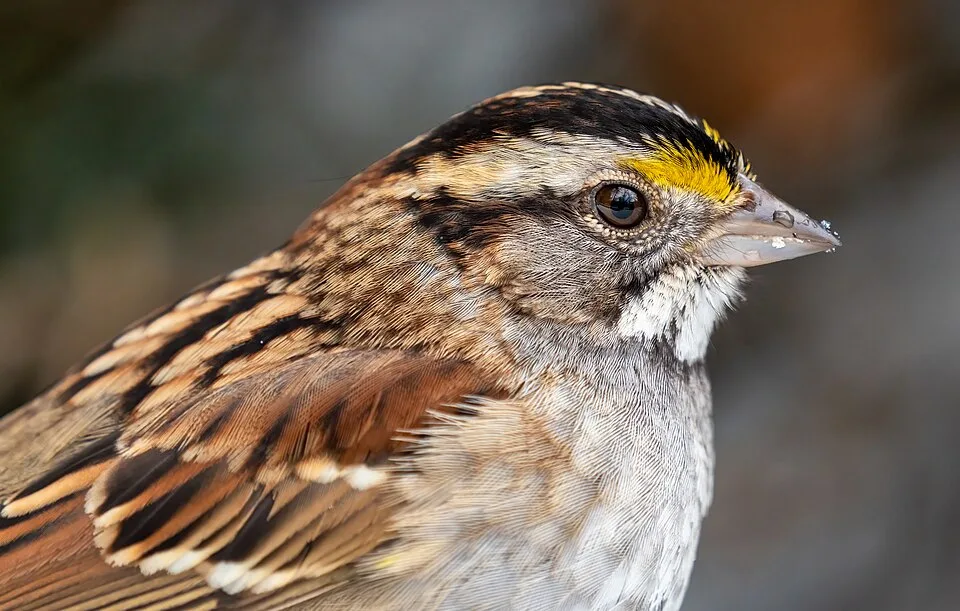
The White-throated Sparrow (Zonotrichia albicollis) is one of the most familiar and beloved winter residents across the eastern and southern United States. While its plumage is subtle, this sparrow is instantly recognizable by its striking facial patterns and, more famously, its clear, whistled song, often translated as "O-sweet-Canada, Canada, Canada" or "Poor Sam Peabody, Peabody, Peabody." Though it spends its breeding season in the dense coniferous and mixed forests of the North, it is in the winter thickets and backyard feeders of the lower 48 states that this bird truly makes its presence known, adding a touch of melody and beauty to the coldest months.
Identification: The Face of a Sparrow
The White-throated Sparrow is a mid-sized, robust sparrow, larger than many of its smaller cousins. Its identification relies on a few key, distinct features:
The Throat Patch: The bird's most diagnostic feature is a clean, bright white patch of feathers on the throat, which is sharply delineated from the gray or brownish breast and provides the species its common name.

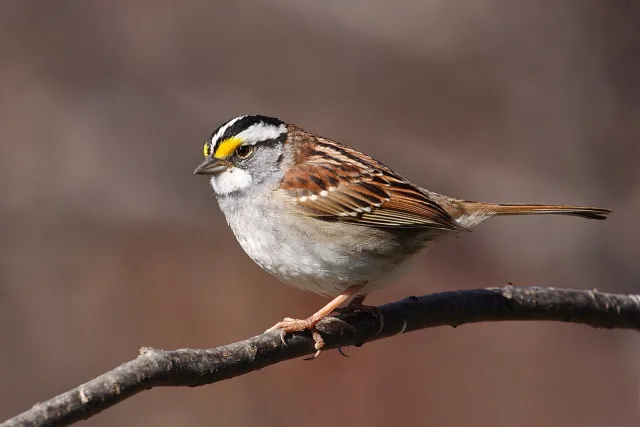
White-throated Sparrow Facial Stripes: The head is patterned with strong alternating stripes. It features a bold, white median crown stripe running down the center of the head, bordered by two dark stripes. Below this, a prominent yellow or white patch sits above the lores (the area between the eye and the bill).
Bill: It has a relatively small, conical bill that is usually a dark gray or blackish color.
The Two Color Morphs: Tan-striped and White-striped
A fascinating biological feature of the White-throated Sparrow is the existence of two distinct color morphs, or forms, which breed simultaneously but are genetically and socially distinct:
White-striped Morphs: These birds exhibit the boldest, most striking coloration. The median crown stripe and the supercilium (eyebrow stripe) are a brilliant white. These birds are typically more aggressive and dominant at feeders and in territorial disputes.
Tan-striped Morphs: These birds are duller, with the crown and eyebrow stripes appearing as a dull, pale buff or tan color. These individuals are generally less aggressive.
Remarkably, these two morphs exhibit assortative mating—they almost always mate with the opposite color type (tan-striped males mate with white-striped females, and vice versa). This unusual genetic strategy ensures maximum genetic diversity and is a unique characteristic of this species.
Range and Habitat: The North-South Shift

The White-throated Sparrow undertakes a significant migration, making it a bird of two distinct habitats.
Breeding Grounds (Summer): It breeds extensively across the boreal forests and mixed coniferous and deciduous woodlands of Canada and the northeastern United States (New England, Great Lakes states). Here, it prefers areas with dense undergrowth, brushy clearings, and boreality (Northern) bog edges, where it is often difficult to spot in the dense cover.
Wintering Grounds (Winter): Nearly the entire breeding population migrates south to winter across the eastern and southern United States, from the mid-Atlantic coast south to Florida and the Gulf Coast, and west into the central states. In these wintering areas, they are ubiquitous in forest edges, parks, suburban yards, and areas with dense, low cover for protection.
Behavior in Winter: They are primarily ground-feeders during the winter, scratching through leaf litter for seeds and insects. They are highly social, gathering in loose flocks that often include other sparrow species, juncos, and cardinals.
The Song: A Cultural Icon
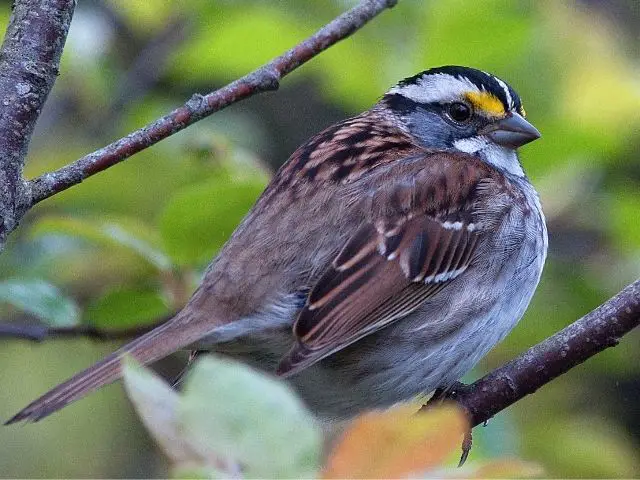
The White-throated Sparrow’s song is arguably its most famous feature. Unlike many songbirds that fall silent during the winter, the White-throated Sparrow sings year-round, even on cold, overcast days in its southern range, though the intensity increases as spring approaches.
Structure: The song consists of a pure, clear, whistled opening note, followed by two or three triplets of repeated notes at a lower pitch.
Mnemonic Devices: The song has inspired numerous mnemonic translations, reflecting its simple, repetitive structure:
"O-sweet-Canada, Canada, Canada" (Common in the North and Canada)
"Poor Sam Peabody, Peabody, Peabody" (Common in the US)
The song is a vital soundscape element, offering a cheerful, almost melancholy melody to the quiet winter months.
Diet and Nesting
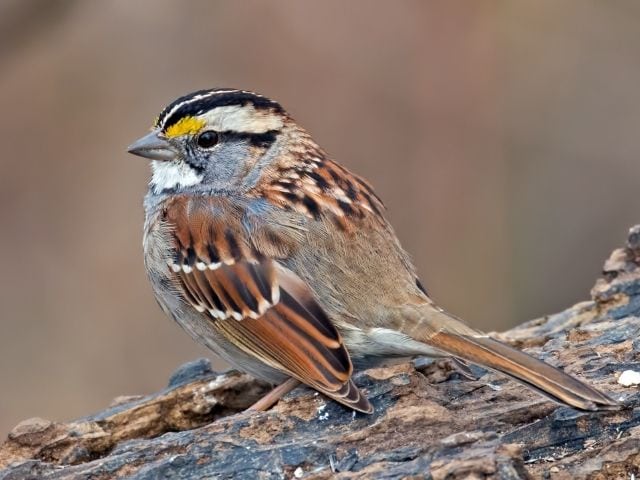
Like most sparrows, the White-throated Sparrow is an omnivorous generalist that relies heavily on seeds but supplements its diet with insects.
Diet: During the winter, it consumes large quantities of grass seeds, weed seeds, and grains. It readily visits backyard feeders, preferring to forage on the ground for scattered seeds, especially millet and cracked corn. In the breeding season, its diet shifts to include more insects (beetles, caterpillars, spiders), which provide essential protein for its young.
Nesting: The species is a ground nester. The female builds a neat, cup-shaped nest hidden on or very close to the ground, usually concealed beneath a thick brush pile, a low shrub, or a clump of ferns. The nest is woven from grass, twigs, bark, and lined with fine grasses and hair.
Brood Parasitism: The White-throated Sparrow is a common host for the Brown-headed Cowbird (Molothrus ater). In many areas, cowbird parasitism significantly reduces the sparrow's reproductive success.
Conservation Status
The White-throated Sparrow is currently classified as a species of Least Concern by the IUCN. It has a massive range and an extremely large estimated population, ensuring its overall stability.
However, recent studies have indicated that the overall population may be experiencing a slow, gradual decline, possibly due to several factors:
Habitat Fragmentation: Logging and development are fragmenting the dense forest habitat required for successful breeding in the northern US and Canada.
Climate Change: Changes in climate patterns may be shifting the availability of suitable breeding habitat and altering migration patterns.
Pesticide Use: The widespread use of pesticides reduces the insect availability during the critical breeding season when high-protein insect food is essential for the young.
Despite these pressures, the White-throated Sparrow remains one of the most numerous and accessible songbirds in North America. Its familiar song, whether heard in the deep boreal woods or a sun-dappled winter thicket, is a constant, clear presence in the continent's avian chorus.
The Winter Spectacle: Where to Spot and Watch Eagles in the U.S.
