
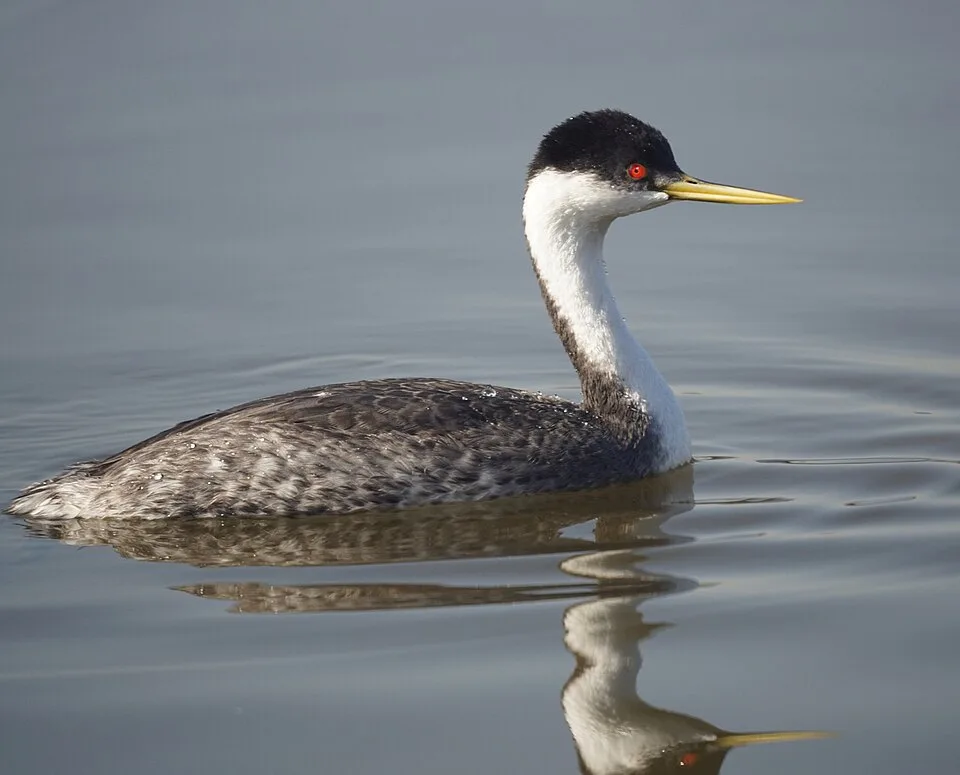
Among the myriad of waterfowl that grace the lakes and coastlines of western North America, few possess the singular elegance and dramatic presence of the Western Grebe (Aechmophorus occidentalis). A bird of striking contrasts, it appears almost awkward on land, yet transforms into a creature of liquid grace the moment it touches the water. With its serpentine neck, sleek black-and-white plumage, and piercing red eyes, the Western Grebe is a defining feature of the continent's large freshwater marshes, reservoirs, and protected marine bays.
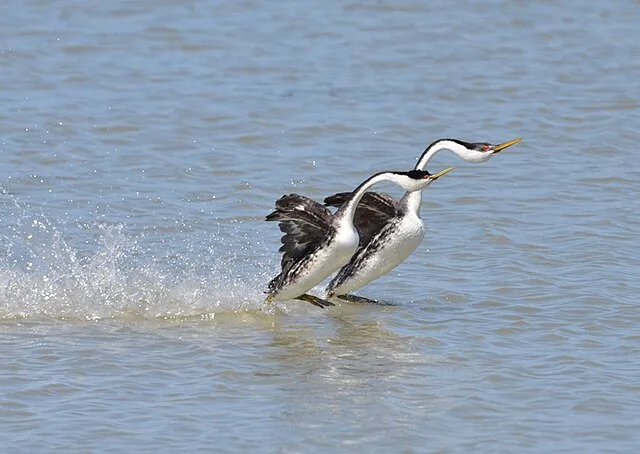
The Western Grebe is not just admired for its beauty, but celebrated for its extraordinary courtship ritual—a mesmerizing display known globally as the "rushing dance." This unique behavior, involving two birds running across the water's surface in perfect synchronization, elevates the species from a mere waterfowl to one of nature’s most compelling performers.
Anatomy of an Aquatic Specialist
The Western Grebe is the largest species of grebe in North America, measuring up to 29 inches in length. Its entire morphology is an adaptation for a life spent almost entirely in the water.
Appearance
Size and Shape: It is a large, slender bird with a long, thin, swan-like neck that gives it an upright posture on the water.
Plumage: Its plumage is sharply defined: a dark gray-black cap, neck, and back contrasting dramatically with a pure white chest and belly.
Facial Features: The black cap extends down below the eye, leaving a prominent white cheek. The eyes are a brilliant, almost sinister ruby-red.
Bill: It possesses a long, thin, sharp yellow-green bill, perfectly adapted for spearing and catching fish.
Legs and Feet: Like all grebes, its legs are set far back on its body—an evolutionary trade-off. This rearward placement provides exceptional thrust and maneuverability underwater, making the grebe a phenomenal diver. However, it renders the bird virtually immobile on land; they rarely come ashore except to nest. Their feet are not fully webbed like ducks' but are lobed, with broad, fleshy flaps around each toe, maximizing their power as aquatic paddles.

Western Grebe
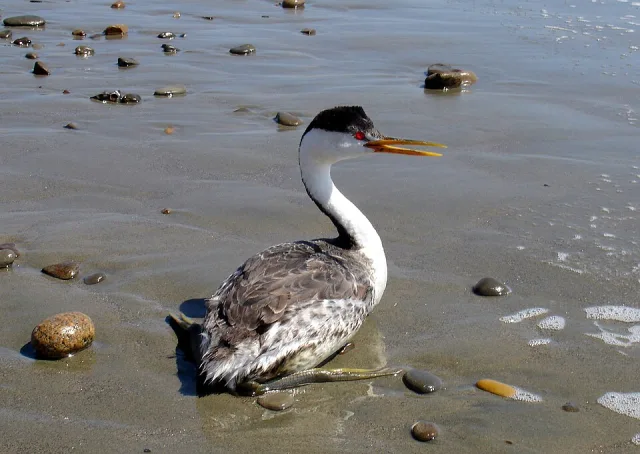
Subspecies Distinction: The Clark's Grebe
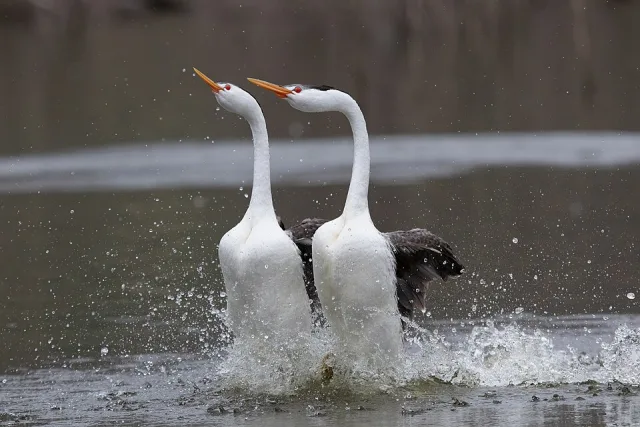
Birders must also be aware of the closely related and almost identical Clark's Grebe (Aechmophorus clarkii). Until the 1980s, the two were considered a single species. The key visual differences are subtle:
| Feature | Western Grebe (A. occidentalis) | Clark's Grebe (A. clarkii) |
| Eye Color | Dark red | Bright red |
| Bill Color | Yellow-green/Olive | Brighter yellow/Orange-yellow |
| Facial Plumage | Black cap covers the eye | White cheek extends above the eye |
| Flank Color | Darker, more slaty gray | Paler gray |
The two species often hybridize, adding complexity to identification, but they generally maintain distinct populations across their shared range.
Distribution and Habitat: A Bird of the West
The Western Grebe's distribution is concentrated in the western half of North America, aligning with its breeding and wintering needs.
Breeding Range
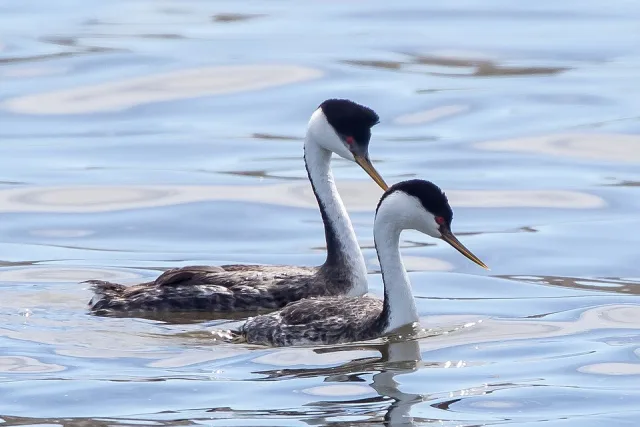
Western Grebes are most prevalent in the vast freshwater lakes, large marshes, and reservoirs of the Great Plains and interior West. Major breeding colonies are established in states like Utah (Great Salt Lake area), Nevada, California, and the Canadian Prairie Provinces. They require large, open bodies of water surrounded by emergent vegetation (like reeds and cattails) for nesting.
Wintering Range
Following the breeding season, they migrate to the Pacific Coast, congregating in large, dense flocks in protected saltwater bays and estuaries from British Columbia down through California and into Mexico. They also winter on some large, open inland lakes that remain unfrozen.
Diet and Foraging
The Western Grebe is almost entirely piscivorous (fish-eating), though it will also consume crustaceans, insects, and amphibians. They are pursuit divers, meaning they actively chase fish underwater. Unlike the surface feeding of ducks, a grebe often dives for extended periods, remaining submerged for 30 seconds or more, capable of catching swift-moving prey at considerable depths.
The Rushing Dance: An Iconic Courtship Display
The Western Grebe's most celebrated feature is its incredible, species-defining courtship ritual. This display is performed primarily in the spring and involves three key behaviors, culminating in the famous "rushing."
1. The Weed Ceremony
The ritual begins with the male and female diving to retrieve strands of aquatic vegetation (weeds). They then surface, holding the weeds in their bills, and perform an intricate head-shaking dance, presenting the weeds to each other.
2. The Advertisement Display
The pair then moves into a synchronized routine of "parallel swimming" and "bob-preening," where they raise their bodies slightly out of the water and preen their flanks in perfect unison.
3. The Rushing
The display climaxes with the "rushing" (or "water dance"). The pair suddenly launches forward, bills tucked into their chests, and begins running across the surface of the water side-by-side. Their lobed feet act as powerful paddles, allowing them to rapidly pat the water and remain upright as they sprint for distances up to 60 feet. This feat requires immense energy and perfect coordination, often ending in a synchronized dive or a rapid halt. It is one of the most remarkable displays in the entire avian world.
Nesting and Parental Care
Western Grebes are colonial nesters, often forming massive, crowded colonies that can include hundreds or even thousands of pairs.
Nest: They build floating nests anchored to submerged vegetation or built up from debris in dense beds of emergent plants. The constant contact with water helps regulate the temperature and humidity of the eggs.
Parenting: Both parents share incubation duties and care for the chicks. The chicks are often carried on the parents' backs, even during short dives. This practice, known as back-brooding, is a common feature among many grebe species and provides warmth and protection from predators.
Conservation and Challenges
While the Western Grebe is currently stable and locally abundant, it faces typical challenges common to large, highly specialized waterfowl:
Habitat Loss: The drainage of large inland marshes for agriculture and development poses the most significant threat to their breeding grounds.
Water Quality: Grebes are sensitive to water pollution, including contaminants and oil spills in their coastal wintering areas.19
Disturbance: Because they nest in dense, large colonies, a single human or predator disturbance can cause mass panic and abandonment, leading to high rates of egg or chick mortality.
The Western Grebe is a perpetual source of fascination, symbolizing the wild heart of North America’s aquatic ecosystems. From their stealthy, submarine hunting to the dazzling, balletic rush, they offer a constant reminder of the specialized beauty that evolution can sculpt. Their presence is a bellwether for the health of the vast, intricate network of lakes and coastlines they call home.
The World’s Feathered Masterpieces: A Celebration of Avian Beauty
