
When the sun dips below the horizon, most birdwatchers pack up their optics, head inside, and call it a day. But right now in mid-to-late May, a completely different, mysterious avian world is just waking up.
Across spring birding forums, there is a massive surge in chatter about twilight and nocturnal birding. While European birders are currently tracking the legendary "churring" of the European Nightjar, U.S. birdwatchers are heading out into the dusk to welcome back our own elusive, cryptic equivalents: Common Nighthawks, Eastern Whip-poor-wills, and Chuck-will's-widows.
Because these birds possess near-perfect camouflage and only active themselves during twilight (crepuscular) and nighttime hours, standard daylight identification guides are completely useless. To find a nightjar, you have to trade your eyes for your ears.
Here is your definitive guide to "audio-tracking" America’s strangest nocturnal insect-eaters by sound alone, and how to optimize your own backyard to help them.
1. The Nightjar Audio Profile: Decoding the Sounds of the Dark
Members of the Caprimulgidae family (collectively known as nightjars or "goatsuckers") have wide gapes for catching insects mid-air, cryptic wood-patterned feathers, and highly mechanical, almost haunting vocalizations. If you are standing at the edge of a pine forest or an open field at dusk right now, here is exactly what you are listening for.
1. Common Nighthawk (Chordeiles minor)

Despite the name, these are not hawks at all. They are frequent summer residents across almost the entire United States, often seen flying over city lights or open fields.
The Vocalization: A sharp, nasal, electric "peent!" call, given repeatedly while in flight. It sounds remarkably similar to an American Woodcock but is delivered high in the air.
The Mechanical Sound: Look out for the famous "booming" display. When a male dives steeply toward the ground and pulls up sharply, the air rushing through his primary wing feathers creates a deep, resonant boom or whoosh that sounds like a miniature jet engine.
2. Eastern Whip-poor-will (Antrostomus vociferus)
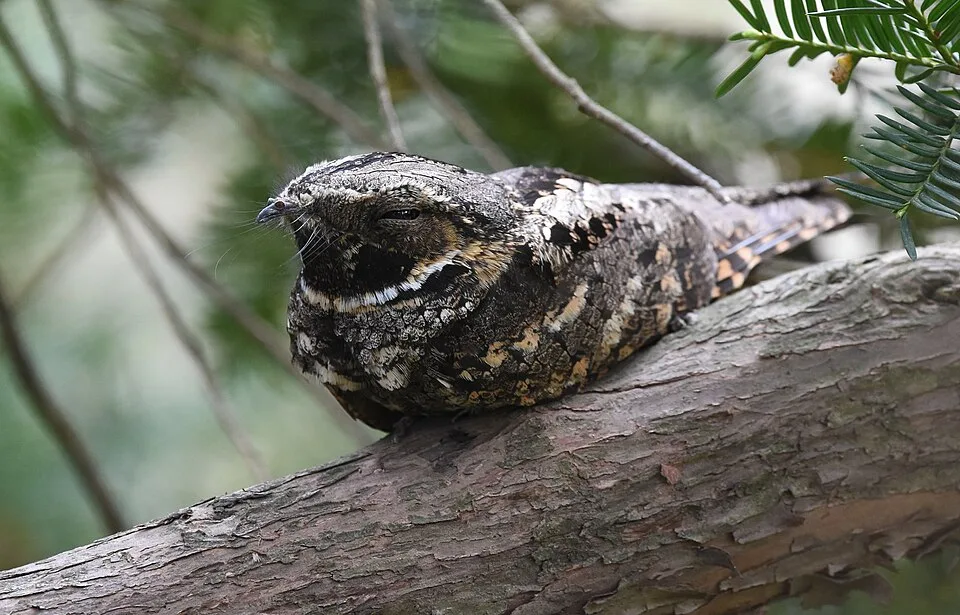
Famous in American folklore, this species is heard thousands of times more often than it is seen throughout the forests of the East and Midwest.
The Vocalization: An incredibly loud, chanting, rhythmic whistle that sounds exactly like its name: "whip-poor-will!"
The Audio Clue: A single bird can repeat this phrase hundreds of times without a break. If you are very close to a perched bird, listen carefully for a sharp, quiet cluck sound immediately preceding each "whip."
3. Chuck-will's-widow (Antrostomus carolinensis)

The largest nightjar in North America, replacing the Whip-poor-will in the pine woods and maritime forests of the American South.
The Vocalization: A lower-pitched, slightly slower chant: "chuck-will's-widow."
The Audio Clue: The first "chuck" syllable is very low and often drops off entirely if you are listening from a distance, making it sound like they are just saying "will's-widow."
2. Low-Light Field Tactics: How to Spot a Shadow
Audio tracking is 90% of the game, but if you want to catch a physical glimpse of a nightjar without disrupting their natural behaviors, you need specialized low-light tactics.
The Moon Factor: Nightjars are highly visual hunters that rely on moonlight to silhouette flying insects. Your highest chance of active calling and flight displays occurs during the one week surrounding a full moon in May and June.
Isolate the Eye-Shine: Nightjars have a specialized reflective layer behind their retinas called a tapetum lucidum (similar to cats and deer). If you use a headlamp, hold it at eye level (resting against your temple). As you scan fence posts, dirt roads, or low branches, their eyes will glow an intense, bright ruby-red in the beam.
Keep Your Distance: Ground-nesting birds are highly vulnerable. Never use bright flashlights or spotlights directly on a nesting bird, and never use electronic audio playback at night, which can draw them away from hunting or caretaking.
3. Dark-Sky Birding: How to Attract Nocturnal Insect-Eaters to Your Area
Nightjars face steep population declines due to habitat loss and a massive reduction in large insect populations. Because they hunt by sight, artificial light pollution actively disrupts their ability to forage naturally.
| The Problem | The Backyard Fix | Why It Works |
| Blue Light Glare | Swap bright white outdoor security bulbs for warm amber or red LED bulbs. | Bugs are less attracted to warm wavelengths, reducing the "insect vacuum" effect around houses and keeping bugs out in the canopy where nightjars hunt. |
| Unnecessary Sky-Glow | Install down-shield fixtures on all outdoor garage and porch lights. | Directs light exactly where humans need it on the ground while keeping the night sky dark for migrating birds. |
| Lack of Insect Biomass | Plant native host plants (like Oaks, Willows, or Evening Primrose) and eliminate pesticides. | Boosts the population of large nocturnal moths and beetles, creating a reliable feeding station for passing nighthawks and whip-poor-wills. |
Step Into the Dark: Have you ever heard the haunting call of a Whip-poor-will or seen a Nighthawk booming over a city stadium? Drop a comment below with your state and your favorite nighttime birding memory—and let us know if you hear any "peenting" in the sky this week!
