
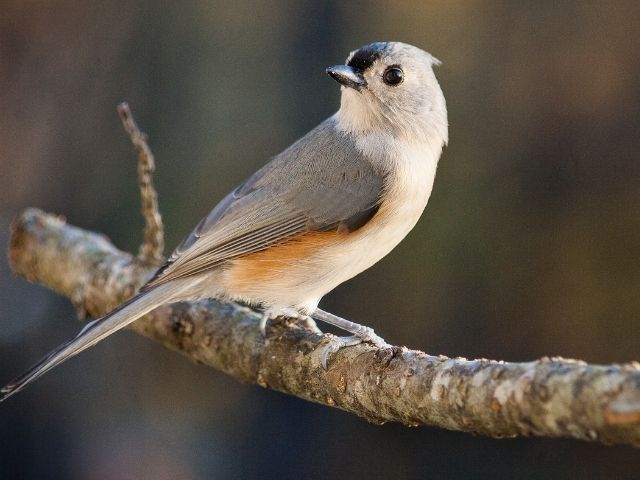
The titmouse, with its jaunty crest and spirited chatter, is one of the most charismatic small songbirds in North America. These year-round residents belong to the genus Baeolophus, part of the wider Paridae family that also includes the familiar chickadees. The United States is home to five distinct titmouse species, each adapted to a unique corner of the country.
While they share the key characteristic of an erectable crest, their subtle differences in plumage, song, and—most importantly—geographic range are what set them apart. For American birders, understanding these variations is the key to identifying these delightful and perpetually curious feathered friends.
1. The Eastern Icon: Tufted Titmouse (Baeolophus bicolor)
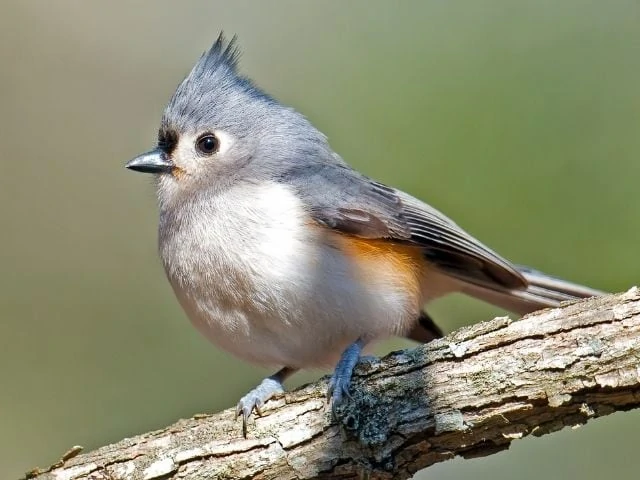
The Tufted Titmouse is the most widespread and recognizable of the American titmice, embodying the classic image of the species across the eastern half of the nation.
Identification and Appearance
The Tufted Titmouse is easily recognized by its silvery-gray back, white underside, and a noticeable wash of rusty-peach or buff color on its flanks. Its large, dark eyes contrast with a pale face, but the most distinctive feature is the black patch on its forehead, right above the bill. Its crest, which is typically a lighter gray than the main body, is often held upright, giving it a perpetually alert look. It’s a slightly larger titmouse, measuring around 6 inches long.
Habitat and Range

This species is a non-migratory resident of deciduous and mixed forests throughout the eastern United States, stretching from the Great Plains eastward to the Atlantic coast and from the Gulf Coast north into southern Canada. It thrives in areas with large, mature trees and is a frequent, often boisterous, visitor to backyard feeders and suburban parks.
Voice and Behavior
The Tufted Titmouse is famous for its clear, whistled "peter-peter-peter" song, a sound that brightens the winter woods. They are energetic and acrobatic foragers, often hanging upside-down on branches. Like chickadees, they are known to cache food, taking one sunflower seed at a time from a feeder, shelling it, and hiding the kernel in bark crevices for later retrieval. They are highly social, frequently joining mixed-species foraging flocks outside the breeding season.
2. The Texas Twin: Black-crested Titmouse (Baeolophus atricristatus)
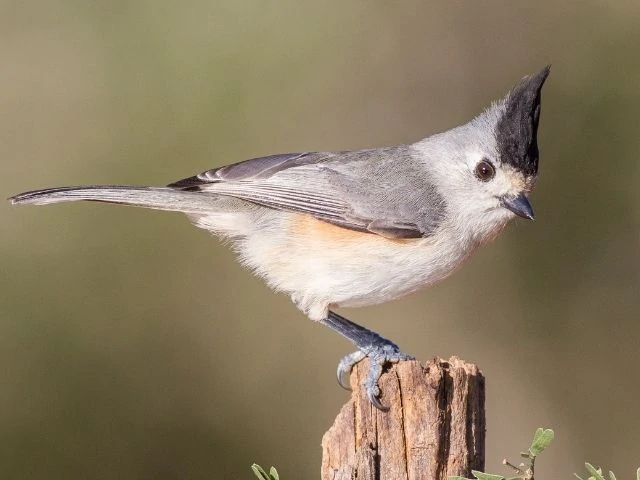
For many years, the Black-crested Titmouse was considered a subspecies of the Tufted Titmouse. However, genetic analysis confirmed it as a distinct species, separated by clear visual and geographic boundaries.
Identification and Appearance
The primary difference is right in its name: the Black-crested Titmouse boasts a prominent, jet-black crest and a white forehead. Unlike its eastern cousin, it lacks the black patch on the forehead and typically has less or no rusty coloring on its flanks. In all other respects—size, shape, and overall gray body—it is nearly identical to the Tufted Titmouse.
Habitat and Range
The Black-crested Titmouse is a bird of the South-Central U.S., primarily occupying most of Texas and extending into southwestern Oklahoma and eastern Mexico. It prefers dry, open woodlands, particularly those dominated by oaks. Where its range meets that of the Tufted Titmouse in east-central Texas, a narrow hybrid zone exists, where birds with mixed-color crests (dark gray) can be seen.
Voice and Behavior
Its behavior and song are very similar to the Tufted Titmouse. Its song is also a whistled phrase, though it is sometimes described as having a slightly different quality, providing one of the most reliable methods for differentiation in the few areas where the species' ranges touch.
3. The Plain Western Duo
The remaining two titmouse species in the continental US—the Oak Titmouse and the Juniper Titmouse—were once lumped together as a single species, the Plain Titmouse. They are visually much less striking than their eastern counterparts, characterized by their overall drab gray plumage and less contrasting head patterns.
Oak Titmouse (Baeolophus inornatus)
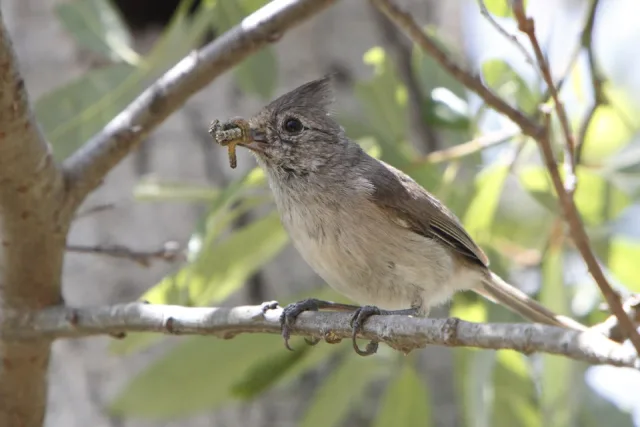
The Oak Titmouse is one of the most common birds of the California oak woodlands.
Identification and Appearance
This is a small, relatively plain-looking titmouse. It is a uniform brownish-gray on its back, head, and flanks, with a slightly paler belly. Its crest is short and often flattened, making it appear round-headed, and it has no strong facial markings. Its overall muted coloration makes it perfectly blend into the bark of its favored trees.
Habitat and Range
The Oak Titmouse is a non-migratory resident of oak and oak-pine woodlands along the Pacific Slope of North America, from southern Oregon south through California to Baja California.
Voice and Behavior
Its song is a whistled, repeated phrase, often described as a "sweet" peta-peta-peta with distinct alternating high and low notes. They are highly dependent on oak trees for food, feeding on acorns, insects, and other invertebrates found within the foliage and bark.
Juniper Titmouse (Baeolophus ridgwayi)
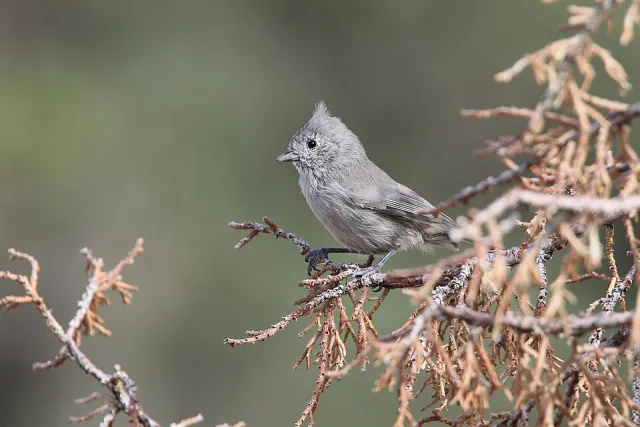
The Juniper Titmouse occupies the dry, arid interior of the western United States, a habitat starkly different from the coastal oak woodlands.
Identification and Appearance
The Juniper Titmouse is nearly identical in appearance to the Oak Titmouse, which is why they were once considered a single species. However, the Juniper Titmouse averages a paler and grayer color overall, typically lacking the brownish wash found on the Oak Titmouse. Like its western cousin, it has a short, plain crest and a lack of distinctive facial markings.
Habitat and Range
This species is restricted to the Great Basin and interior West, found in sparse, arid woodlands dominated by Juniper and Pinyon Pine trees. Its range stretches from eastern California, across the Great Basin, and into the mountains of Arizona, New Mexico, Utah, and Colorado. The species’ reliance on these specific, often isolated, woodland patches makes it a more difficult bird to find than the eastern titmice.
Voice and Behavior
The most reliable way to distinguish it from the Oak Titmouse is its song, which is typically a faster, "drier" trill on a single pitch, lacking the alternating high and low notes of the Oak Titmouse's call. Like all titmice, it is a cavity nester and a food cacher.
4. The Southwestern Marvel: Bridled Titmouse (Baeolophus wollweberi)
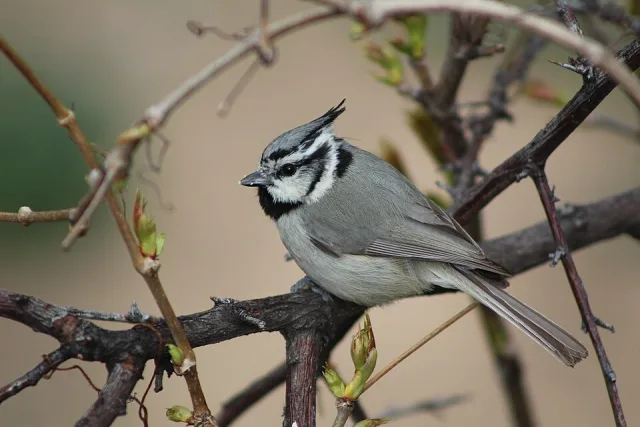
The Bridled Titmouse is the most uniquely marked and often considered the most visually striking of the American titmice.
Identification and Appearance
The Bridled Titmouse is the smallest of the group and is immediately identifiable by its intricate, boldly striped black-and-white facial pattern. It has a sweeping black line that forms a "bridle" across its white face, a small black bib, and a distinct black-and-white pattern on its crested head. Its body is gray, with a small patch of olive-gray on the back and flanks. Its sharp, ornate markings set it apart from all other North American titmice.
Habitat and Range
This beautiful titmouse is restricted to the mountain woodlands of the Southwest, found in southeastern Arizona and southwestern New Mexico, extending south into Mexico. It favors canyon and foothill habitats with sycamores and oak-pine-juniper forests.
Voice and Behavior
The Bridled Titmouse often acts more like a chickadee, exhibiting a highly social nature and sometimes engaging in cooperative breeding, where young from a previous brood help their parents raise the current nestlings. Its song is a varied series of clear, whistled notes and trills, often described as a repeated, complex musical phrase.
The Titmouse Tribe: A Study in Speciation
The five titmouse species in the U.S.—Tufted, Black-crested, Oak, Juniper, and Bridled—demonstrate a fascinating pattern of allopatric speciation, where geographic separation, often caused by natural barriers like deserts or mountain ranges, led to the evolution of distinct species.
From the booming voice of the Tufted Titmouse in the humid eastern woods to the subtly camouflaged Juniper Titmouse in the arid West, these crested cavity-nesters fill unique ecological niches. They share a remarkable intelligence, a persistent curiosity toward humans (especially at bird feeders), and a year-round residence that makes them a consistent joy for birders, no matter the season or region. They truly are the spirited jewels of the American tree canopy.
The Amazing Abilities of North American Birds You Never Knew
