

With their elegant, slender wings and deeply forked tails, terns are the epitome of grace over water, earning them the old nickname "sea-swallows." These highly migratory seabirds are found across all three major American coastlines—the Atlantic, Pacific, and Gulf—as well as the vast inland waterways of the Great Lakes and major rivers. Their unique hunting style, which involves hovering over the water before plunge-diving headfirst to spear small fish, makes them a captivating sight for any birder.
The United States is home to over a dozen species of terns, each with distinct size, plumage, and habitat preferences. From the tiny, protected Least Tern to the colossal Caspian Tern, these birds tell a story of immense migration, challenging nesting habits, and ongoing conservation efforts.
The Coastal Crowd: Atlantic and Gulf Coasts
The Eastern Seaboard is arguably the most populated region for terns, hosting several key species that breed on barrier islands, salt marshes, and rocky offshore islands.
1. The Common Tern (Sterna hirundo)
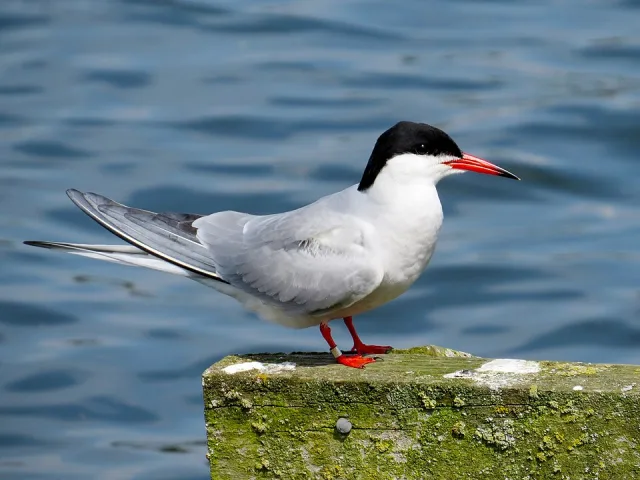
Living up to its name, the Common Tern is the most widespread and abundant tern in North America. It breeds along the Atlantic Coast from Canada to North Carolina, and is also one of the few species found breeding on major inland lakes like the Great Lakes.
Identification: A medium-sized tern (about the size of a pigeon) with a light gray back, white underparts, a glossy black cap, and an orange-red bill with a black tip during the breeding season. Its pointed wingtips are noticeably darker than other similar species, particularly the Arctic Tern.
Behavior: They are highly gregarious, nesting in large, noisy colonies in shallow scrapes on sand or shell beaches. Their call is a harsh, rolling "kee-urr". They were nearly extirpated in the late 19th century by plume hunters but have since recovered thanks to protection under the Migratory Bird Treaty Act.
2. The Roseate Tern (Sterna dougallii)
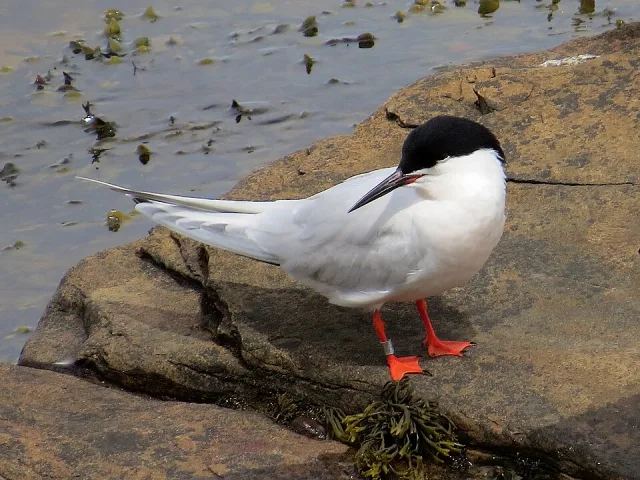
A sensitive and highly specialized species, the Roseate Tern is considered threatened in the U.S. and often nests in close association with larger colonies of Common Terns.
Identification: It is slightly smaller and paler than the Common Tern. In breeding plumage, it has a black cap and an entirely black bill. Its name comes from the faint pink or rose-colored flush visible on its breast and belly during the breeding season, though this is often difficult to see in the field. Crucially, its tail streamers are significantly longer than the Common Tern's.
Habitat and Conservation: Its breeding is concentrated almost entirely on a few protected offshore islands from New England to Long Island, New York. Conservation efforts often focus on protecting these few critical nesting sites from predators and human disturbance.
The Ring-billed Gull: The Opportunistic North American Scavenger
3. The Least Tern (Sternula antillarum)
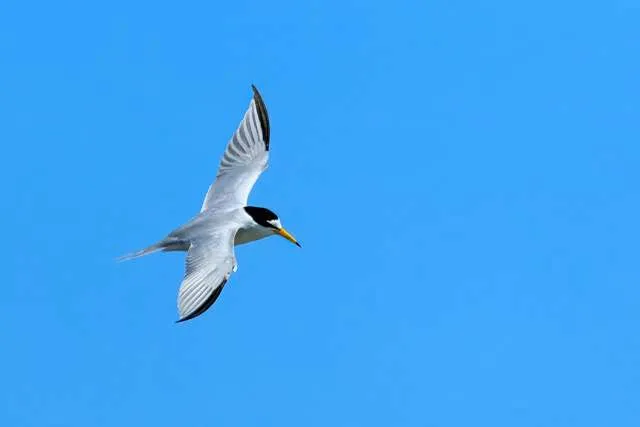
The smallest of all North American terns, the Least Tern is one of the continent's most vulnerable beach-nesting birds.
Identification: Tiny, roughly the size of a sparrow, with a white forehead patch on its black cap and a yellow bill with a black tip. Its diminutive size and rapid, erratic flight are key field marks.
Nesting Challenge: Least Terns nest directly on open, sandy beaches and river sandbars, areas that are increasingly popular for human recreation. This conflict has led to the endangerment or threatened status of several regional populations (like the interior river populations). In some urban areas, they have adapted by nesting on gravel rooftops near the coast.
4. The Sandwich Tern (Thalasseus sandvicensis)

This elegant, medium-large tern is primarily a southern coastal breeder, regularly found along the Gulf Coast and the southern Atlantic states.
Identification: It has a black cap with a distinctive shaggy crest at the back, a grayish back, and a long, sharp, black bill with a yellow tip. Its slightly larger size and heavy bill help distinguish it from the Common and Roseate Terns. It is a colonial nester, often seen in spectacular, dense groups.
The Giants and the Pacific Wonders
The western U.S. and the inland lakes host species that differ dramatically in size and appearance from the slender eastern terns.
5. The Caspian Tern (Hydroprogne caspia)

This is the largest tern species in the world, comparable in size to some gulls, and possesses a proportionally massive bill.
Identification: A very large, stocky bird with a pale gray body, black cap, and a huge, thick, coral-red bill that looks almost like a lobster claw. Its call is a deep, low, gravelly "kraaah", unlike the high-pitched calls of smaller terns.
Distribution: Found across the U.S., breeding in isolated colonies on islands in the Great Lakes, the Pacific Coast, and inland lakes and reservoirs. They often feed farther from their colony sites than other terns, capable of flying long distances to find food.
6. The Elegant Tern (Thalasseus elegans)

True to its name, this tern is an emblem of the Pacific Coast, primarily breeding in massive, dense colonies in Baja California but foraging and migrating extensively up the coast of California.
Identification: Slim and medium-sized, it is best recognized by its extremely long, thin orange-yellow bill and its shaggy, black, backward-sweeping crest. Its slender profile and buoyant flight make it unmistakable over the Pacific surf.
7. The Forster’s Tern (Sterna forsteri)

While superficially similar to the Common Tern, the Forster's Tern has a key difference: it prefers freshwater and brackish marsh habitat over open ocean beaches for nesting.
Identification: In breeding plumage, the bill is orange with a black tip. A crucial in-flight difference is the absence of the dark wingtips seen on the Common Tern; the Forster's Tern's wingtips are generally the same pale gray as the rest of the wing.
Habitat: It builds its nests on mats of floating vegetation or muskrat houses in extensive coastal and inland marshes, particularly around the Great Lakes, the Great Basin, and the Gulf Coast.
The Marsh and River Specialists
These species have adapted away from the traditional oceanic beach setting.
8. The Black Tern (Chlidonias niger)
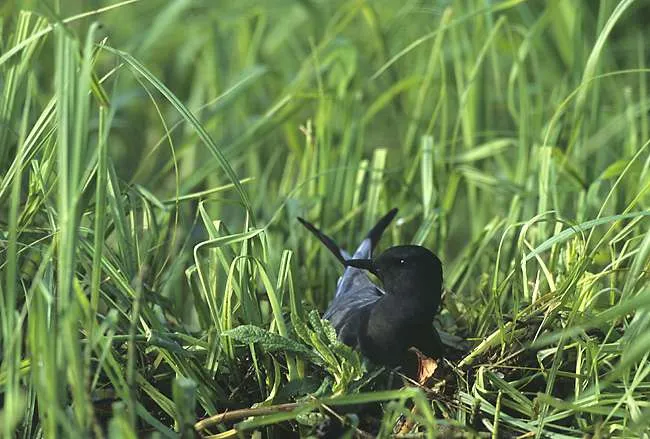
Unlike the predominantly black-and-white coastal terns, the Black Tern is an inland specialist of freshwater marshes.
Identification: In its summer breeding plumage, the adult is distinctive: a black head, neck, and underparts contrasting with a dark gray back and white undertail. In flight, they look like large, dark swallows.
Habitat: They breed in shallow freshwater marshes, often constructing their fragile nests on floating vegetation. Like many marsh specialists, their populations have faced threats from wetland drainage and degradation.
9. The Arctic Tern (Sterna paradisaea)
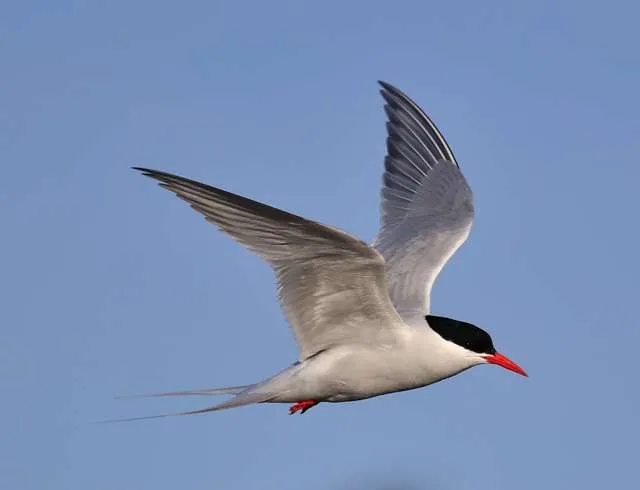
The Arctic Tern is legendary for having the longest migration of any bird on Earth. While it breeds primarily in the Arctic and sub-Arctic regions of North America, it passes through the U.S. during its monumental journey to the Antarctic wintering grounds.
Identification: Nearly identical to the Common Tern, but typically has a full red bill (no black tip) and shorter legs. Distinguishing them requires careful observation, often focusing on the light gray primary feathers.
The Epic Journey: A bird hatched in New England may fly 12,000 miles to the Southern Ocean and back annually, covering a distance equivalent to three round trips to the Moon over its lifetime.
The terns of the U.S. are a constant reminder of the incredible connection between global ecosystems. From the rocky islands of Maine where the Roseate Tern breeds to the rooftop nests of the Least Tern in Florida, their presence is a delicate balance of marine health, climate stability, and human responsibility. Watching a tern hover motionless against a stiff wind, only to plunge with lightning speed into the water, remains one of the most sublime experiences in American birding.
