
The Great Smoky Mountains National Park (GSMNP), straddling the border of Tennessee and North Carolina, stands as the crowning jewel of the Southern Appalachians and, arguably, the most vital sanctuary for migratory songbirds east of the Mississippi River. Recognized internationally as a biosphere reserve, the park’s staggering biodiversity is largely due to its immense, unbroken forest cover and dramatic elevation gradient. This gradient—rising from 800 feet to over 6,600 feet—creates ecological zones ranging from lowland cove hardwood forests to high-elevation spruce-fir boreal forests. This complexity is the secret ingredient for the annual Warbler Extravaganza, drawing birders to the park every spring to witness one of North America's most exciting avian spectacles.
For the vast majority of neotropical migrants, particularly the warblers, the Great Smoky Mountains serve two critical purposes: a haven for resting and refueling during migration, and a reliable, high-quality breeding ground. Over 30 species of wood warblers regularly occur here, making it one of the most warbler-diverse spots in the world.
The Ecological Engine: Elevation and Forest Types
The diversity of warblers is directly tied to the diversity of the forest itself. Each warbler species is a specialist, partitioning the forest by height, tree type, and even the size of the branch it forages on.

1. Cove Hardwood Forests (Low and Mid-Elevation)
The deep, moist valleys—or coves—are home to the oldest, most species-rich hardwood forests, characterized by towering tulip poplars, basswood, and buckeyes. These areas are magnets for specialized breeding warblers:
Hooded Warbler: A strikingly beautiful bird whose male has a vibrant yellow face framed by a black hood. They prefer the dense understory and low saplings, often flicking their white tail feathers to startle insects.
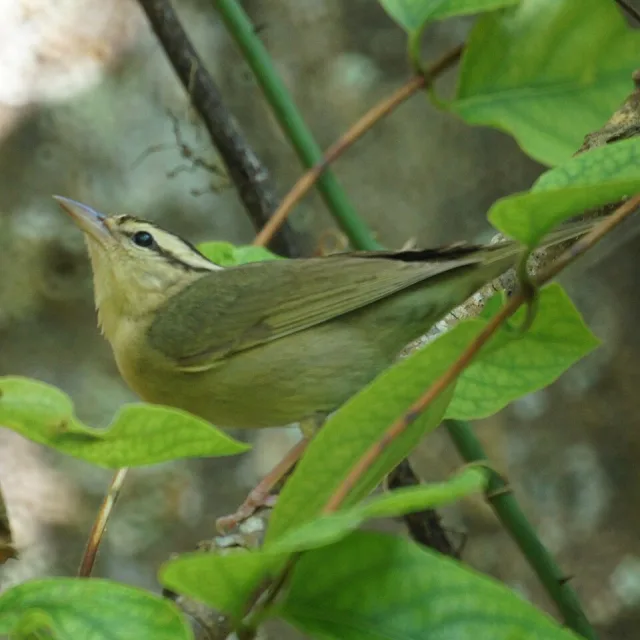
Worm-eating Warbler: A ground-nesting specialist found on steep, forested slopes, known for its streaky, buff-colored head and its unique foraging style, where it picks insects out of dead, rolled-up leaves.
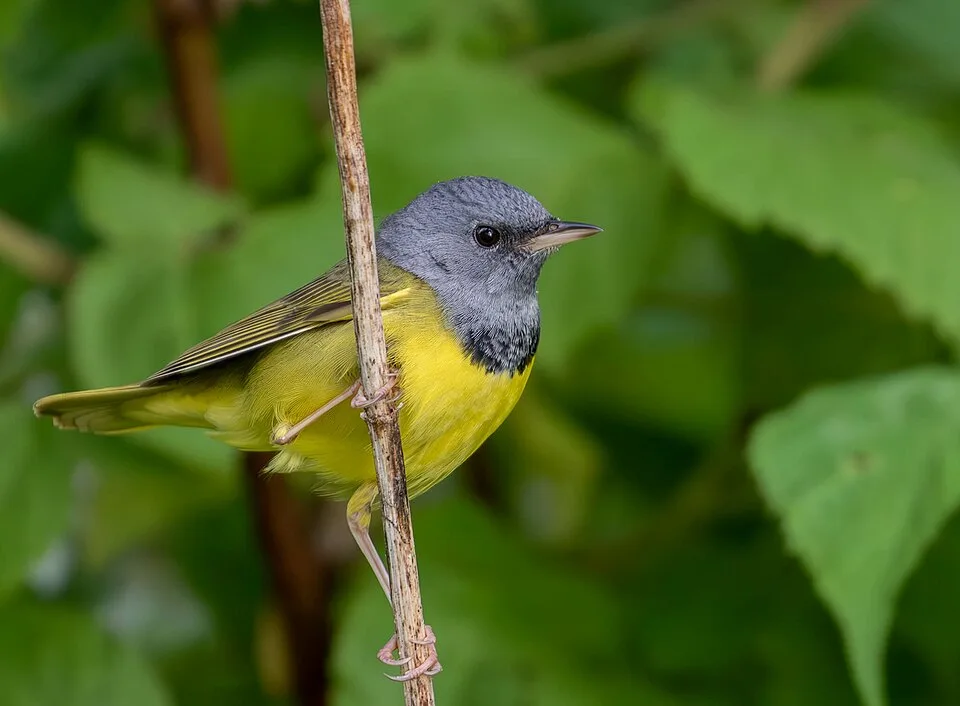
Kentucky Warbler: Another species favoring the forest floor and thick, brushy undergrowth, easily identified by its bright yellow spectacles (yellow around the eye) and black cheek patch.

Worm-eating Warbler
2. Montane Oak and Northern Hardwoods (Mid to High Elevation)
As elevation increases (above 3,500 feet), the forest shifts to drier oak and hickory forests, gradually giving way to beech and birch. This zone is a primary breeding habitat for some of the most sought-after warblers:
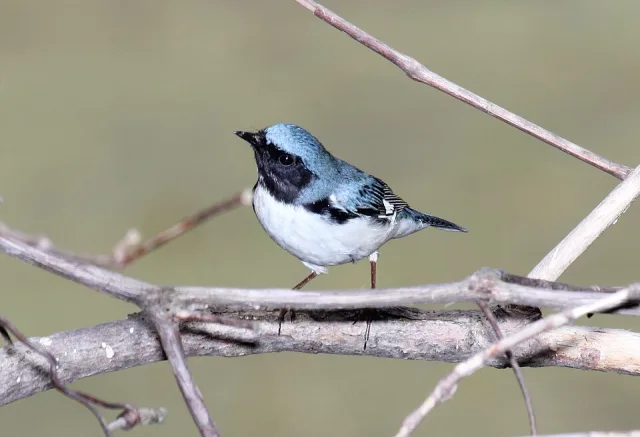
Black-throated Blue Warbler: A favorite among birders, the male is an unmistakable mix of black, white, and slaty blue. They typically forage in the mid-story, often near rhododendron thickets.
Black-throated Green Warbler: One of the most common and vocally persistent warblers, easily recognized by its buzzy song ("Zzz-Zzz-Zoo-Zee") and its bright yellow face framed by a black bib. It is abundant in the mature forest canopy.
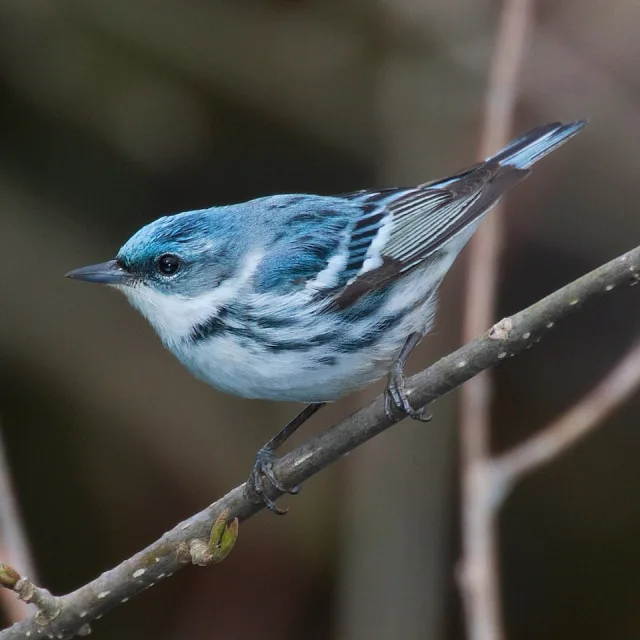
Cerulean Warbler: A species of high conservation concern due to habitat loss, the GSMNP is one of its most important strongholds. This tiny, electric-blue bird favors the topmost branches of the tallest oaks, making it a challenging, but rewarding, sighting.
3. Spruce-Fir Forests (High Elevation)
The highest elevations (above 5,000 feet) near peaks like Clingmans Dome are home to relic communities of Red Spruce and Fraser Fir. These forests are essentially islands of boreal habitat, remnants from the last ice age, that support birds normally found much farther north.
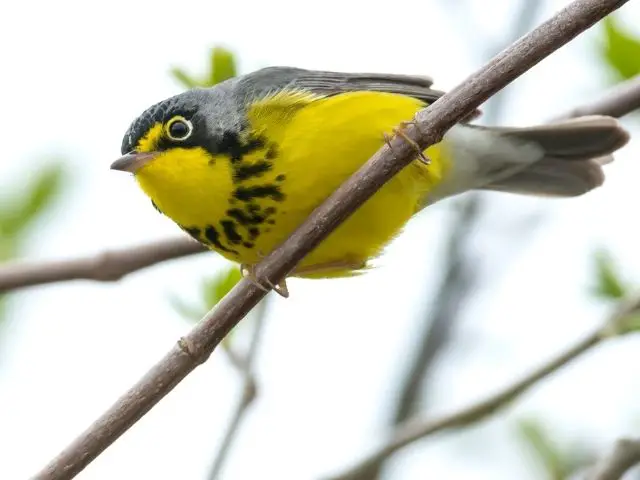
Canada Warbler: A stunning bird with a distinct "necklace" of black streaks across its bright yellow chest. It breeds in the dense, moist undergrowth of the high-elevation forests.
Blackburnian Warbler: Perhaps the most spectacular warbler of all, the male features a brilliant fiery orange throat and face against black and white streaking. It exclusively feeds and nests in the canopy of the highest spruce and fir trees.

Blackburnian Warbler

The Seasonal Rush: Peak Migration and Breeding
The absolute best time to experience the warbler explosion is from late April through the middle of May. During this period, transient migrants mix with returning breeders, resulting in the highest density and diversity of species.
The Transients: Passing Through
Some warblers don't stay to breed in the Smokies but simply use the park as a crucial migratory stopover. These transient species add significantly to the May deluge:
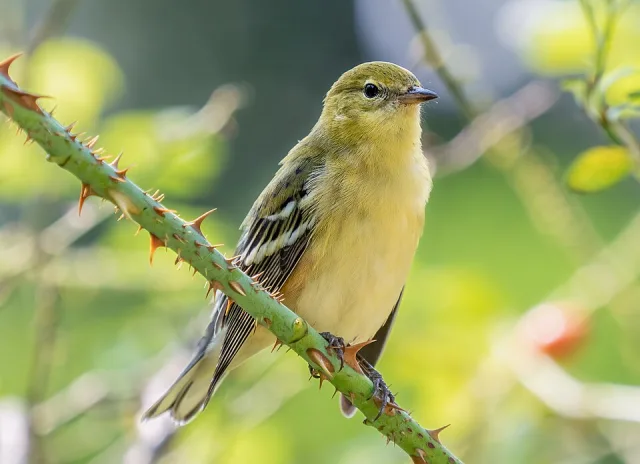
Bay-breasted Warbler: A handsome bird with a distinctive chestnut patch on its flanks and throat.
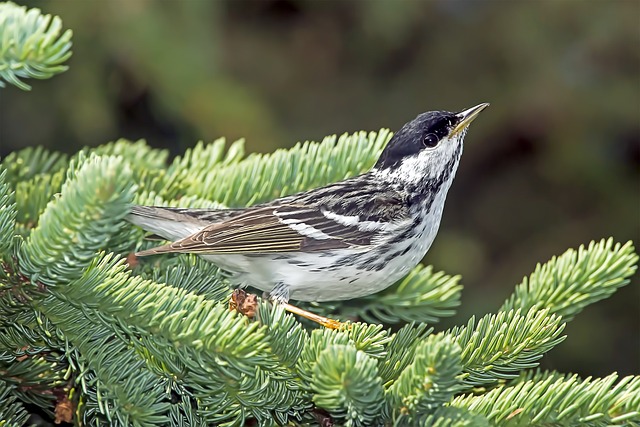
Blackpoll Warbler: An amazing long-distance traveler, this species is identifiable by its solid black cap and white cheeks. It passes through the Smokies on its way to breed in the boreal forests of Canada.
The Breeders: The Summer Song

By late May, the transients have moved north, and the park settles into its breeding season. The males sing constantly to define territory and attract mates. At this time, the true residents of the park become easier to find:
Ovenbird: Heard everywhere, this bird is not a warbler but is classified as one (Seiurus aurocapilla). It is identified by its loud, ringing song: "Teacher! TEACHER! TEACHER!" and its terrestrial foraging habits.
American Redstart: A hyperactive, fanned-tailed sprite whose males flash black, orange, and white patches as they dart through the mid-story, constantly chasing insects.

American Redstart

Prime Birding Locations in the GSMNP
Access to the best warbler viewing often involves utilizing the park's roads and trails that traverse the critical elevation gradient.
1. Cades Cove (Low Elevation)
While famous for its open fields and wildlife, the surrounding forests and riparian areas are excellent for early-season warblers and understory specialists like the Hooded and Worm-eating Warblers. The tranquility of the early morning here, before traffic peaks, is ideal for listening.
2. Newfound Gap Road (Elevation Gradient)
This is the main north-south road that climbs from Gatlinburg, Tennessee, to the highest reaches of the park. It is a mobile birding experience, allowing observers to sample different habitats by simply pulling over at different elevations.
Chimneys Picnic Area: Excellent mid-elevation spot for Louisiana Waterthrush (along the stream) and Black-throated Green Warblers.
Alum Cave Trailhead: The lower section of this trail is fantastic for finding Cerulean and Blackburnian Warblers in the mature canopy.
3. Clingmans Dome and the Appalachian Trail (High Elevation)
The parking area and trails around Clingmans Dome (the highest point in the park) are the only places to reliably find the high-elevation boreal specialists. Here, you are immersed in the spruce-fir zone, and the key species are the Canada Warbler and the Blackburnian Warbler. Be sure to check the dense rhododendron and mountain laurel thickets for the secretive Mourning Warbler during peak migration.
The Great Smoky Mountains National Park is more than just a beautiful wilderness; it is an irreplaceable reservoir of biodiversity, particularly for the vibrant, resilient, and utterly charming wood warblers. Every spring, these tiny travelers transform the quiet gray forests into a resounding kaleidoscope of color and song, proving that the health of the entire hemisphere is reflected in the vibrancy of the Southern Appalachian canopy.
