

Take a look up at the sky on a warm summer evening. Chances are, you will see small, dark shapes slicing through the air with breathtaking speed, twisting and turning in pursuit of invisible targets.
These are aerial insectivores—birds that hunt, catch, and eat insects entirely while in flight.
In the skies of North America, two dominant players rule this backyard airspace: the Chimney Swift and the Barn Swallow. Beginners frequently mix them up because they share the exact same hunting grounds, look vaguely similar from a distance, and move with a frantic, roller-coaster energy.
But behind the scenes, these two birds are radical examples of convergent evolution. They are not closely related cousins. In fact, one of them is biologically closer to a hummingbird than to the other.
Let's break down how nature built these two very different aerial vacuums, and how you can effortlessly tell them apart on your next birding walk.
The Family Tree: A Songbird vs. A "Hummingbird"

To truly appreciate these birds, you have to look at their taxonomic identities. They might share the same airspace, but they come from entirely different worlds.
| Attribute | Chimney Swift (Chaetura pelagica) | Barn Swallow (Hirundo rustica) |
| Family | Apodidae (Swifts) | Hirundinidae (Swallows) |
| Order | Apodiformes (Swifts, Treeswifts, Hummingbirds) | Passeriformes (Perching Birds / Songbirds) |
| Core Trait | Non-passerine; tiny, vestigial legs unable to perch | True songbird; feet adapted for gripping twigs and wires |
The Barn Swallow is a classic passerine—a highly evolved songbird with vocal tracking and strong feet. The Chimney Swift, however, belongs to an ancient lineage. Its family name, Apodidae, translates literally from Greek as "footless." While they do have feet, they are so tiny and weak that a swift can never perch on a tree branch or a power line; it can only cling vertically to rough surfaces like the inside of a chimney or a hollow tree.
The Aerial Blueprint: How to Build an Insect Vacuum

Because flying insects are fast, erratic, and highly alert, catching them in mid-air requires extreme aerodynamic optimization. To conquer this high-speed niche, both families arrived at the exact same physical solutions:
1. The Cavernous Gape
If you look at a swift or a swallow close up, their beaks look incredibly tiny. But look closer when they open their mouths: their jaw hinges are set incredibly far back on the skull. This creates a massive, wide, scoop-like mouth called a gape. When they fly through a swarm of gnats, they don't pick them out one by one—they open their mouths and act like living butterfly nets, scooping up "aerial plankton."
2. High-Aspect Ratio Wings
Both birds possess long, narrow, swept-back wings. This shape maximizes lift while minimizing drag, allowing them to maintain high speeds and execute instantaneous, G-force-defying turns to intercept fleeing bugs.
The Cheat Sheet: How Beginners Can Tell Them Apart
You don't need a high-end spotting scope to tell these two apart. By focusing on three key clues—Silhouette, Style, and Sound—you can identify them instantly, even at a distance.
Clue 1: The Silhouette (Cigar vs. Anchor)
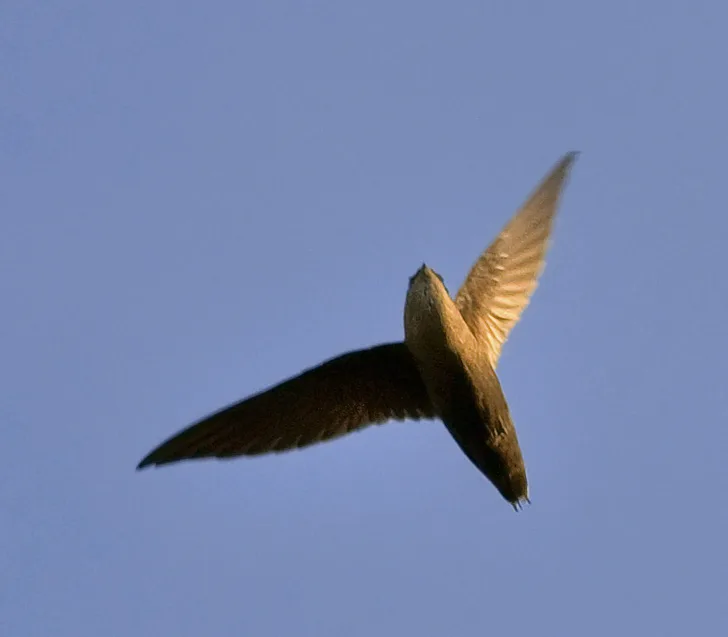
The Chimney Swift: Often described by birders as a "flying cigar" or a "twinkie with wings." It has a blunt, stubby head, a tiny, almost non-existent tail, and long, curved, sickle-shaped wings. It looks completely uniform, dark grayish-brown all over.
The Barn Swallow: Features a sleek, classic silhouette with a deeply forked, elegant tail (the "swallow-tail"). Up close, it is highly colorful—steely metallic blue on top, with a rich, cinnamon-rust underbody and throat.
Clue 2: Flight Style (Frantic Twisting vs. Graceful Gliding)
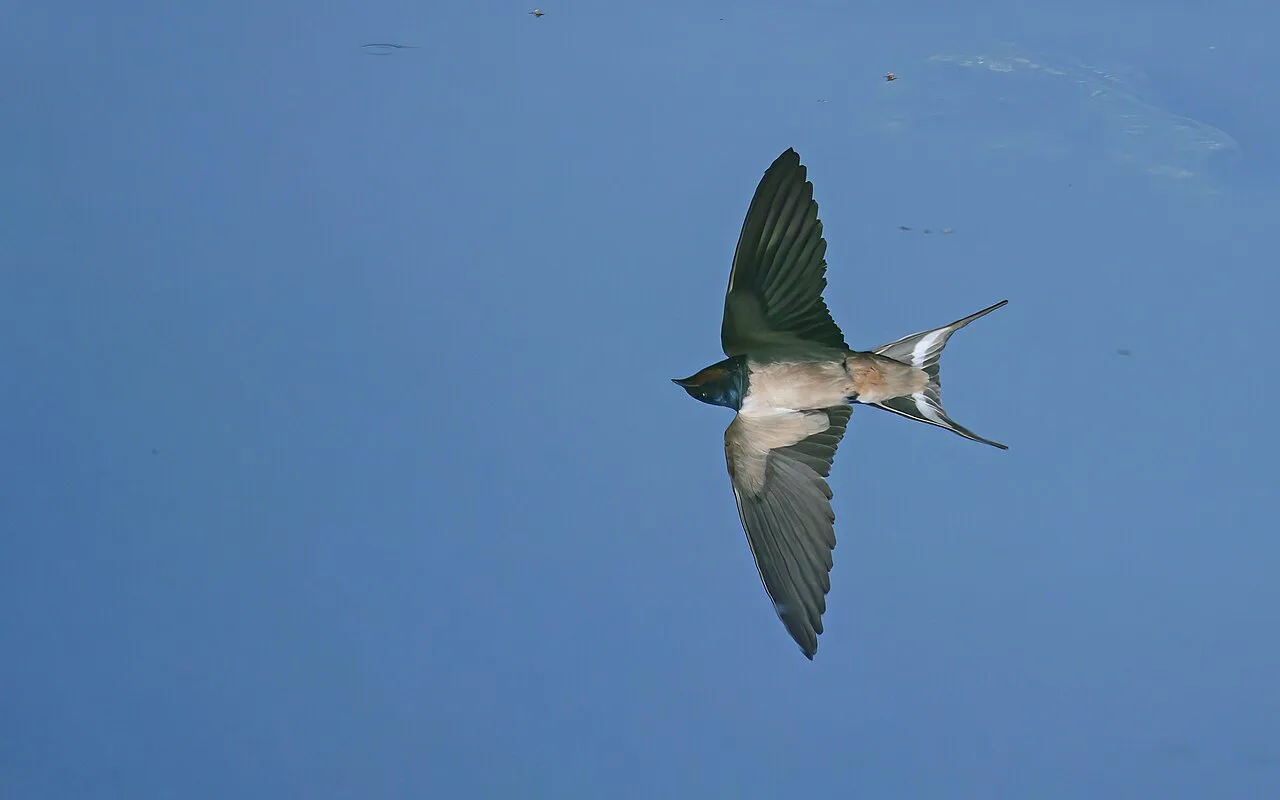
The Chimney Swift: Flies with an incredibly rapid, choppy, mechanical wingbeat. It looks almost erratic, tilting stiffly from side to side like a wind-up toy, rarely gliding for more than a second or two.
The Barn Swallow: The epitome of grace. It utilizes a swooping, roller-coaster flight path, taking long, beautiful glides close to the ground or just inches above water surfaces.
Clue 3: The Sound (Chatter vs. Song)
The Chimney Swift: You will often hear them before you see them. They travel in loose groups and emit a continuous, high-pitched, rapid chattering or ticking sound ($chi-chi-chi-chi-chi$) that sounds almost like a mechanical clicker.
The Barn Swallow: Gives a soft, musical, cheerful liquid twittering song, often interspersed with a sharp, metallic $wit-wit$ call when they are hunting near each other.
The Takeaway for Birders
The next time you enjoy an evening on your patio without being eaten alive by mosquitoes, you can thank these masters of the sky. While the Barn Swallow took the path of elegance, color, and songbird agility, the Chimney Swift took a radical, ancient path of pure, unadulterated speed and specialized vertical living. They may look like twins from below, but they represent two beautifully unique solutions to one of nature's toughest hunting challenges.
