

The arrival of the Summer Tanager (Piranga rubra) across the eastern and southwestern United States is a moment of pure, tropical brilliance in the temperate forest. The adult male, a striking bird of robin-like proportions, is unique among North American species as the only completely red bird—a wash of rosy-red or strawberry-red from head to tail, lacking the black mask or black wings that distinguish the familiar Northern Cardinal or the closely related Scarlet Tanager. The Summer Tanager is an ambassador of the sun, a long-distance migrant whose ecological role as a specialist predator of stinging insects makes it one of the most fascinating and important residents of the U.S. summer canopy.
A Study in Sexual Dimorphism: Plumage and Identification
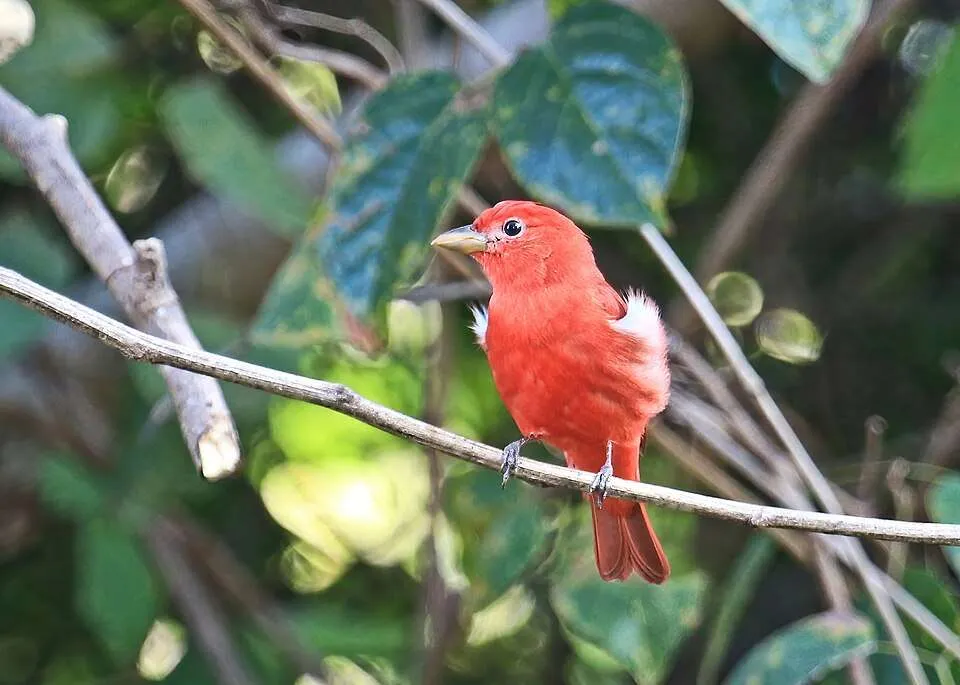
The Summer Tanager exhibits pronounced sexual dimorphism, meaning the male and female look dramatically different, a trait that makes identification both straightforward and tricky, depending on the bird’s age and sex.
The Male: A Rosy Spectacle
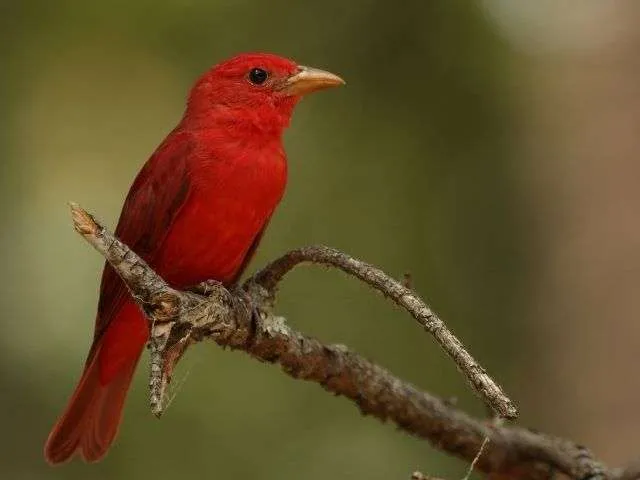
The adult male is instantly identifiable by his uniform rosy red or orange-red plumage. Unlike the Scarlet Tanager male, who boasts jet-black wings and tail, the Summer Tanager is a single, striking color year-round. This pale-red coloration, often likened to strawberry or rose wine, is maintained even during the non-breeding season, distinguishing him from the seasonally greenish male Scarlet Tanager.
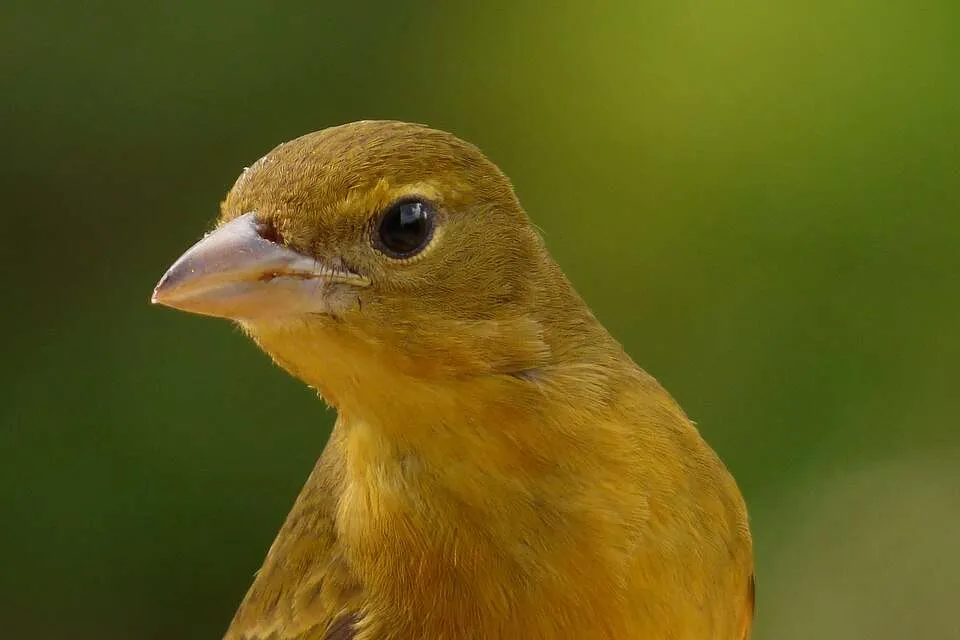
A key identification feature for both sexes is the stout, pale bill (often pinkish or horn-colored), which is noticeably thicker and more blunt-tipped than most other songbirds, perfectly adapted for its unique diet.
The Female and Immature Birds
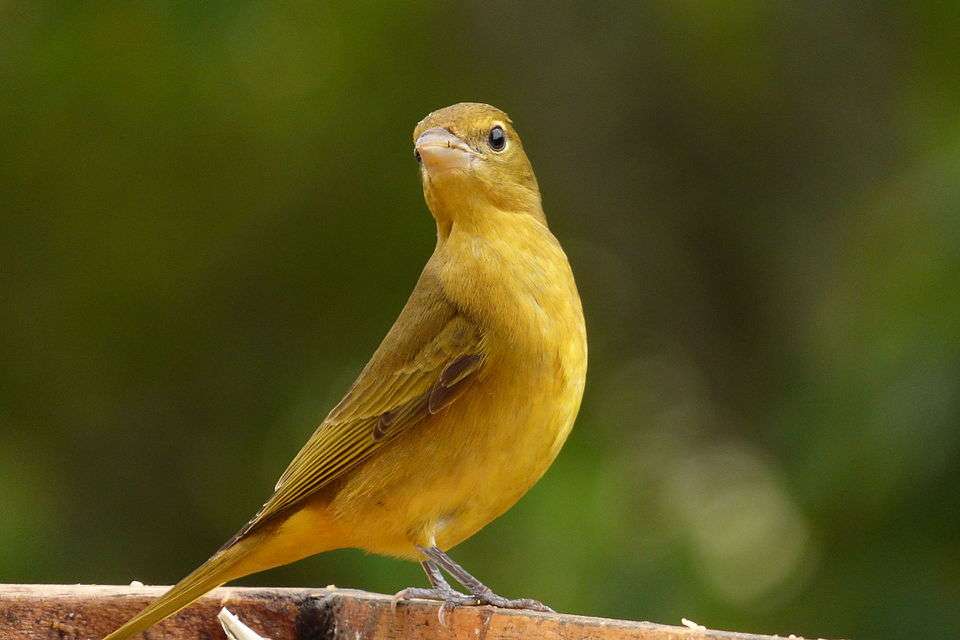
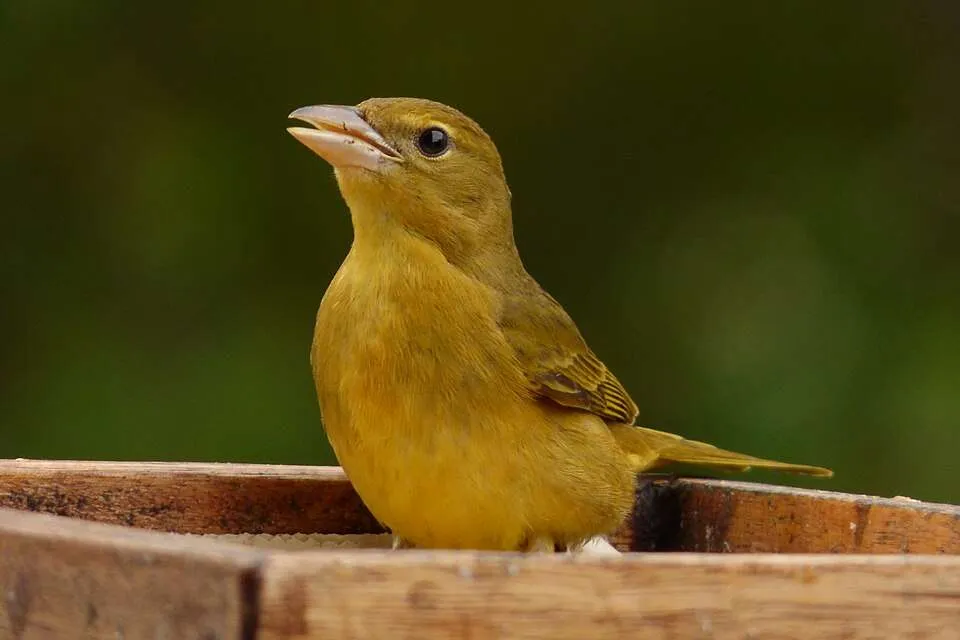
The adult female is clad in a soft, uniform yellow-olive plumage—yellower on the head and underparts and slightly greener on the back and wings. They are yellower and less greenish than the female Scarlet Tanager. Older females may occasionally show patches of red or orange, sometimes becoming heavily splotched.
Immature males are the most confusing, displaying a patchy yellow and red coloration as they molt into their full adult plumage, a process that may take two years. A young male in his first breeding season is often a colorful, two-toned mess, earning him the descriptive nickname "strawberry-banana" tanager.
Voice: The Melodic Whistler
While the brilliant color of the male draws the eye, the bird's vocalizations are equally distinctive. The song is a sweet, musical whistle, often compared to the song of the American Robin, but it is typically slower, clearer, and more uniform in its phrases, possessing a softer quality than its cousins.
More useful for identification is the call note, a sharp, rattling “picky-tuck-tuck” or “pit-i-tuck” that sounds agitated and is a reliable sign of a tanager lurking high in the canopy.
Ecology and Behavior: The Bee-Eating Specialist
The Summer Tanager’s most remarkable trait is its specialized diet and the behavior developed to exploit it.
The Wasp Specialist
While they consume a wide variety of insects, including beetles, cicadas, caterpillars, and grasshoppers, the Summer Tanager is known as the "bee bird" for its unusual preference for bees and wasps. This is an uncommon diet for any raptor, let alone a songbird.
The tanager exhibits an impressive hunting sequence: it sallies forth from a high perch to catch a stinging insect in mid-air. It then returns to the perch and methodically kills the prey by beating it repeatedly against the branch. Most importantly, the tanager is a master surgeon: it removes the stinger by wiping the insect along the perch before consuming it. They will even actively harass wasp nests until the adult wasps abandon the comb, allowing the tanager to feed on the defenseless larvae and pupae. This specialized behavior minimizes its competition with other insectivorous birds and highlights its role as a controller of stinging insect populations in its ecosystem.
Breeding and Nesting
Summer Tanagers are generally serial monogamists, forming a pair bond for one breeding season. They arrive on their U.S. breeding grounds in late April to early May, with males establishing territories quickly.
- Nest Construction: The female constructs the nest almost entirely on her own, a rather flimsy, shallow cup woven from dried grasses, stems, and plant material. This nest is typically placed in a fork on a horizontal branch, often well away from the trunk and overhanging a clearing, road, or creekbed. Nest height is highly variable, ranging from just a few feet to over 70 feet high.
- Incubation and Young: The female lays a clutch of three to four pale blue or green eggs, spotted with brown. Incubation lasts 12 to 13 days, and the male frequently feeds the incubating female. Both parents share the duty of feeding the altricial (helpless at birth) chicks, which fledge in about 10 days, though the parents continue to feed the young for another three weeks as they learn to fly and forage independently.
Migration and U.S. Range
As a long-distance neotropical migrant, the Summer Tanager spans the length of the Americas.
Breeding Habitat
Its U.S. breeding range is extensive, though segmented into distinct eastern and western populations:
- Eastern Population: Breeds across the eastern and central states, from New Jersey and southern Iowa south to the Gulf Coast. They favor open deciduous or mixed oak-pine woodlands, often near forest edges or gaps.
- Western Population: Breeds in the southwestern U.S., notably along the lower Colorado River and in Arizona, where it is found almost exclusively in riparian woodlands of cottonwood and willow at lower elevations, or sometimes in mesquite and saltcedar stands.
The Night Flight South
The Summer Tanager begins its southbound migration early, typically in August and September, migrating almost entirely at night.
- Eastern Route: Eastern and central populations make a perilous, non-stop flight directly across the Gulf of Mexico to reach wintering grounds in Central and South America. They make brief stopovers along the Gulf Coast to rest and gorge on insects and fruit to accumulate the massive fat reserves needed to fuel the thousands-of-miles journey.
- Western Route: Western populations generally follow a less risky overland route through Mexico.
The species winters from central Mexico south through Central America to northern South America, reaching as far as Ecuador and Brazil.
Conservation Status and Future Threats
The Summer Tanager is currently a species of low conservation concern globally, with a large estimated population of over 12 million individuals, and a stable or slightly increasing trend across much of its range according to the North American Breeding Bird Survey. It is not federally listed as threatened or endangered.
However, the bird's future is not without peril, particularly for the western subspecies:
- Loss of Riparian Habitat: The biggest localized threat is the destruction of critical riparian corridors in the arid U.S. Southwest. The clearing of cottonwood and willow forests along rivers for agriculture and development is a direct loss of the bird’s primary western breeding habitat.
- Forest Fragmentation: In both the East and West, the fragmentation of mature forests for logging and development reduces the quality of nesting and foraging areas.
- Migration Hazards: Like all nocturnal songbird migrants, they are vulnerable to collisions with communications towers, wind turbines, and tall buildings along their long migratory routes.
The Summer Tanager, with its fiery plumage and essential role as a controller of stinging insects, is a beautiful reminder that even the most abundant species require continued stewardship of the mature, complex woodlands they call home.
A Resilient Giant: The Unfolding Success Story of the Whooping Crane's Recovery
