

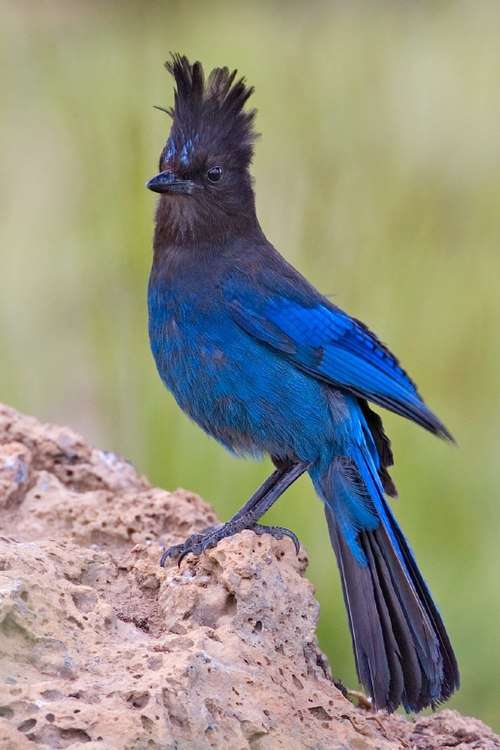
The Steller's Jay (Cyanocitta stelleri) is an unmistakable avian resident of western North America. With its striking combination of deep black and vivid blue plumage, and a prominent, perpetually disgruntled-looking crest, this bird is as bold in appearance as it is in behavior. Named after the German naturalist Georg Wilhelm Steller, who first described the species in 1741, the Steller’s Jay is the western counterpart to the Eastern Blue Jay, but possesses a darker, more intense personality. It is a highly intelligent, adaptable, and often audacious corvid, filling a vital niche in the coniferous and mixed forests from Alaska down through Central America.
Identification: Black Hood and Brilliant Blue
The Steller's Jay is a large songbird, robustly built with a long tail and a heavy bill. Its appearance is defined by a distinct two-toned coloration.
Head and Neck: The front half of the bird—the head, neck, and upper chest—is a dark, sooty black or blue-black. This dark coloration forms a distinct hood that often extends down the back.
Crest: It possesses a prominent, black crest that it can raise or lower depending on its mood or level of alertness. A raised crest often signifies excitement or aggression.
Body and Wings: The rear half of the body, including the wings, lower back, and tail, is a brilliant, dazzling azure or royal blue. The blue wing feathers are often barred with darker black.
Sexual Dimorphism: Unlike many songbirds, the male and female Steller's Jay look identical in plumage.
The species exhibits geographic variation (clinal variation), particularly in the darkness of the hood. Birds in the far north (Alaska and Canada) and at high elevations are typically the darkest, with almost entirely black heads, while those in the south (Mexico and Central America) and at lower elevations show more blue streaking on the forehead.

Range and Habitat: The Mountain Sentinel
The Steller's Jay is found almost exclusively west of the Great Plains, making it the only crested jay in the region.
North American Range: It extends from the southern coast of Alaska and British Columbia, down through the western United States, including the Rocky Mountains, Cascades, and Sierra Nevada, and south into Mexico and Central America.
Habitat Preference: The jay is strongly associated with coniferous forests, including Douglas-fir, pine, spruce, and fir, but it is also comfortable in mixed forests and oak woodlands.
Adaptation to Humans: Critically, the Steller's Jay has adapted seamlessly to human development. It is a common resident in mountain parks, campgrounds, suburban areas with mature trees, and even urban parks, readily exploiting food resources provided by people.
The species is mostly non-migratory but will move vertically—traveling to lower elevations during harsh winter weather—or locally in search of better food sources.
Intelligence and Behavior: The Corvid Commandos
As a member of the Corvidae family (which includes crows, ravens, and magpies), the Steller's Jay is highly intelligent, a trait that contributes directly to its survival and opportunistic behavior.

Auditory Mimicry
One of its most famous behaviors is its skill as a vocal mimic. Steller's Jays are capable of producing a wide array of sounds, including:
Raptor Calls: They frequently imitate the screeching call of the Red-tailed Hawk or the karr of the Cooper's Hawk. This is often used to scare other birds away from a food source, allowing the jay to claim the bounty for itself—a clever form of deception.
Other Birds: They also mimic the calls of other birds, domestic animals, and even various mechanical sounds.
Natural Calls: Their own natural calls are loud, harsh, and varied, including a nasal, descending "shook-shook-shook" and a series of loud, ringing shack! calls often associated with scolding or alarm.
Caching and Problem Solving
Like all corvids, Steller's Jays are exceptional cachers. They collect and hide large quantities of food, particularly acorns, pine nuts, and seeds, burying them to retrieve later during lean times. This behavior makes them vital agents of forest regeneration, as many forgotten caches sprout new trees. They show evidence of complex memory and spatial awareness to relocate these hidden treasures.
Diet: The Ultimate Opportunist
The Steller's Jay’s diet is a reflection of its highly opportunistic nature—it will eat almost anything it can find.
Primary Diet: The core of its diet consists of nuts, seeds, fruits, and berries. Acorns and pine nuts are crucial food sources in many parts of its range.
Animal Protein: They are fierce predators, actively consuming insects, spiders, eggs, and nestlings of other, smaller songbirds.
Scavenging: In developed areas, the jay is a notorious scavenger. It raids picnic tables, campsites, and garbage cans, exhibiting little fear of people when food is involved. Its boldness in confronting rivals or predators makes it a formidable presence at bird feeders, where it often monopolizes the resources.
Nesting and Social Life
Steller's Jays typically form long-term monogamous pair bonds and are known for their secretive nature during the nesting season.
Nest: The nest is a bulky, open cup built in a conifer tree, usually high up in a fork near the trunk. It is constructed from twigs, leaves, and mud, and often reinforced with moss, pine needles, and even strips of paper or plastic collected from human sites.
Brood Parasitism: They are not subject to brood parasitism by Brown-headed Cowbirds, possibly because their large size and aggression deter the smaller cowbirds from laying eggs in their nests.
Social Structure: Outside of the breeding season, Steller’s Jays live in loose family groups or small flocks. Their loud alarms and scolding calls often act as sentinels for the entire forest, alerting other wildlife to the presence of predators like hawks or owls.
Conservation Status
The Steller's Jay is currently listed as a species of Least Concern by the IUCN. Its population is widespread, large, and stable, if not increasing, particularly where human development provides reliable food sources and mature trees for nesting. Its intelligence and adaptability have ensured its survival across a vast and varied portion of the continent.
The Steller's Jay is more than just a beautiful bird; it is a smart, noisy, and assertive character—the definitive, blue-crested ruler of the western woodlands.
