
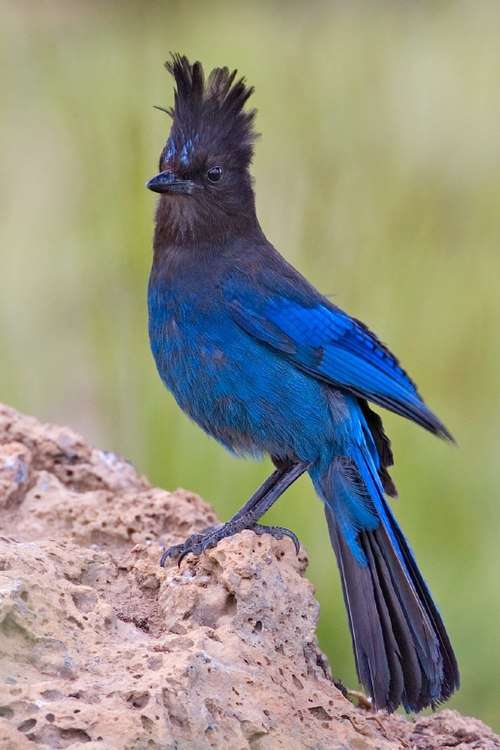
This year, birdwatchers and residents across Arizona’s central region, particularly in the scenic Verde Valley encompassing towns like Sedona, Cottonwood, and Camp Verde, witnessed a spectacular and unusual natural phenomenon: a massive irruption of Steller’s Jays (Cyanocitta stelleri). These crested, blue-and-black corvids, typically found at higher elevations in the Ponderosa pine and mixed-conifer forests, descended upon the lower-elevation, riparian, and even semi-desert habitats of the valley floor in numbers not seen in many years.
The influx, which began in late Fall and peaked during the winter months, transformed local backyards, feeders, and parks, giving observers an unprecedented opportunity to study the behavior and population dynamics of this usually mountain-bound species.
Understanding the Irruption Phenomenon
An "irruption" is a dramatic, irregular movement of large numbers of birds far outside their normal range or, in this case, significantly below their usual elevation. It is not a true migration but rather a nomadic flight driven by environmental factors. For seed-caching species like the Steller’s Jay, the primary cause is almost always food scarcity—specifically, the failure of crucial mast crops, such as acorns and pinyon pine seeds, in their high-elevation breeding habitats.
Reports from the Mogollon Rim and the surrounding high-country forests indicated a notably poor harvest of these essential winter food sources in the previous season. As the jays’ cached food supplies dwindled and temperatures dropped, thousands were forced to move downhill into the more moderate, food-rich environments of the Verde Valley.

A Blue Presence in the Lower Elevations
The sheer numbers of Steller’s Jays observed in the Verde Valley this year were exceptional. Birders reported seeing flocks of a dozen or more where only one or two might be present in a typical year.
Feeder Frenzy: Backyard bird feeders became central hubs for the irrupting jays, who quickly asserted their dominance over smaller songbirds. Observers noted an extremely high demand for sunflower seeds and, particularly, peanuts, which the jays are famous for quickly snatching and caching.
Habitat Shift: The birds were documented in riparian areas along the Verde River, in urban parks dominated by mesquite and cottonwood, and even scavenging in suburban yards far from their usual pine-oak woodlands. This highlighted the species’ adaptability and its opportunistic foraging strategy when survival demands it.
Behavioral Observations: The jays displayed heightened levels of their characteristic "wah-wah-wah" calls and aggressive mobbing behavior, often coordinating to harass predators or rivals. Their aggressive nature, which is a hallmark of the Corvidae family, was on full display as they competed fiercely for limited resources, both natural and provided by humans.
Irruption’s Impact on the Local Ecosystem

While a thrilling sight for bird enthusiasts, the Steller’s Jay irruption presents both opportunities and challenges for the local ecology:
Seed Dispersal: The thousands of seeds and nuts cached by the jays in the lower-elevation zones will result in some incidental planting, potentially facilitating the slow, natural movement of coniferous trees into new areas, though most will be recovered and eaten.
Increased Competition: The massive influx increased competition for food with resident corvids, such as Mexican Jays and Woodhouse's Scrub-Jays, and potentially increased predation pressure on the eggs and nestlings of smaller, early-breeding birds, as jays are known nest predators.
As the weather moderates in the coming spring and summer, the vast majority of these irrupting Steller’s Jays will slowly filter back up to their higher-elevation breeding grounds. The great irruption of 2025 will be remembered as a classic example of an ecological event driven by climate and food scarcity, turning the Verde Valley into a temporary, noisy, and unforgettable sea of blue and black.
The Cardinal of Summer: Profiling the Fire-Red Summer Tanager
