

The Steller's Eider (Polysticta stelleri) is not merely a bird; it is a stunning piece of the Arctic ecosystem, a small but spectacular sea duck whose existence is intrinsically linked to the icy, shallow waters and vast, marshy tundra of the far north. As the smallest of the four eider species, this duck, named for German naturalist Georg Wilhelm Steller, possesses a unique beauty and a secretive lifestyle that has made its study and conservation both fascinating and challenging.
A bird of contrasts, the Steller's Eider exhibits one of the most vibrant plumages in the duck family, only to shed it for a more cryptic camouflage outside of the breeding season. Its population, though spread across two continents, faces serious and complex threats, making it a priority species for Arctic conservationists.
A Masterpiece in Plumage: Identification
The Steller's Eider is easily distinguished from its larger relatives—the Common, King, and Spectacled Eiders—not only by its smaller size (about 18 inches long) but also by its unique color palette, particularly in the male (drake).
The Male (Drake)

In breeding plumage, the male Steller's Eider is an unforgettable sight:
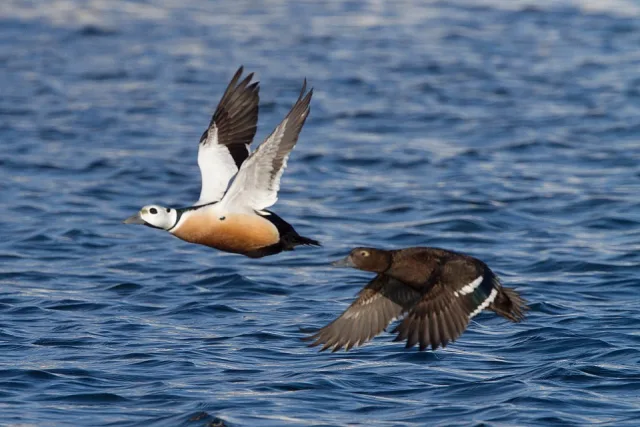
Head and Neck: The head is primarily white with a distinctive, angular flat crown. A bold black ring encircles the neck, connecting to the black back. The most striking features are the black eye-patch and a wash of sea-green feathers on the back of the head and nape.
Body: The breast and sides are a rich, warm orange-buff or chestnut, leading to a black tail and vent. A unique black spot on the flank, sometimes referred to as a "burn," gives it a distinct look.
Wings: In flight or display, the wings show a prominent, glossy cobalt-blue speculum (wing panel) bordered by thick white streaks, a feature more characteristic of a dabbling duck than a typical sea duck.
The Female (Hen)
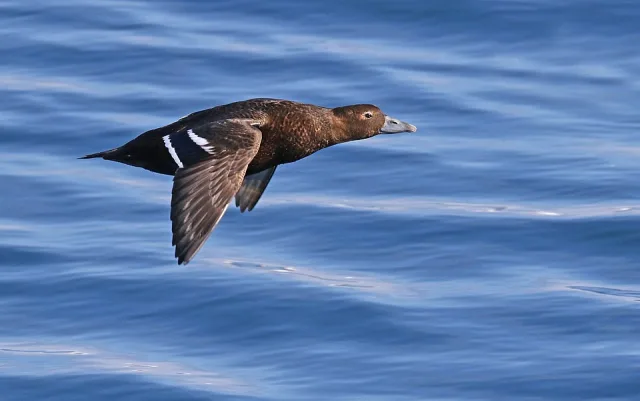
The female is much more reserved, sporting a uniform, dark cinnamon-brown plumage with cryptic black barring and mottling. She shares the flat-crowned, angular head shape of the male, and can be distinguished from other female eiders by the small size and a distinct light eye-ring. Like the male, she displays a blue speculum with white borders on the wings when in flight.
Structurally, the Steller's Eider is more agile and less bulky than other eiders, moving gracefully on the water and flying in tight, highly coordinated flocks.
Arctic Life Cycle: Habitat and Distribution
The Steller's Eider has a highly specialized life cycle centered on the Arctic and Subarctic regions, defined by two major populations: the Russian-Atlantic population and the Russian-Pacific/Alaskan population.
Breeding Grounds
The vast majority of the global population nests in Arctic Siberia. A much smaller, highly restricted population breeds on the Arctic Coastal Plain of Alaska, with a historical presence on the Yukon-Kuskokwim Delta.
Habitat: On the breeding grounds, they prefer the marshy, low-lying tundra wetlands characterized by interconnected ponds, grasses, and sedges. The female builds a shallow, down-lined nest on a dry ridge or hummock near the water.
Reproduction: The female incubates a clutch of 5–10 eggs alone, with the male departing relatively early in the incubation period to head for molting grounds. The ducklings are precocial—able to walk, swim, and feed themselves shortly after hatching.

Molting and Wintering
The Steller's Eider is highly congregatory during the non-breeding season, often gathering in massive, dense flocks for an intense molt migration.
Molting: After breeding, both sexes gather in highly specific, shallow coastal lagoons, most notably Izembek Lagoon on the Alaska Peninsula, to undergo a synchronous molt of their flight feathers, rendering them flightless for several weeks.
Wintering: They spend the winter primarily in the shallow, coastal waters of the Aleutian Islands, the Alaska Peninsula, and the southern Bering Sea. The Russian-Atlantic population winters in the Barents and Baltic Seas.
Diet: The diet shifts drastically between seasons. On the freshwater breeding grounds, they feed heavily on aquatic insect larvae (midges, caddisflies) and some plant material. In the marine wintering grounds, they forage by diving and dabbling in shallow water, consuming a wide variety of marine invertebrates, especially mollusks, small crustaceans, and marine worms, often associated with eelgrass beds.
A Vulnerable Species: Conservation Challenges
Globally, the Steller's Eider is classified as Vulnerable by the IUCN, but the small Alaska-breeding population is listed as Threatened under the U.S. Endangered Species Act, having experienced a severe contraction of its range and population numbers since the 1970s. While the Russian-Pacific population is much larger, the species as a whole faces compounding threats.
The Mystery of the Decline
The exact cause for the drastic decline of the Alaska breeding population remains unclear and is likely a combination of factors:
Climate Change: The rapid warming of the Arctic poses one of the greatest long-term threats. Changes to the tundra, including the disappearance of small ponds critical for breeding, and shifts in marine conditions that affect their invertebrate prey are serious concerns.
Increased Predation: The decline of native rodent populations, such as lemmings, can force predators like the Arctic fox, ravens, and jaegers to switch their primary prey to the eggs and young of nesting sea ducks like the Steller's Eider.
Oil and Contaminants: Because the eiders concentrate in massive, dense flocks in a very few, highly specific molting and wintering areas (like Izembek Lagoon), a single large oil spill or a localized contamination event could have a catastrophic impact on a significant portion of the entire global population.
Lead Poisoning: Historically, the ingestion of spent lead shot in foraging areas was a significant source of mortality. While lead shot is now banned for waterfowl hunting in many areas, the legacy of its presence in the sediment continues to pose a threat.
Subsistence Harvest: While harvest is closed in the U.S., it is a factor in Russia, and incidental shooting still occurs, which can be significant for a small, threatened population.
The Steller's Eider, a bird whose very being is shaped by the extremes of the high north, serves as a poignant indicator of the health of the Arctic. Its conservation requires international cooperation and intensive research to unlock the secrets of its decline and protect the unique lagoons and tundra wetlands that sustain this magnificent, jewel-toned duck.
