
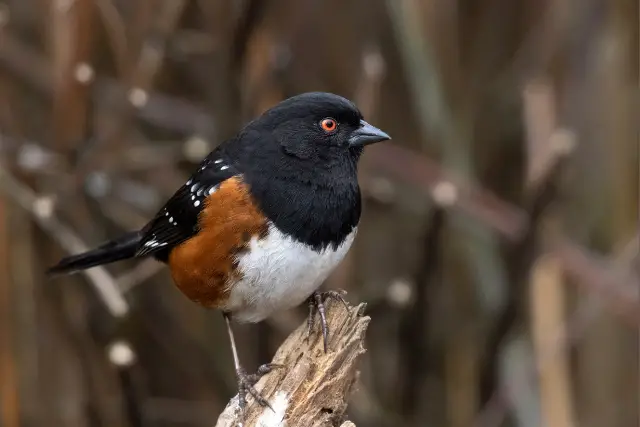
The Spotted Towhee (Pipilo maculatus) is a robust and energetic songbird characteristic of the dense underbrush and thickets of western North America. Renowned for its bold, striking plumage and its distinctive, noisy foraging style, this sparrow-like bird is a constant and charismatic presence in chaparral, scrublands, and suburban hedges alike. Formerly considered a subspecies of the Eastern Towhee, the Spotted Towhee was split into its own species based on differences in appearance, song, and genetics, cementing its unique identity as the quintessential ground-dweller of the American West.
Identification: A Dapper, Bold Pattern
The Spotted Towhee is one of the largest and most colorful sparrows, making it relatively easy to identify.
Size and Shape: It has a large, chunky body, a long, rounded tail, and a stout, conical bill perfectly adapted for crushing seeds.
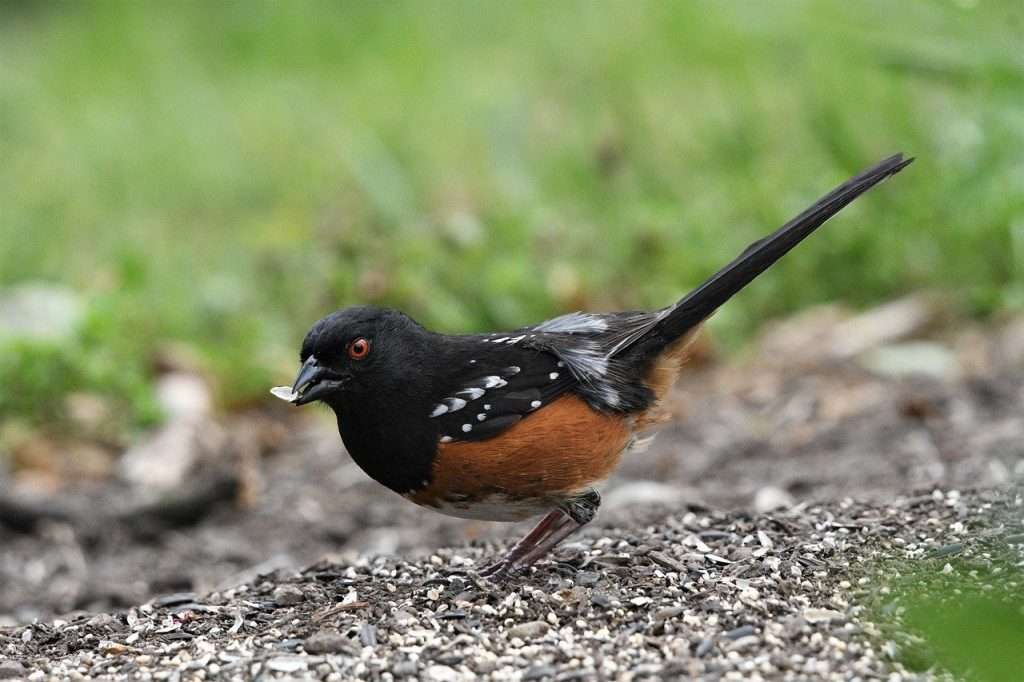
Plumage (Male): The male is instantly recognizable by its sharp contrast of colors:
Head and Back: A striking solid black hood (head, throat, and upper breast).
Underparts: A clean, contrasting white belly.
Sides: Bright rusty-red or rufous flanks (sides).
Spots: Unlike the uniform Eastern Towhee, the Spotted Towhee has prominent white spots on its wings and back, giving the species its name.
Plumage (Female): Females share the same pattern but have a dark gray or brownish-gray hood instead of black, providing better camouflage while nesting.
Eyes: All forms have a noticeable, bright red iris.
Voice and Behavior: The Scratcher
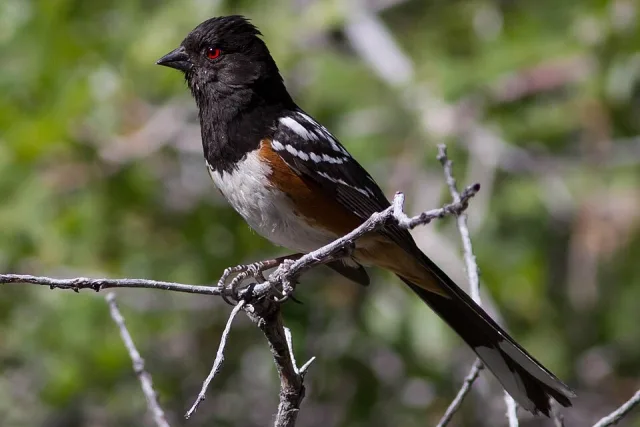
The Spotted Towhee’s presence is often revealed by its actions and voice before it is actually seen.
Foraging: The "Double-Scratch"
Its most famous behavioral trait is its unique foraging method, often referred to as the "double-scratch." The towhee lands on the leaf litter and kicks backward simultaneously with both feet, scattering the debris and exposing insects, larvae, and seeds underneath. This vigorous, noisy action produces a distinctive scratch, scratch, scratch sound that is a signature acoustic cue of its preferred habitat.
Song and Calls
The song is a musical, accelerating trill, often described as "che-weep, che-weep, che-weep... trill." The quality and complexity vary regionally.
Its most common call is a sharp, often metallic "chewink!" or "tow-hee!" (where its common name originates) and a high, sharp "dink!" alarm call. Males often sing from exposed perches atop a bush or low tree limb to defend their territory, but they spend most of their time feeding on the ground.
Range and Habitat: The Western Scrub Specialist
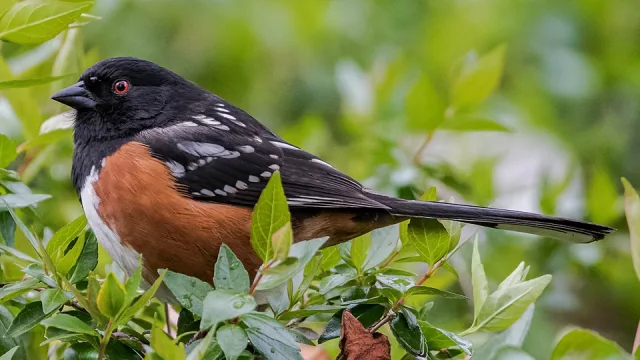
The Spotted Towhee is a permanent resident throughout much of its range, generally avoiding long-distance migration.
Geographic Range: It dominates the western half of North America, ranging from British Columbia south to central Mexico and extending eastward into the Great Plains.
Habitat Preference: The species is a champion of dense, low cover. It thrives in habitats characterized by thick, shrubby vegetation, which provides both protection from predators and an abundance of food on the forest floor.
Key Habitats: Chaparral, dense scrub, sagebrush thickets, tangled riparian corridors (along rivers), canyon bottoms, and brushy suburbs.
Subspecies and Geographic Variation
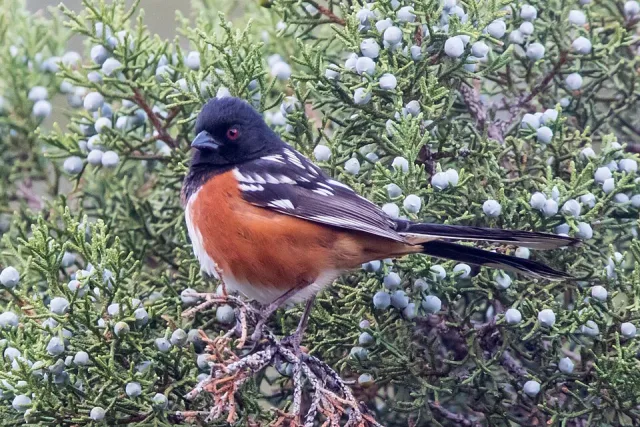
The Spotted Towhee species complex includes many distinct subspecies across its wide range, reflecting environmental pressures and geographic isolation. These subspecies primarily show differences in the depth of the red on the flanks and the intensity of the white spotting.
Coastal Forms: Tend to be darker overall, which may help them absorb more solar radiation in the cooler, moister climate of the Pacific Coast.
Inland/Desert Forms: Tend to be paler and often smaller, adapting to warmer, drier environments.
These variations underscore the species' successful adaptation to diverse ecological niches across the western landscape.
Nesting and Reproductive Success
Spotted Towhees are ground nesters, which makes them vulnerable but also allows them to maintain a close relationship with their food source.
Nest Location: Nests are typically built in a small depression on the ground, often concealed at the base of a dense shrub or grass clump, or sometimes built low in a bush just a few feet off the ground.
Materials: The nest is a bulky, open cup constructed of bark strips, leaves, twigs, and lined with finer materials like rootlets and hair.
Brood Parasitism: Like many ground-nesting birds, the Spotted Towhee is highly susceptible to brood parasitism by the Brown-headed Cowbird (Molothrus ater). Cowbirds lay their eggs in the towhee's nest, and the larger cowbird chick often outcompetes the smaller towhee young for food, lowering the reproductive success of the towhee.
Conservation Status
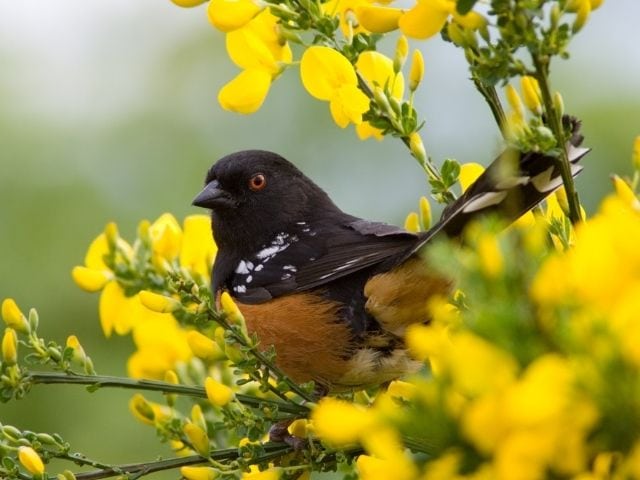
The Spotted Towhee is currently listed as a species of Least Concern by the IUCN, owing to its vast range and large, stable population. Its adaptability allows it to thrive even in fragmented habitats, such as brushy edges and parks within suburban sprawl.
However, local populations face threats from:
Habitat Loss: The destruction of chaparral and scrubland for development, which removes their dense, necessary cover.
Invasive Species: The presence of domestic and feral cats, which are highly effective predators of ground-nesting birds and the juvenile towhees that forage close to the ground.
As a hardy, persistent, and visually striking bird, the Spotted Towhee remains a familiar and beloved fixture—a hidden gem whose scratchy foraging noise is the constant, reliable soundtrack to the scrublands of the American West.
