

The term "eyes like a hawk" is more than just a common cliché; it's a profound statement of biological supremacy. Hawks, along with eagles and falcons, belong to the order Accipitriformes (diurnal raptors), a group that possesses the most sophisticated visual systems in the animal kingdom. For these aerial hunters, sight is the difference between a successful meal and starvation. They are equipped with a suite of physical and cellular adaptations that grant them a level of visual acuity far exceeding that of humans—a true sixth sense finely tuned for hunting the vast landscapes of the United States.
This article investigates the science of raptor vision, exploring the specific mechanisms that allow U.S. species like the Red-tailed Hawk, Cooper's Hawk, and Northern Harrier to spot a scurrying rodent from thousands of feet in the air or navigate the complex geometry of a dense forest chase.
The Hardware: Anatomy Built for Vision
A hawk's eyes are proportionally massive, often taking up more space in the skull than its brain. This anatomical commitment to sight is the foundation of their prowess.
1. Proportional Size and Shape
While human eyes are roughly spherical, a hawk's eyes are flattened or tube-shaped. This geometry increases the distance between the lens and the retina, allowing for a larger image to be focused onto the light-sensitive surface, much like a telephoto lens on a camera.
2. The Foveae: Dual Focal Points
Humans have one small, centralized area on the retina called the fovea, which is responsible for sharp, detailed vision. Hawks, however, possess two foveae in each eye, granting them a unique advantage:
- Central Fovea: Used for focusing on objects directly ahead and for accurate depth perception and tracking. It is crucial during the final moments of a dive or strike.
- Temporal Fovea: Positioned to view the side of the visual field. This fovea is specialized for monocular vision (using one eye) and allows the hawk to maintain a sharp image of the horizon or a sweeping view of the landscape while soaring, helping it locate prey far below.
3. Pecten Oculi: Nourishment without Blind Spots
Raptors have a unique, comb-like structure called the Pecten Oculi located within the eye. In mammals, the blood vessels that nourish the retina create blind spots. The Pecten Oculi is a folded, fan-shaped structure rich in capillaries that nourishes the retina without the need for an extensive network of surface blood vessels, thus eliminating blind spots and maintaining continuous, clear vision.
The Software: Cellular and Chemical Superiority
The raw hardware of the hawk's eye is complemented by cellular features that dramatically boost resolution and color perception.
1. Density of Photoreceptors
The sharpness of an image is determined by the density of photoreceptor cells (rods and cones) in the retina. Humans have about 200,000 photoreceptors per square millimeter.
- Hawks and eagles can possess up to a million photoreceptors per square millimeter in their fovea.
- This extreme density is why a hawk's visual acuity is estimated to be 4 to 8 times better than a human's. If a human can read a sign at 100 feet, a hawk could theoretically read the same sign at 400 to 800 feet.
2. Seeing in UV Light
Hawks possess four types of cone cells, compared to the three types found in humans (red, green, blue). This extra cone allows them to perceive light in the ultraviolet (UV) spectrum.
- The Vole Trail Advantage: Many small rodents, like voles and mice, mark their trails with urine and feces, which reflect UV light. A soaring hawk sees these UV markings as bright lines against the dull background, allowing them to track the movements of hidden prey. A rodent hiding in thick grass is virtually invisible to human eyes, but the hawk can see the luminous trail leading right to it.
3. Color Filters (Oil Droplets)
The cone cells of hawks contain tiny, colored oil droplets—red, yellow, or orange. These droplets act like biological filters:
- They reduce glare from the sky and water, improving contrast and reducing haze.
- They effectively sharpen the image by ensuring only highly focused light hits the photoreceptors. This is akin to wearing specialized high-contrast sunglasses designed solely to cut through atmospheric distortion.
Sight in Action: U.S. Hawk Examples
The diverse visual needs of North America's hawks have led to different specializations in their already incredible sight.
1. The Red-Tailed Hawk (Buteo jamaicensis): The High-Altitude Surveyor

The Red-tailed Hawk is the most common soaring raptor in the U.S. It relies on its incredible distance vision to survey large, open territories.
- The Power of Magnification: Using its large, flat eyes, a Red-tail can effectively spot a mouse moving in the grass from a soaring altitude of 1,000 to 1,500 feet (300 to 450 meters). To a human, a mouse from that height would be entirely imperceptible; to the hawk, it's a visible, moving target.
- Binocular Overlap: While soaring, it uses its temporal foveae for wide-angle scanning, but once prey is spotted, it pivots the head to bring the target into the deep focus of its central foveae, initiating the dive.
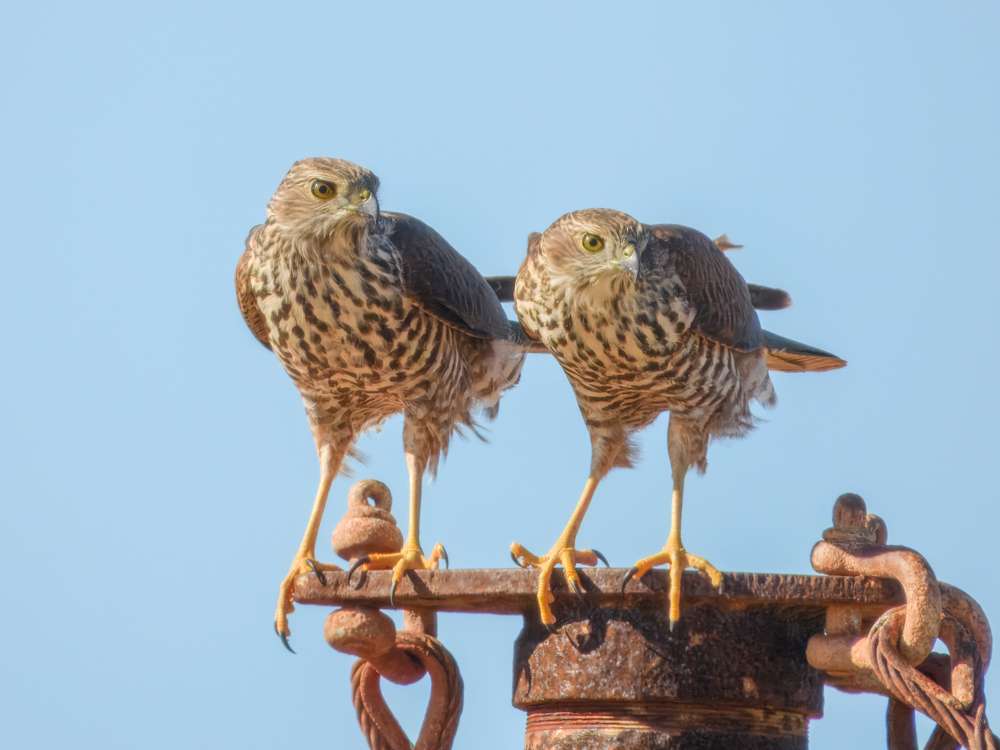
2. Cooper's Hawk (Accipiter cooperii): The Forest Pursuit Specialist

Cooper's Hawks are "accipiters"—shorter, broad-winged hawks built for explosive speed and maneuvering within wooded areas. Their vision is optimized for high-speed, close-quarters accuracy.
- High-Speed Focus: A Cooper's Hawk often pursues songbirds through dense trees at high speed. Its ability to maintain a sharp, focused image of its target while rapidly navigating obstacles relies on an extremely high flicker fusion frequency (the speed at which a continuous image blurs into individual frames). They process visual information much faster than humans, preventing the fast-moving world from becoming a blur.
- Depth Perception: Its tightly focused central fovea is critical for the precise timing and angle needed to snatch a bird out of the air or off a branch without colliding with the dense forest structure.
3. Northern Harrier (Circus hudsonius): The Sensory Synthesis

The Northern Harrier is unique among hawks because it hunts low over marshlands and fields, blending sight with sound.
- Visual vs. Auditory: While highly visual, the Harrier has a partial facial ruff (like an owl) that helps funnel sound to its ears. This is a crucial adaptation because its prey (voles, shrews, small birds) are often hidden beneath dense vegetation.
- The Low Glide: It uses its dual foveae and high visual acuity for scanning at close range, but it often complements its sight by hearing the slightest rustle of movement, demonstrating that even for the visually dominant raptors, other senses play a supporting role.
Conclusion: A Different Way of Seeing
The visual system of the hawk is a biological masterpiece—a high-resolution, wide-angle, telephoto lens capable of seeing in wavelengths invisible to us. From the sheer distance sight of the Red-tail surveying the vast plains to the high-speed processing of the Cooper's Hawk navigating a woodland thicket, North American hawks embody the pinnacle of visual evolution. Their abilities remind us that the world we perceive with our eyes is only a fraction of the reality experienced by these ultimate aerial hunters.
