

The bird bill, or beak, is arguably nature’s most elegant piece of biological engineering. Far more than a simple mouth, the bill is a multifunctional tool—a marvel of evolutionary adaptation that dictates a bird’s diet, foraging behavior, and even aspects of its social life. The dazzling array of bill shapes and sizes seen across the more than 10,000 species of birds is a testament to the power of natural selection, each form meticulously honed to exploit a specific ecological niche.
The science of bill morphology is a study in form and function. Composed of bone covered by a sheath of keratin (the same material as human fingernails), the bill is lightweight yet incredibly strong, capable of everything from delicately grooming a feather to crushing a hard nut. Understanding the structure of a bird’s bill is often the key to unlocking the mysteries of its existence.
The Power of the Probe: Hummingbirds and Nectar Specialists
The specialized bill of the Hummingbird is a classic example of co-evolution, demonstrating an intimate link between a bird and its primary food source: flower nectar.

The bill of a typical hummingbird, such as the Ruby-throated Hummingbird (Archilochus colubris), is a long, slender probe perfectly sized to reach the nectaries deep within tubular flowers. This bill acts as a sheath for the hummingbird's tongue, which is the true feeding instrument. The tongue is not a simple straw; rather, it is divided at the tip into two grooves fringed with tiny, hair-like extensions called lamellae. When the hummingbird inserts its tongue into the nectar, these lamellae open out like capillary wicks, trapping the liquid. As the bird retracts its tongue, the lamellae curl inward, capturing the nectar and drawing it rapidly back into the mouth.

Furthermore, some hummingbirds, like the Sword-billed Hummingbird (Ensifera ensifera) of the Andes, have bills that are nearly as long as the rest of their body. This extreme adaptation allows it to feed on a few specific flowers with exceptionally long corollas (e.g., Passiflora mixta), demonstrating a level of specialization that makes the bird entirely dependent on that floral niche.
The Fine-Tuned Filter: The Spoonbill
At the opposite end of the spectrum from the precision probe is the Roseate Spoonbill (Platalea ajaja), whose bill is designed for non-visual, tactile filtering in shallow, muddy water.

The spoonbill’s bill is unmistakable: it is long, spatulate, and distinctly flattened at the tip into a paddle or "spoon." The key functional elements are the highly sensitive nerve endings and mechanoreceptors concentrated around the bill tip.
When feeding, the spoonbill sweeps its open bill back and forth just below the surface of the water or mud. It does not need to see its prey. When the sensitive tip makes contact with small aquatic invertebrates, fish, or crustaceans, the bill snaps shut instantly and automatically, filtering the prey out of the water. This broad, flattened shape maximizes the surface area swept per unit of time, making the spoonbill an incredibly efficient, specialized filter feeder in turbid, estuarine environments.
The Master Plunderer: The Crossbill
The Crossbill (Loxia species) offers a textbook example of a bill designed for a single, highly challenging food source: conifer cones.
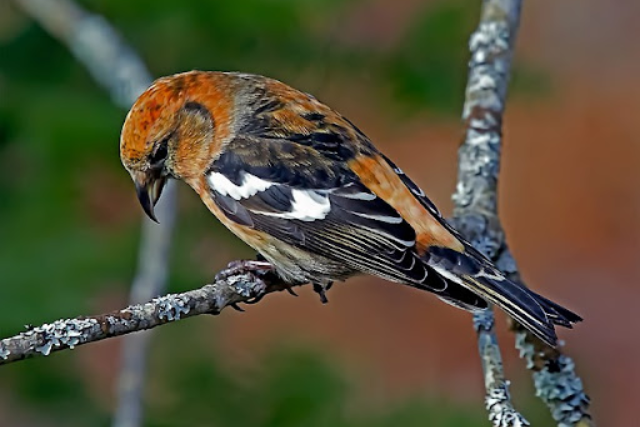
Unlike seed-eating birds with blunt, crushing bills (like finches), the crossbill's mandibles are uniquely crossed at the tip. This bizarre morphology is an adaptation for prying open the scales of hard, closed cones. The bird uses its strong neck muscles to insert the tip of its bill between two scales, then leverages the crossed tips to force the scales apart. Once the scale is bent back, the bird can easily access and remove the seed with its tongue.
The degree of curvature and size of the bill varies across the different crossbill species (e.g., Red Crossbill vs. White-winged Crossbill), with each bill type being optimized for the cones of a particular tree species (e.g., spruce, hemlock, or pine). This variation is so specific that many types of Red Crossbills are now recognized as distinct call types, which may soon be formally split into separate species.
The Oceanic Hook: The Albatross
The bill of the Albatross (Diomedeidae family), such as the Wandering Albatross (Diomedea exulans), is a massive, formidable structure perfectly adapted for a pelagic life of scavenging and long-distance flight.

The bill is large, stout, and ends in a powerful hook (the unguicorn). This hook is essential for grasping slippery prey like squid and fish from the ocean surface and for tearing apart carcasses. The albatross bill is also notable for the presence of external, tubular nostrils positioned on the sides of the upper mandible. These tubes serve two vital functions:
They allow the albatross to excrete excess salt ingested from seawater, an essential adaptation for marine birds.
They enhance the bird's sense of smell, helping it locate prey and potential feeding opportunities over vast distances at sea—a sensory ability rare in birds.
Other Marvels of Bill Adaptation
The examples above are just a few in a continuum of specialized forms:
| Bird Example | Bill Morphology | Primary Function |
| Flamingos | Upside-down, filter plate-lined | Fine-tuned filtering of algae/diatoms |
| Pelicans | Large, distensible pouch (gular sac) | Scooping large volumes of water and fish |
| Woodpeckers | Chisel-like, straight, heavy | Drilling into wood to access insects |
| Hawks/Eagles | Sharply hooked, powerful | Tearing meat and separating muscle/bone |
| Seed-eating Finches | Short, thick, conical | Crushing hard seeds with immense force |
The Evolutionary Lesson
The driving principle behind the incredible diversity of bird bills is competitive exclusion. Where many species share a limited resource (like food), natural selection favors those individuals with bills slightly better suited to exploit a specific, smaller portion of that resource. Over millions of years, this pressure leads to the divergence of bill shapes, allowing multiple species to coexist in the same environment by having slightly different diets—a concept known as niche partitioning.
The bird bill is a constant reminder that form follows function in the natural world. It is the ultimate tool for survival, demonstrating how the modification of just one anatomical feature can unlock an entirely new way of life, turning a generalist ancestor into a highly specialized master of its domain.
