
The sight of birds flying together—whether it's the precise, arrow-straight V-formation of migratory geese or the mesmerizing, shape-shifting swarm of a starling murmuration—is one of nature's most sophisticated collective behaviors. It appears effortless, synchronized, and almost magical. Yet, beneath the grace lies a complex interplay of physics, geometry, and simple biological rules that allows hundreds or even thousands of individuals to move as a single, fluid superorganism. The science of flocking—or collective animal motion—is a rich field that reveals how birds leverage aerodynamic forces and rapid-fire visual communication to enhance their survival, conserve energy, and navigate the skies.
The Aerodynamic Efficiency of the V-Formation
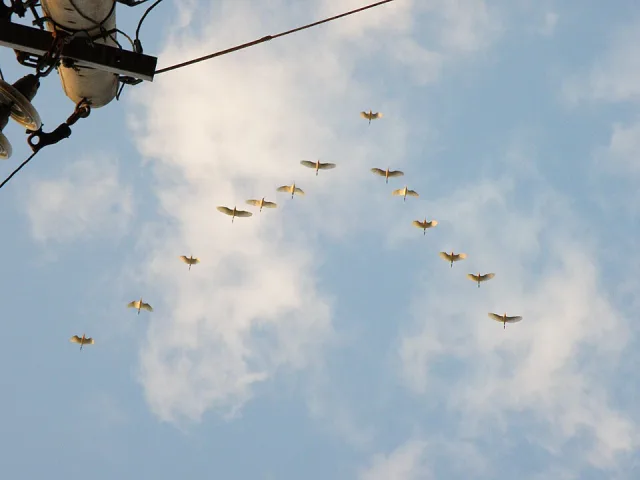
The iconic V-formation, common among large migratory birds like geese, swans, and pelicans, is the most mechanically understood form of collective flight. Its purpose is purely energetic efficiency.
Harnessing the Upwash
The physics of the V-formation is directly related to the concept of wingtip vortices. As a bird flaps its wings and generates lift, air pressure above the wing drops while pressure below increases. This difference causes air to swirl off the wingtip, creating a rotating column of air known as a vortex.
- Downwash and Upwash: At the center of the vortex, behind the wingtip, the air is pushed down (downwash). Crucially, however, the air immediately outside and slightly behind the wingtip is pushed up (upwash).
- Energy Savings: A bird flying in the correct position—with its wingtip precisely positioned within the upwash generated by the bird immediately ahead of it—receives a small amount of free lift. This reduces the amount of power the bird needs to generate to support its own weight, thus decreasing induced drag (the drag inherent to producing lift).
- Quantifiable Gain: Studies using GPS loggers and heart-rate monitors on birds like the Northern Bald Ibis have shown that birds flying in the optimal V-position reduce their heart rates and can save an estimated 12% to 20% of the energy they would expend flying solo. For a large flock, this energy saving can increase their effective migratory range by up to 71%.
Precision and Coordination
Achieving this maximum benefit requires astonishing precision:
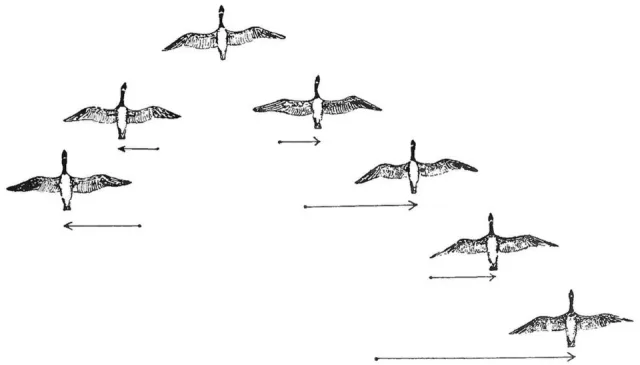
- Optimal Positioning: Each bird positions itself laterally and longitudinally relative to the lead bird, ensuring its wingtip is constantly riding the upwash.
- Wingbeat Synchronization: Research shows birds don't just position themselves; they also precisely time their wing flaps with their neighbor. They achieve a complex spatial phasing of wing beats to maximize the capture of upwash throughout the entire flap cycle and avoid the energy-draining regions of downwash.
- Rotation: Since the lead position—which receives no upwash benefit—is the most energetically demanding, the birds in the V-formation cycle through the front position in a timely fashion to distribute the fatigue among the flock members, similar to cyclists drafting in a peloton.
The Enigma of the Murmuration
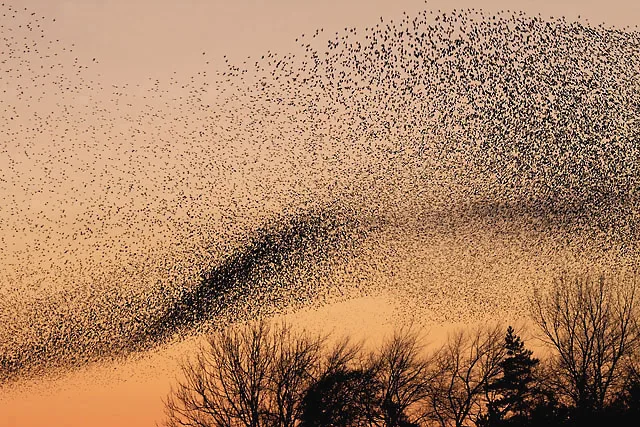
In stark contrast to the V-formation's mechanical efficiency, the rapid, complex, and irregular movements of starling murmurations are driven primarily by visual cues, defense, and collective information transfer. These clusters, involving thousands of starlings, frequently shift from dense spheres to elongated ribbons in a breathtaking display of synchronization.

The Simple Rules of Self-Organization
Murmurations operate without a leader or a fixed plan. Scientists have developed computational models that show this complex movement can arise from every individual bird following only three fundamental, "selfish" rules applied to its nearest seven neighbors:
- Avoid Collision (Attraction/Repulsion): Maintain a minimum distance from immediate neighbors.
- Match Velocity (Alignment): Adjust speed and direction to align with the average movement of the neighbors.
- Stay with the Group (Cohesion): Be generally attracted to distant members to prevent the flock from splintering.
The key finding is the optimal number of neighbors (seven). By focusing only on the nearest six or seven birds, information about a change in direction or the presence of a predator can ripple across the entire flock almost instantaneously, regardless of the flock's total size (a phenomenon known as scale-free correlation). The entire group responds as one fluid entity.
The Anti-Predator Strategy
The primary function of this rapid synchronization is defense:
- Dilution Effect: Simply being one bird in a flock of thousands significantly reduces the individual probability of being caught by a predator like a Peregrine Falcon.
- Confusion and Focus Lock: The sudden, synchronized changes in direction and density confuse the predator, making it extremely difficult for the raptor to achieve focus lock on a single target. The shimmering waves of movement across the flock make the entire mass appear unpredictable and intimidating.
The Foundational Science: Visual and Mechanical Cues
Regardless of whether a bird is in a V-formation or a murmuration, two core mechanisms allow for synchronized flight: visual cues and subtle aerodynamic feedback.
A. Optic Flow and Collision Avoidance
Birds possess extraordinary eyesight, and they use a mechanism called optic flow to calculate their speed and distance from obstacles and neighbors.
- Optic Flow: This is the apparent speed of the visual environment that an animal experiences as it moves through space. By balancing the optic flow experienced by their two eyes, birds can precisely judge and adjust their airspeed and navigate narrow gaps, even in dense formations, to avoid collisions.
- Maneuverability: Studies show that birds, particularly those in tight cluster formations, invest more energy by increasing their wingbeat frequency. This increased flapping requires more aerodynamic power but increases visual stability and maneuverability, allowing them to make the rapid, high-G turns seen in murmurations.

B. Aerodynamic "Springs" in Small Flocks
A more recent discovery shows that subtle aerodynamic forces can physically assist small flocks in maintaining their formation, much like invisible springs:
- Small Group Benefit: In small groups (up to about four birds), the vortices and swirls of flow left by the leading bird act to push the follower back into place if it is displaced. This means the birds can maintain an orderly queue with regular spacing with less effort—the physics is doing some of the work.
- Large Group Disruption: For larger, straight-line groups, however, these same flow interactions become destabilizing, creating erratic oscillations that travel down the line, potentially causing collisions. This suggests that large flocks must rely more heavily on visual alignment and constant corrective movements, rather than aerodynamic assistance, to hold their shape.
Wrapping Up
The science of flocking, therefore, presents two distinct masteries: the V-formation is a marvel of applied physics where large birds exploit the air to save energy over vast distances, and the murmuration is a marvel of decentralized computation, where small birds use simple social rules to achieve collective survival. Both phenomena demonstrate that when individual biological units connect, they form a unified whole capable of feats far beyond the capacity of a single bird.
