

Darting through a summer garden, a blur of iridescent green and a distinct, high-pitched hum announces the presence of the Ruby-throated Hummingbird (Archilochus colubris). For millions of Americans east of the Great Plains, this tiny powerhouse is the only hummingbird species they'll encounter. Far from fragile, this bird is a marvel of evolutionary engineering, a fearless long-distance migrant, and a constant source of wonder in our open woodlands, parks, and backyards.
Anatomy of an Aerial Ace: Size and Appearance
The Ruby-throated Hummingbird is a creature of almost unbelievable smallness. At a mere 2.8 to 3.5 inches in length and a weight of only 0.1 to 0.2 ounces—less than the weight of a U.S. nickel—it’s among the smallest birds on the continent. Its wingspan, ranging from 3.1 to 4.3 inches, powers a flight capability unmatched in the avian world.
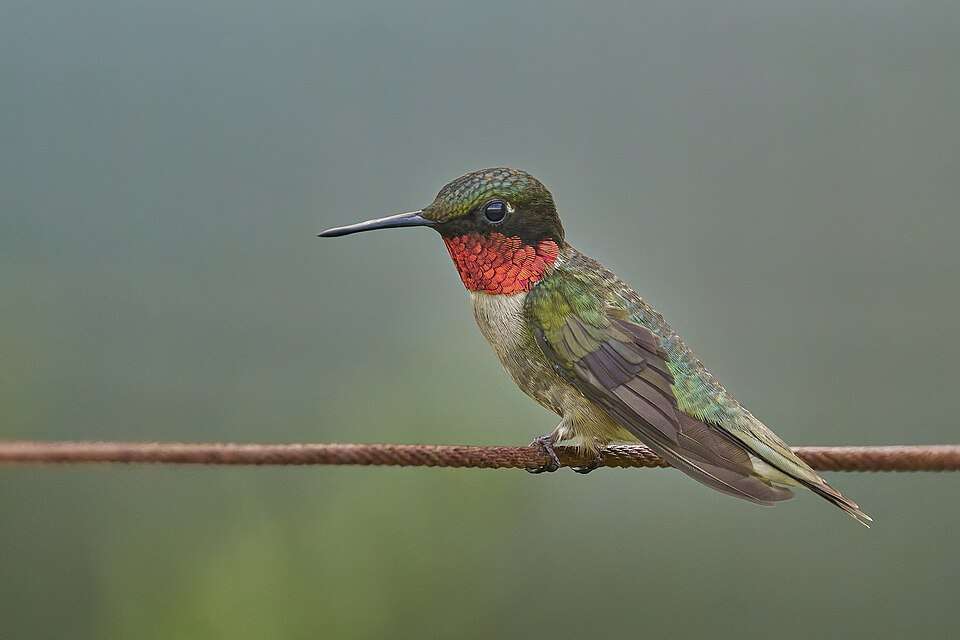
Its plumage is a metallic masterpiece. Both sexes sport a bright emerald-green back and crown. However, distinguishing the male from the female is simple, thanks to the male's signature feature: the brilliant, iridescent ruby-red throat patch, or gorget. This spectacular color is not pigment, but a structural coloration caused by microscopic air bubbles in the feathers that scatter light. When viewed from different angles, the gorget can flash from brilliant scarlet to dark, velvety black. The female lacks this fiery patch, displaying a plain white throat instead, often with a dusky mask and buffy flanks. The female's tail is also slightly rounded with distinctive white tips on the outer feathers, while the male's tail is forked and solid black.

Their physical adaptation for their high-energy lifestyle is remarkable. Their legs are so short and weak that they can only perch or shuffle sideways; they cannot walk or hop. Their wings, in contrast, are long, blade-like, and connect to the body in a unique ball-and-socket joint that allows them to rotate nearly 180 degrees. This extraordinary mobility enables them to fly forward, backward, and, most famously, hover with exquisite control. During these maneuvers, their wings can beat an astonishing 50 to 80 times per second, producing the characteristic hum that gives the bird its common name.
Fueling the Fire: Diet and Metabolism
Living life in the fast lane demands an enormous amount of fuel. Due to their incredibly high metabolism, Ruby-throated Hummingbirds must feed almost constantly, consuming roughly half their body weight in sugar every day. They are opportunistic foragers, visiting hundreds of flowers daily.
Their diet consists of two main components:
- Nectar: This sugary liquid from flowers, or sugar water from feeders, is their primary source of energy. They prefer tubular flowers, particularly those in shades of red and orange, such as native Cardinal Flower, Trumpet Creeper, and Honeysuckle. They use their long, grooved, and extensible tongue to lap up the nectar at a rapid pace.
- Insects and Spiders: Crucially, hummingbirds are not just sugar drinkers; they are also insectivores. Small arthropods, including gnats, aphids, mosquitoes, fruit flies, and spiders, provide the essential protein, fats, minerals, and vitamins that nectar lacks. They expertly pluck these tiny creatures from spiderwebs, leaves, or catch them mid-air. This protein is especially vital for growing nestlings.
This relentless consumption allows them to maintain a daytime heart rate that can reach 1,260 beats per minute. To survive cold nights or periods of food scarcity, they can enter a state of deep sleep called torpor, slowing their metabolism and dropping their body temperature to conserve energy.
The Great North-South Commute: Migration
Perhaps the most astounding fact about this minute bird is its legendary migration. The Ruby-throated Hummingbird is a medium-to-long-distance migrant, breeding across the eastern United States and southern Canada and wintering primarily in Mexico and Central America.
The journey is a grueling one, covering thousands of miles. To prepare, the birds will gorge themselves, sometimes doubling their body weight to build up a critical fat reserve. The most famous leg of the trip is the nonstop flight across the Gulf of Mexico, an expanse of approximately 500 to 600 miles over open water. This marathon flight, lasting roughly 20 hours, is completed solely on the strength of their fat reserves—a feat of endurance that defies their size and makes them one of the most remarkable travelers in the world.
Males typically depart in August and arrive in the southern U.S. Gulf Coast as early as late February or mid-March, a few weeks ahead of the females. The migration is solitary, driven entirely by instinct.

Life in the Breeding Range: Courtship and Nesting
The Ruby-throated Hummingbird is the only breeding hummingbird in eastern North America, making it a familiar fixture of summer life. The males arrive first to establish and fiercely defend a feeding and breeding territory.
Courtship is a dazzling spectacle. The male performs a dramatic U-shaped dive for a female perched nearby, ascending to heights of up to 50 feet and then plummeting down past her head, pulling up at the last moment with a burst of chirps and wing noises.
Once mating is complete, the male’s duties end, and the female takes on all parental responsibility.
The Thimble-Sized Home
The female’s nest is a tiny architectural marvel. It’s a thimble-sized cup, often saddled atop a slender, slightly drooping deciduous tree branch 10 to 40 feet above the ground.
The primary building materials are plant down (from dandelions or thistles) held together with sticky, elastic spider silk. The silk is essential because it allows the nest to stretch as the two pea-sized eggs hatch and the nestlings rapidly grow. The exterior of the nest is meticulously camouflaged with fragments of lichen and moss, making it look exactly like a small, natural knot on the branch and nearly impossible for predators to spot.
She lays a clutch of two white, bean-sized eggs, which she incubates for about 14 to 16 days. The young birds are fed an insect-heavy diet by the mother and will fledge, or leave the nest, after about two to three weeks, instantly ready to begin their journey as aerial dynamos.

Attracting the Little Jewel
For American backyard enthusiasts, attracting and supporting these incredible birds is a popular pastime. The most effective ways to invite the Ruby-throated Hummingbird into your space are to provide a reliable source of their preferred food:
- Plant Native Flowers: Focus on native, tubular, nectar-rich plants. Favorites include Bee Balm (Monarda), Salvia, Cardinal Flower (Lobelia cardinalis), and Coral Honeysuckle (Lonicera sempervirens).
- Use Hummingbird Feeders: A simple solution of one part granulated white sugar to four parts water is the perfect substitute for natural nectar. Never use red dye, honey, or artificial sweeteners, as these can harm the birds. Change the water every few days, especially in hot weather, to prevent fermentation.
- Offer Perches and Shelter: Maintain some tree cover and perching spots near food sources, as the birds are territorial and need a lookout to defend their claim.
The Ruby-throated Hummingbird is more than just a beautiful bird—it’s a symbol of spring, a tireless pollinator, and a reminder that the world’s most astounding feats of strength and endurance often come in the smallest packages. Its life cycle, from the arduous migration to the diligent, solitary parenting, encapsulates a wild spirit that brightens the entire eastern half of the nation.
