
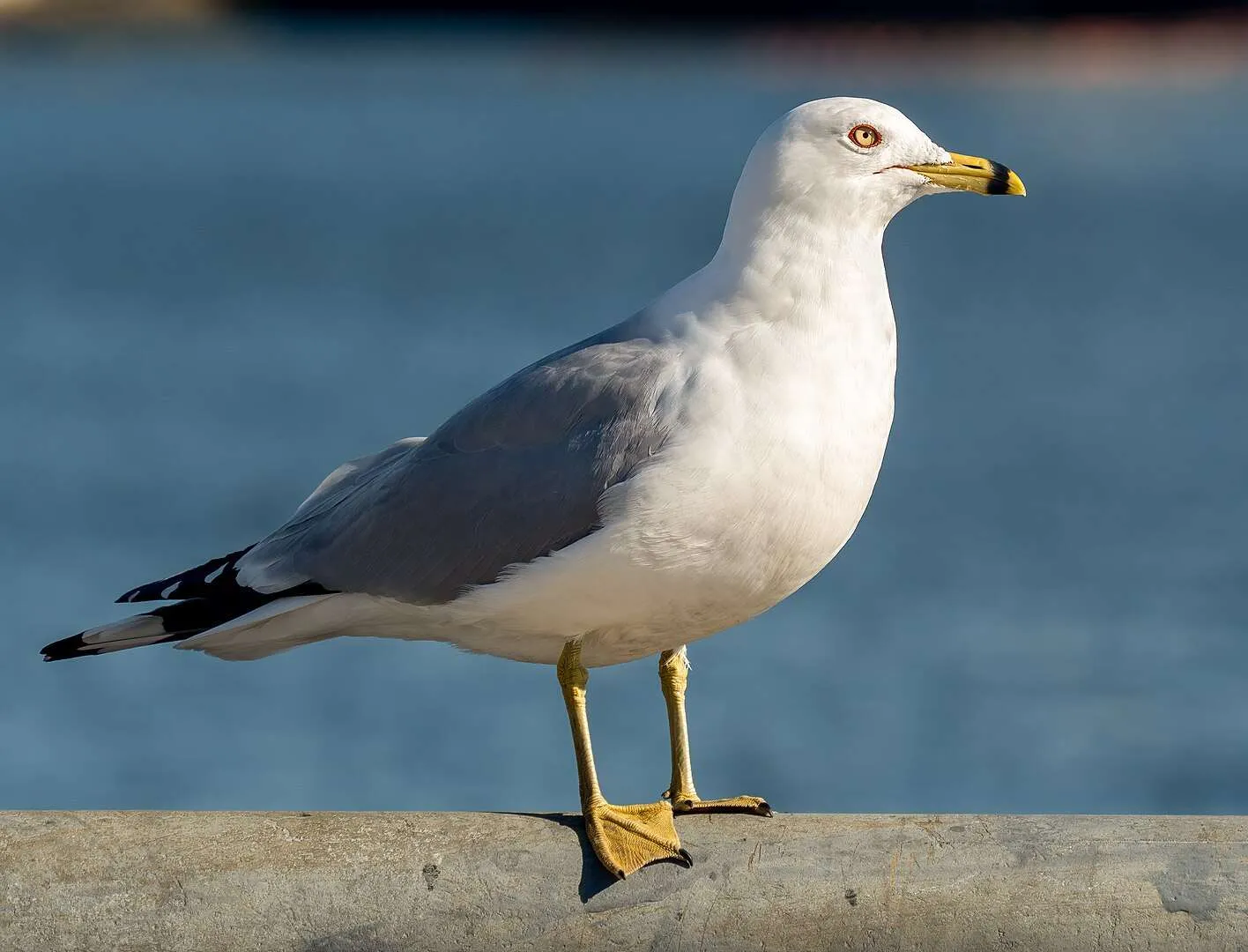
The Ring-billed Gull (Larus delawarensis) is perhaps the most familiar and successful gull species across inland North America. Often mistaken for its larger coastal relative, the Herring Gull, the Ring-billed Gull has flourished spectacularly by adapting to human-altered landscapes. It is a highly intelligent, gregarious, and opportunistic bird, transforming from a traditional coastal and Great Lakes resident into a ubiquitous feature of parking lots, garbage dumps, agricultural fields, and urban parks throughout the continent. Its adaptable nature and tolerance for crowds have earned it the title of North America's most common and rapidly expanding gull.
Identification: Defining the Ring
The Ring-billed Gull is a medium-sized gull, distinctively smaller and more slender than the large "white-headed" gulls. Its identification is straightforward, particularly in breeding plumage.
Size: It measures around 16–19 inches in length, with a wingspan of approximately 43–49 inches.
Adult Plumage: Adults display the classic "gull" pattern: a white head, neck, and underparts; a pale gray mantle (back and upper wings); and black wingtips marked with white "mirrors."
The Bill: The defining feature, which gives the species its name, is a sharp, contrasting black ring encircling the distal third of the bright yellow bill.

Ring-billed Gull Eyes and Legs: Adults have pale yellow eyes and yellowish-green legs and feet.
Juvenile and Non-breeding Plumage
Identification can be trickier in winter and for immature birds:
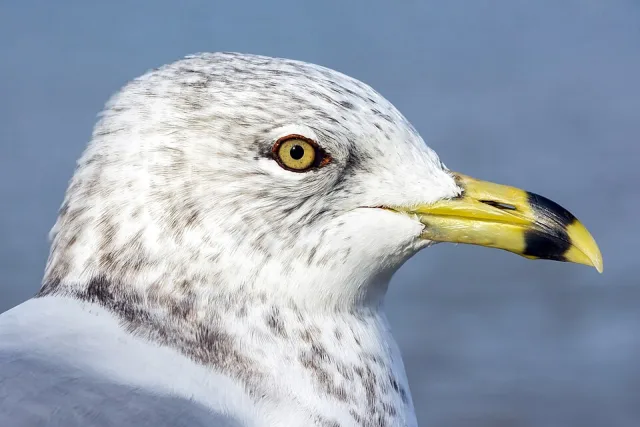
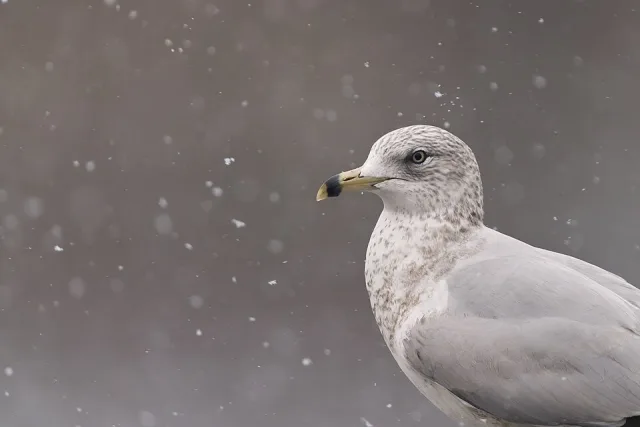
Winter (Non-breeding): The pure white head gains subtle, dusky brown streaking on the nape and crown, giving it a somewhat "dirty" appearance. The bill ring remains but may be less stark.
Juveniles: Immature birds undergo a complex plumage transformation over three years before achieving full adult coloring. Juveniles are heavily mottled with brown and white, and their bills are flesh-colored with a black tip. By their second year, they resemble adults but retain brown on their wings and tail.
Range and Habitat: The Inland Specialist
The Ring-billed Gull is a native North American species with a distribution centered inland, making it unique among gulls which are often strictly coastal.
Breeding Grounds: It breeds almost entirely inland, primarily around the Great Lakes region, the vast lakes and wetlands of the Prairie Provinces of Canada, and the interior northwestern United States. They form large, dense colonies on islands, peninsulas, or sandbars to protect their nests from terrestrial predators.
Migration and Wintering: The species is highly migratory. After the breeding season, flocks disperse widely. They move south to winter along the Pacific and Atlantic coasts, the entire length of the Mississippi River, and across the southern United states and Mexico, making it a familiar sight in nearly every state.
Habitat Adaptability: While they must be near water for breeding, their foraging habitat is remarkably diverse. They are just as likely to be seen scavenging at landfills and sewage ponds as they are following tractors in agricultural fields to snatch exposed worms and insects, or patrolling the skies over shopping center parking lots for scraps of dropped food.
Diet and Behavior: The Master Opportunist
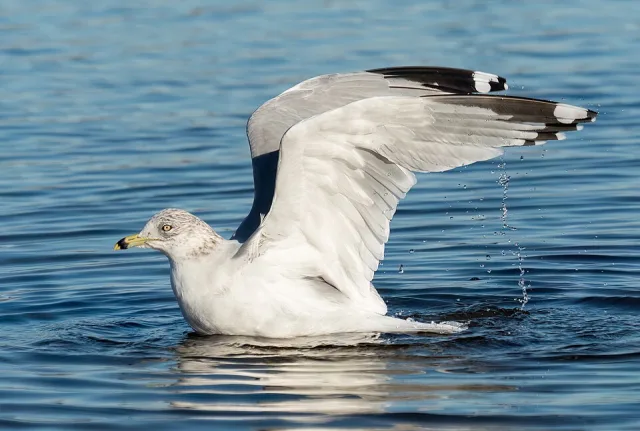
The Ring-billed Gull is an ecological generalist and a true master of opportunism, a characteristic that is central to its immense success. Its diet is incredibly varied, allowing it to exploit nearly any available food source.
Primary Foraging: They are proficient at catching fish, aquatic insects, and crustaceans from shallow water. They also actively consume earthworms, rodents, and berries.
The Scavenger Role: Their most famous role is that of a scavenger. They actively forage at garbage dumps (landfills), quickly colonizing any site that provides reliable access to human waste. They also gather in large numbers at parks, beaches, and fast-food restaurant parking lots, patiently waiting for dropped or discarded food.
Kleptoparasitism: Like many gulls, the Ring-billed Gull is a kleptoparasite, meaning it often harasses other birds (and even people) to force them to drop food, which the gull then steals.
Agricultural Foraging: A key behavior is "plow-following," where large groups follow farm machinery to prey on invertebrates, rodents, and other organisms unearthed by the turning soil. This makes them beneficial to farmers by controlling pests but also sometimes causes them to be viewed as a nuisance when they gather in overwhelming numbers.
Population Success and Concerns
The Ring-billed Gull has experienced one of the most dramatic population explosions of any North American bird species in the last century.
Historical Decline and Recovery: Populations declined heavily in the late 19th and early 20th centuries due to hunting (for the millinery trade) and egg harvesting. However, after protective legislation (Migratory Bird Treaty Act) was implemented, their numbers began a rapid recovery.
The Anthropogenic Advantage: The exponential growth since the mid-20th century is attributed almost entirely to the increase in human refuse (landfills) and the expansion of agricultural land. These human-created food subsidies provide abundant, predictable, and easily accessible nourishment, especially during the harsh winter months, boosting survival rates dramatically.
Urban Conflict: While successful, their massive numbers often lead to conflict. Large flocks can contaminate reservoirs and beaches with droppings, threaten public health at landfills, and cause noise and mess in urban areas. Management strategies often focus on excluding them from sensitive areas, such as airport runways and water treatment facilities.
Social Structure and Vocalizations
The Ring-billed Gull is extremely gregarious throughout the year. It lives, breeds, forages, and roosts in large groups, relying on the safety and information-sharing benefits of large colonies.
Vocalization: The Ring-billed Gull is highly vocal, using a variety of calls for communication. Its primary call is a loud, ringing "ke-ow" or "kyow-kyow" cry, which is higher-pitched and less deep than the call of the Herring Gull. Calls are used for territorial defense, courtship, and alerting the flock to food or danger.
The Ring-billed Gull’s story is a testament to the power of adaptability. It is a true survivor, having successfully navigated human development to become an integral, and often dominant, part of North America's contemporary landscape, a constant, recognizable presence from the inland waterways to the coastal parking lots.
