

The Red-winged Blackbird (Agelaius phoeniceus) is one of the most abundant and instantly recognizable birds in North America. From the smallest roadside ditch to the sprawling cattail marshlands, its presence is signaled by the sharp, ringing "konk-la-ree!" song of the male, a characteristic sound of spring and summer across the continent. This is a species defined by sharp contrasts: the male's striking, unmistakable plumage versus the female's cryptic camouflage; its status as a breeding success story versus its reputation as an agricultural pest; and its fierce territoriality versus its gregarious nature in winter flocks. A true icon of North American wetlands, the Red-winged Blackbird embodies the successful adaptation and ecological resilience of the Icterid family.
Identification: The Badge of Dominance
The Red-winged Blackbird exhibits one of the most pronounced cases of sexual dimorphism among common North American songbirds.
The Male
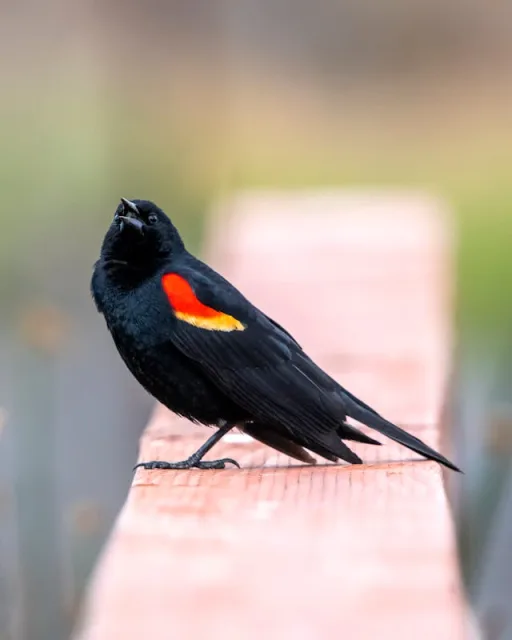
The male is instantly identifiable. He is a glossy, velvety jet-black bird with two strikingly colored patches on the shoulder of his wing, known as epaulets or patagial tags. These patches consist of a bright, fiery red shoulder cover, bordered just below by a band of yellow or buff feathers.
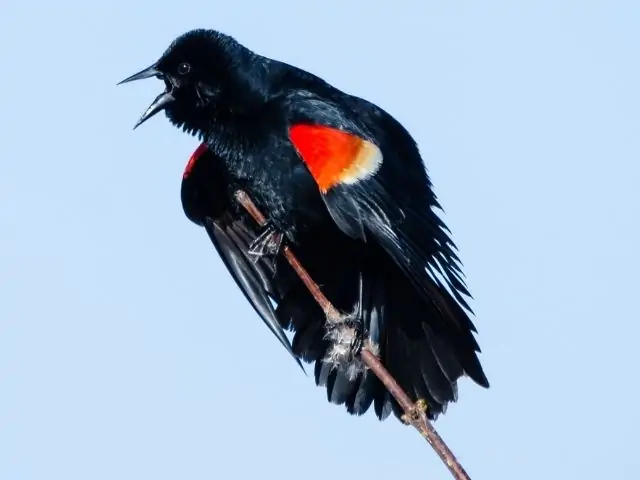
Display: When relaxed or foraging, the male often hides the bright red and yellow under the black coverts. However, during territorial disputes or courtship displays, he dramatically flares his epaulets while arching his back and spreading his tail, turning the red and yellow into a conspicuous signal of dominance and fitness.
The Female
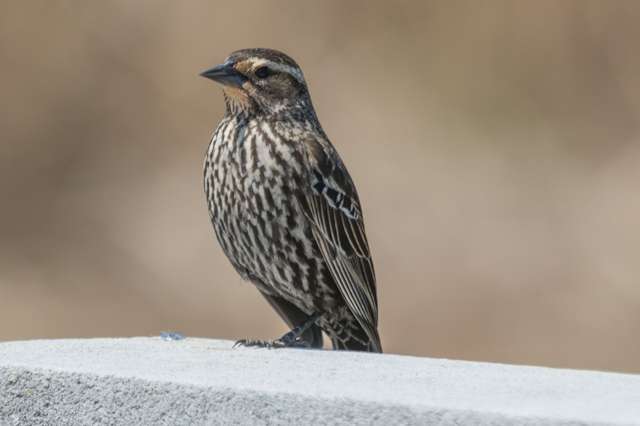
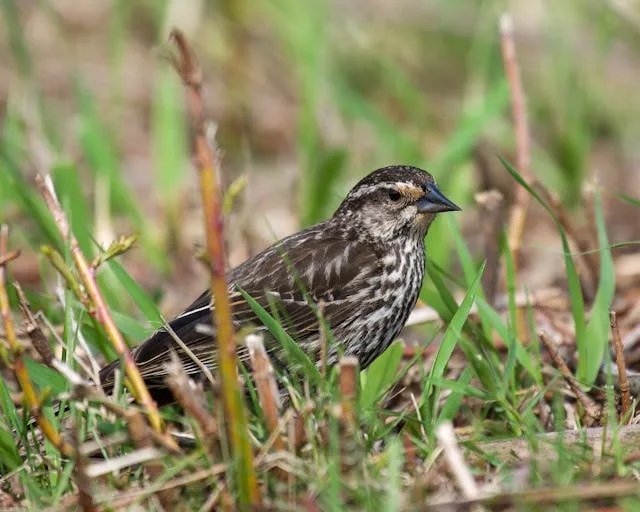
In contrast, the female is easily mistaken for a large, streaked sparrow. She lacks the black body and bright epaulets, instead possessing a streaked brown and white plumage with an indistinct white or buff supercilium (eyebrow). This cryptic coloration is vital, as it allows her to remain inconspicuous while incubating the nest, protecting her from the high risk of predation in the open marsh. The only hint of the male’s brilliance she possesses is a pale reddish or pinkish wash on the bend of the wing, which is often difficult to see.
Range and Habitat: The Wetland Blueprint
The Red-winged Blackbird is one of the most widely distributed songbirds in North America, with its range extending from Alaska and Canada down through the United States and into Central America.
Habitat Preference: The species is a strict wetland obligate during the breeding season. It requires dense, vertical emergent vegetation for nesting and cover.
Primary Habitat: Cattail marshes, sedge meadows, wet hayfields, and the edges of ponds and slow-moving rivers.
Winter Range: Most northern populations are migratory, moving south to the southern United States and Mexico for the winter. In the southern and coastal states, the species is often a year-round resident. During the non-breeding season, their habitat preference broadens considerably; they leave the wetlands to forage in fields, suburbs, and grasslands.
Breeding and Social Dynamics: The Polygynous King

The Red-winged Blackbird employs a highly successful and intense polygynous mating system, where a single male may mate with up to 15 different females within his territory.
Territorial Defense: Males arrive in the marsh early in the spring, establishing and fiercely defending territories that are often quite small—sometimes only a few square yards of prime nesting reeds. The intensity of a male's defense, including his flamboyant song and epaulet display, is crucial for attracting multiple mates.
Nesting: The female chooses a specific nesting site, weaving a deep, cup-shaped nest, typically suspended high between several vertical stems of cattails or bulrushes, keeping it just above the water level. The dense canopy above the nest provides protection from aerial predators.
Parental Care: While the male is busy defending his territory and attracting new mates, the female does the vast majority of the work, including building the nest, incubating the eggs, and feeding the young. Males may contribute food to the young in their primary nest but rarely assist secondary mates.
Diet and Conflict: The Price of Success
The Red-winged Blackbird’s success is built upon its omnivorous and opportunistic diet, but this adaptability often brings it into conflict with human interests.
Natural Diet: During the breeding season, its diet is heavily insectivorous, consisting of dragonflies, spiders, beetles, moths, and other invertebrates—a beneficial service to the marsh ecosystem. They also consume seeds and grains, especially in the fall and winter.
Agricultural Conflict: The conflict arises because the wintering and migrating flocks are often enormous, numbering in the hundreds of thousands or even millions of birds. These massive mixed-species flocks (often including European Starlings and Common Grackles) descend upon agricultural fields, primarily feasting on winter cereal grains and sunflower seeds. This consumption can lead to significant economic losses for farmers, particularly in the southeastern and mid-Atlantic states, where the flocks concentrate.
Suburban Annoyance: While not as problematic as the Common Grackle, large roosting flocks near urban centers can also become a nuisance due to noise and excessive droppings.
The Power of the Roost
During the non-breeding season, the Red-winged Blackbird transitions from a solitary, territorial bird to an extremely gregarious one. They form enormous communal roosts, often in the same dense wetlands where they breed, but now serving as massive overnight shelters shared with millions of other blackbirds and starlings.
Safety in Numbers: The primary advantage of these large roosts is defense against predation. The sheer number of eyes and ears provides collective security.
Information Sharing: It is theorized that these communal roosts also serve as centers for information transfer, where successful foragers lead their less-successful neighbors to rich new feeding grounds the following morning, further enhancing the species' overall survival.
Conservation Status
Despite facing control efforts in agricultural areas, the Red-winged Blackbird is a remarkable conservation success story. It is listed as a species of Least Concern and is likely the single most abundant species of native songbird in North America, with estimated populations ranging into the hundreds of millions.
Its proliferation is a testament to its genetic flexibility, its ability to exploit both natural and human-altered environments, and its highly efficient social system. The Red-winged Blackbird, with its brilliant flash of red and its ringing marsh song, is a permanent fixture—a dominant, boisterous, and highly successful element of the American soundscape.
