

The puffin, often affectionately dubbed the "sea parrot" or "clown of the ocean," is one of the most beloved and instantly recognizable seabirds in the world. With their distinctive, brightly colored bills, tuxedo-like plumage, and comical gait, puffins draw thousands of visitors to the rocky coasts where they breed. Within the United States, three species of puffins can be observed, each occupying a distinct ecological niche across the Atlantic and Pacific coasts.
Puffin Species in U.S. Waters
The three species of puffins found in U.S. territories belong to the genus Fratercula, meaning "little brother" or "friar," perhaps a nod to their black and white vestments. Their distribution is cleanly split between the East and West Coasts.
1. Atlantic Puffin (Fratercula arctica)

The Atlantic Puffin is the only puffin species found in the Atlantic Ocean. Its U.S. population is almost exclusively limited to the islands off the coast of Maine.
Appearance: This is the quintessential puffin. It has a black back and a white underside, with a striking white face patch. During the breeding season, its triangular bill sheath becomes brilliant orange, yellow, and blue, making it highly conspicuous.
Distribution in U.S.: The Atlantic Puffin's breeding stronghold is in the North Atlantic, but small, critically important colonies exist on islands in the Gulf of Maine, most notably at Eastern Egg Rock and Machias Seal Island. They spend the non-breeding season far out at sea.
2. Horned Puffin (Fratercula corniculata)
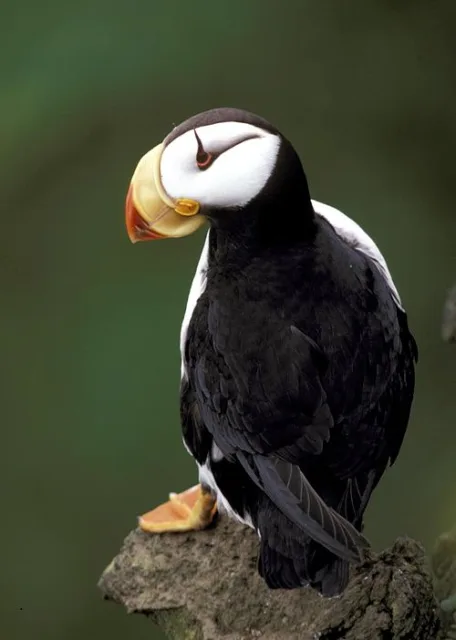
The Horned Puffin is a species of the North Pacific and Alaska, easily distinguished from its Atlantic cousin.
Appearance: Similar black-and-white body plumage, but the Horned Puffin has a large white cheek patch and a distinctive, fleshy, black, horn-like projection (or spike) above its eye during the breeding season. Its bill is brightly colored yellow at the base and red toward the tip.
Distribution in U.S.: They breed extensively along the coasts of Alaska, particularly the Aleutian Islands and the Bering Sea islands. They forage throughout the northern Pacific, relying on cold, nutrient-rich waters.
3. Tufted Puffin (Fratercula cirrhata)
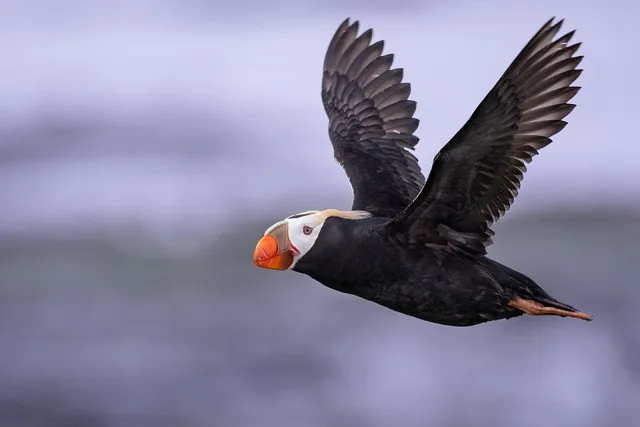
The largest and arguably the most dramatic-looking of the puffins, the Tufted Puffin is the most widely distributed puffin species along the Pacific coast of the contiguous United States.
Appearance: Adults are almost entirely sooty black, with a contrasting bright white mask around the eyes. Their signature feature is a pair of long, pale golden-yellow ear tufts that sweep back from the head. Their bill is massive and brightly colored red and yellow during the breeding season.
Distribution in U.S.: They breed from the Aleutian Islands and Alaska south along the coast through Washington, Oregon, and Northern California. They are the puffin most likely to be sighted by boaters off the coast of the lower 48 Pacific states.
Small Feet, Big Adaptations: The Evolutionary Reasons for Tiny Bird Feet
Nesting and Lifestyle
All puffin species are colonial seabirds, meaning they gather in huge, dense colonies on remote, rocky islands or cliff faces to breed.
Nest Sites: Puffins are burrow nesters. They use their sharp claws and strong bills to excavate burrows in soft soil or nest in existing crevices between rocks. The Tufted Puffin is particularly known for its deep, elaborate burrows.
Reproduction: Puffins are monogamous and typically lay a single, large egg per season. Both parents share the incubation duties and subsequent chick-rearing.
Feeding the Chick (Puffling): One of the most endearing sights is watching an adult return to the burrow with its beak loaded with small fish, a behavior called "parading" the catch. They can hold dozens of fish crosswise in their bill at once, using specialized serrations on the bill and tongue to grip the slippery prey.
An Underwater Hunter
Puffins are superb swimmers and divers, using their short, powerful wings to "fly" underwater in pursuit of prey. Their legs act as rudders for steering.
Diet: Their diet consists almost entirely of small schooling fish, such as sand lances, herring, capelin, and small cod. Their breeding success is intrinsically linked to the availability and caloric value of these prey species.
At Sea: Outside of the breeding season (roughly nine months of the year), puffins live a truly pelagic life, spending their time far out in the open ocean, where they are rarely seen from shore. They return to land only to nest.
Conservation in the U.S.
All three puffin species face significant conservation challenges, making their protection a priority for wildlife agencies.
Atlantic Puffin: Historically extirpated from Maine due to overhunting, the population was successfully restored thanks to the work of the National Audubon Society's Project Puffin, which used decoys and sound recordings to attract young puffins to former breeding islands. Today, the main threat is climate change, which alters the distribution of their preferred cold-water prey (sand lance and herring), forcing them to seek out less nutritious food.
Pacific Puffins: Horned and Tufted Puffins face similar threats from oil spills, bycatch in commercial fishing gear, and predation from invasive species (like rats) on their nesting islands. The decline in the abundance of key forage fish due to ocean warming also poses a severe long-term risk to these Pacific populations.
The puffin is a resilient and vital part of both U.S. coasts, but its future hinges on maintaining the health and productivity of the cold northern oceans it relies upon.
The Granite and the Great Ocean: A Birder’s Guide to Maine’s Seabirds
