

If you ever watch an Atlantic Puffin take off from the ocean surface, you might notice it looks a bit… frantic. Its short, stubby wings beat furiously, blurring as it struggles to lift its heavy body into the air.
Now, travel down to the stormy, freezing waters of the Southern Ocean near Cape Horn. There, you will find a tiny, black-and-white bird called the Magellanic Diving-Petrel doing the exact same thing. It whirs across the tops of the waves, flying with a rapid, buzzy, mechanical wingbeat that looks identical to a puffin.
Early maritime explorers were baffled by this. They naturally assumed these birds were closely related. But they aren't. They belong to completely distinct branches of the avian family tree, separated by oceans, hemispheres, and roughly 60 million years of independent evolution.
Their uncanny resemblance is a masterclass in how a single, brutal lifestyle—wing-propelled underwater pursuit predation—can radically sculpt a bird's entire skeletal structure and anatomy.
The Evolutionary Split: Meet the Non-Cousins
Before looking at how they became twins, let's look at who they actually belong to. Their ancestral backgrounds could not be more different:
| Attribute | Atlantic Puffin (Fratercula arctica) | Magellanic Diving-Petrel (Pelecanoides magellani) |
| Primary Range | North Atlantic (Breeds from Maine to Iceland) | Southern Oceans (South American fjords and islands) |
| Family | Alcidae (Auks) | Procellariidae (Diving-Petrels / Tubenoses) |
| True Relatives | Murres, Guillemots, and Gulls | Albatrosses, Shearwaters, and Storm-Petrels |
Think about the true relatives for a moment. A diving-petrel is technically a "tubenose"—a member of the group famous for the Albatross, a bird with massive, long, narrow wings built to glide thousands of miles over the ocean without flapping once. Yet, the diving-petrel looks and acts absolutely nothing like an albatross. Why? Because it abandoned the skies to conquer the deep.
The Design Compromise: Flying Through Two Mediums

To catch fast-moving fish and krill in freezing, nutrient-rich coastal waters, both of these birds had to face a massive physics problem. Water is roughly 800 times denser than air. A wing optimized for soaring through thin air is completely useless for pulling a body through heavy water.
To become elite underwater hunters, evolution put both families through the exact same anatomical redesign, resulting in a series of highly specific adaptations.
1. The Torpedo Body
Water requires serious streamlining to minimize drag. Both birds independently evolved a compact, neckless, torpedo-shaped torso. Their feathers are incredibly dense, locking together to form a completely waterproof, pressurized dry suit that traps a thin layer of insulating air against their skin.
2. Heavy, Condensed Bones
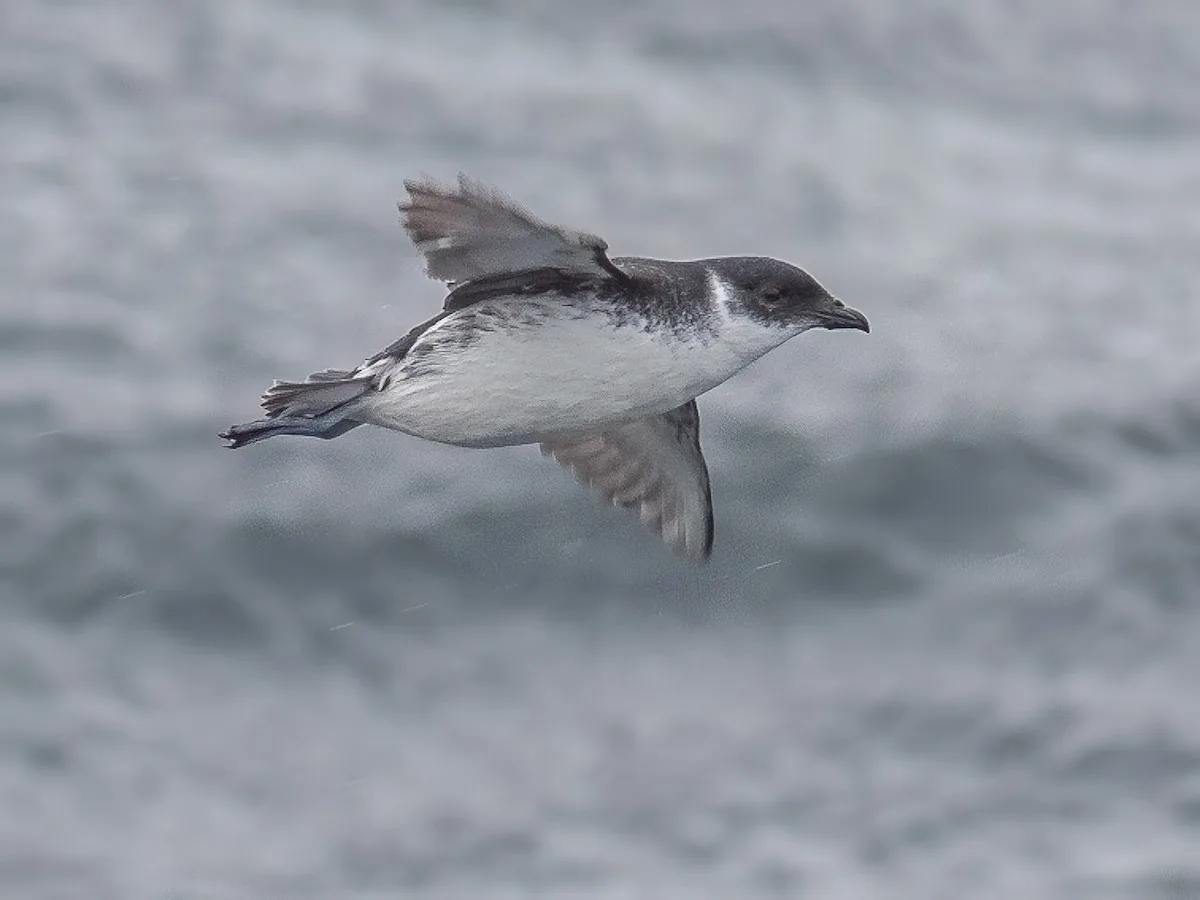
Most birds possess hollow, pneumatic bones to keep them light enough for effortless flight. But a light, air-filled bird is too buoyant; it pops back up to the surface like a cork. To dive deeper, both the puffin and the diving-petrel evolved much denser, heavier bones than their aerial land-lubbing cousins, acting as natural scuba weights.
3. The "Stunted" Wing
This is the most critical convergence. To use a wing as an underwater paddle, it must be short, stiff, and incredibly powerful. Long flight feathers would bend and snap under water pressure.
Both species shortened their wings, reduced the surface area of their flight feathers, and modified their wing joints to restrict bending. When they dive, they are literally "flying" underwater, flattening their wings into rigid, high-speed oars.
The Catch: The High Cost of the Compromise
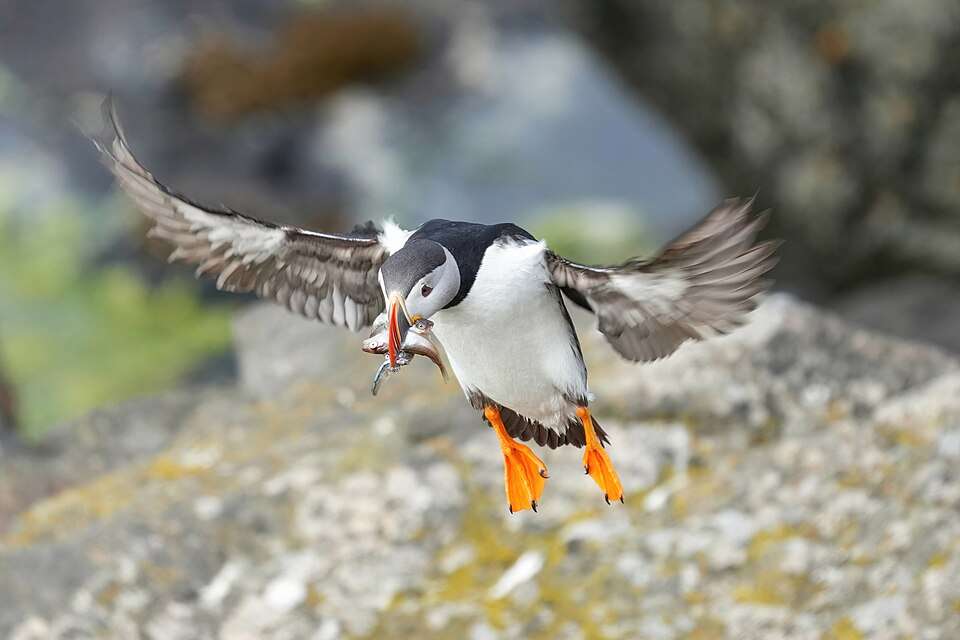
Evolutionary trade-offs always carry a price tag. By optimizing their wings to fly through water, both birds pushed the absolute physical limit of being able to fly through the air at all.
Because their wings are so small relative to their heavy, dense bodies, they have a remarkably high wing loading (the ratio of a bird's weight to its total wing area). To stay airborne:
They cannot glide or soar; they must flap continuously.
An Atlantic Puffin must beat its wings up to 400 times per minute.
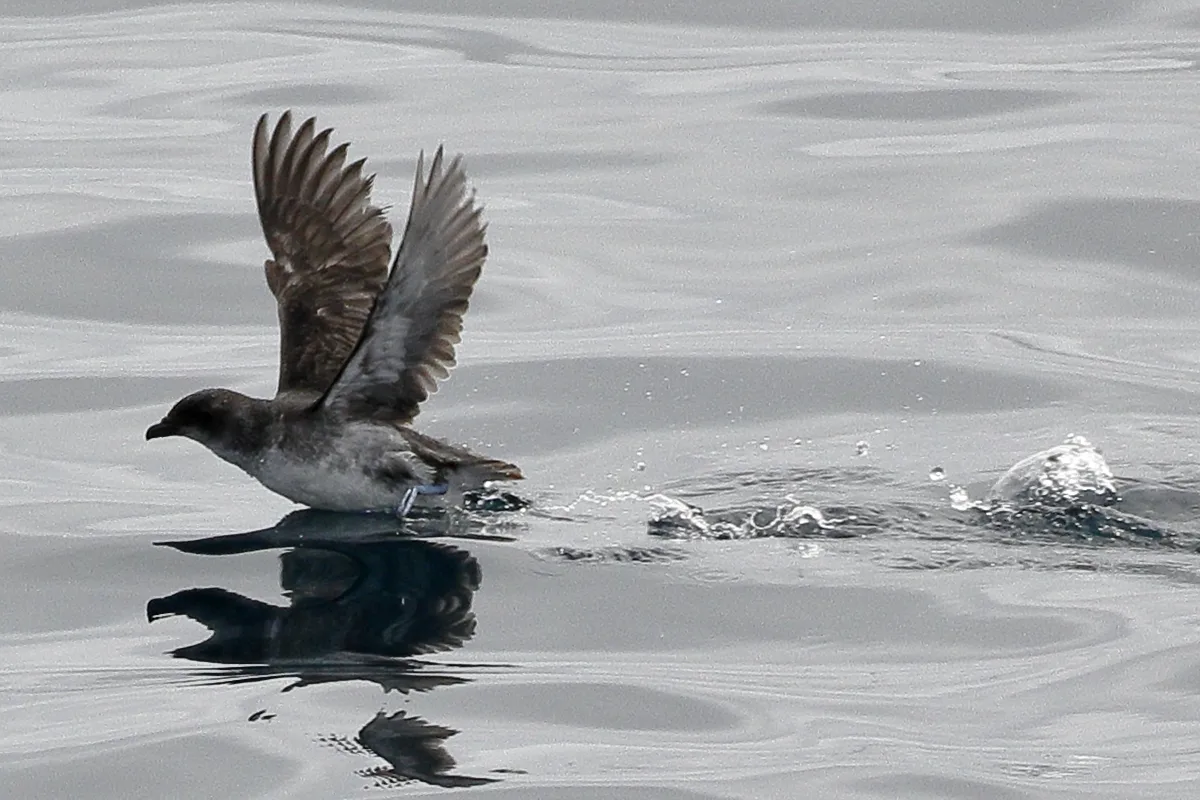
A Magellanic Diving-Petrel beats its wings so fast it looks like a giant, flying bumblebee.
When a storm hits, diving-petrels will often fly directly through the crest of a wave rather than flying over it—their bodies are simply happier moving through water than air.
Subtle Clues: Spotting the True Lineage
Even though natural selection forced them into the same shape, it couldn't erase their genetic history. If you look closely, you can see their true origins:
The Nostrils (The Dead Giveaway): If you look at the base of a Magellanic Diving-Petrel's bill, you will see a pair of short, upright tubes. These are modified nostrils common to all tubenoses (like petrels and albatrosses), used to excrete excess salt swallowed while out at sea. Puffins are shorebirds; they lack these tubes entirely, excreting salt through internal glands above their eyes that drain out of normal nasal slits.
The Beak Shape: The Atlantic Puffin is famous for its massive, brightly colored, triangular breeding bill, built for carrying dozens of small fish back to a burrow at once. The diving-petrel has a much smaller, black, hooked bill with a small pouch underneath, designed for snapping up individual krill and swallowing them immediately.
The Takeaway for Birders
The story of the puffin and the diving-petrel is a beautiful reminder that the natural world has rules. If two completely different organisms want to exploit the exact same resource—high-energy food hidden deep beneath cold ocean waves—physics will eventually force them into the exact same shape.
