

A resounding, rhythmic "thwack-thwack-thwack" echoes through the forest, a powerful, almost industrial sound that announces the presence of one of North America's most impressive avian residents: the Pileated Woodpecker (Dryocopus pileatus). This crow-sized powerhouse, with its brilliant scarlet crest and chisel-like bill, is more than just a magnificent sight; it's a tireless engineer and a keystone species whose very existence is crucial to the health of the entire forest ecosystem.
A Striking Appearance
The Pileated Woodpecker is an unforgettable bird. Measuring between 15 and 19.5 inches long with a wingspan of up to 30 inches, it is the largest living woodpecker in North America, second only to the likely extinct Ivory-billed Woodpecker. Its plumage is predominantly sooty black, sharply contrasted by bold white stripes that run down the neck and face. The most defining feature, and the origin of its common name (from the Latin pileatus, meaning 'capped'), is the flaming-red crest that sweeps back from the forehead.
Sexual dimorphism, though subtle, is present: the male boasts a fully red crest and a prominent red moustachial stripe (malar stripe), whereas the female has a black moustachial stripe and a crest that is black or grayish-brown at the front. In flight, the bird reveals conspicuous white wing linings and a white patch on the underwing, creating a striking black-and-white pattern that aids identification. The large, powerful, silvery-gray bill is the tool of its trade, backed by a specialized anatomy designed to absorb the incredible shock of its repeated blows.

Range and Habitat: The Call of the Mature Forest
The Pileated Woodpecker is a non-migratory species, a year-round resident across a vast range that spans the southern half of Canada, extends throughout the eastern United States, and runs along the Pacific coastal states and northern Rockies.
This bird's primary habitat requirement is the presence of mature forest—specifically, woods with large trees, a high canopy, and an abundance of dead and decaying wood (snags and fallen logs). It thrives in mixed coniferous and deciduous woodlands, riparian areas, and even adapts to large wooded parks and well-treed suburban areas, provided the essential raw materials—large, dead trees—are available for foraging and nesting. These mature forests are its supermarket and its apartment complex all in one.
The Master Excavator: Diet and Foraging

The most characteristic sign of a Pileated Woodpecker is not the bird itself, but the signature of its labor: large, deep, and distinctively rectangular or oval holes excavated into dead trees and logs. Unlike the smaller, circular holes made by other woodpeckers, these deep gouges reveal the bird's relentless pursuit of its favorite prey.
The core of the Pileated Woodpecker's diet consists of carpenter ants and the larvae of wood-boring beetles. The woodpecker is adept at locating these insect colonies beneath the bark by tapping or, remarkably, by listening for the insects moving within the wood. Once a colony is located, its chisel-like bill rapidly excavates the wood, often reducing large snags or stumps to wood chips. It then uses its exceptionally long, barbed, and sticky tongue to probe deep into the tunnels and retrieve its prey. This diet is supplemented seasonally with other insects, as well as wild fruits, berries, and nuts. Its intensive foraging acts as a natural control for forest insect populations and significantly aids in the decomposition and nutrient recycling of dead wood.
Territorial Drumming and Nesting Life
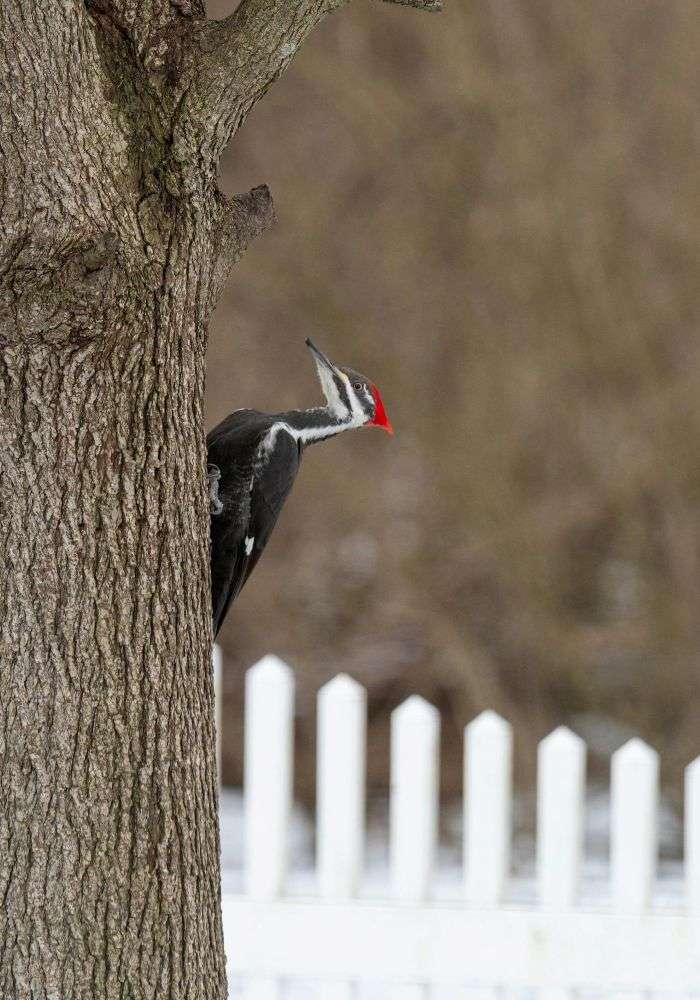
For the Pileated Woodpecker, sound is an essential element of life. Its vocalization is a loud, ringing, "cuk-cuk-cuk-cuk" call that sounds a bit like the laugh of a jungle bird. However, its most powerful communication is drumming. Unlike the slow, irregular pecking used for foraging, drumming is a rapid, resonant tattoo made on a hollow, high-standing tree or other resonant surface (like a telephone pole). This sound is used by both sexes, primarily during the breeding season in late winter and early spring, to declare territory and attract a mate.
Pileated Woodpeckers are generally monogamous, with pairs staying together on a territory year-round. Every year, the mated pair collaborates to excavate a new nest cavity, typically high up (25 to 80 feet) in a large dead tree or snag. This process can take several weeks, resulting in a deep, spacious cavity that averages around 19 inches deep. The female typically lays a clutch of three to five glossy white eggs, which both parents incubate for about 15 to 18 days. The young hatch blind and helpless, relying entirely on regurgitated insects from their parents.
The construction of a new nest cavity each season is not an act of waste, but one of profound ecological generosity.
A Keystone Species and Conservation
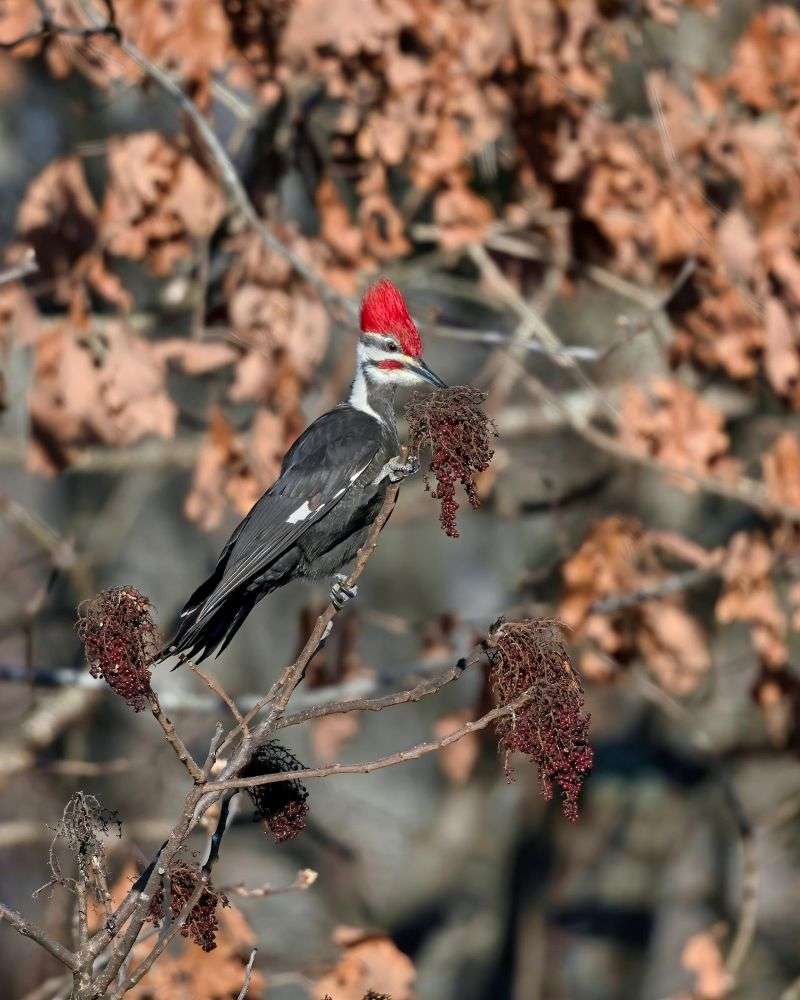
The Pileated Woodpecker is universally recognized by ecologists as a keystone species—an organism whose influence on the ecosystem is disproportionately large compared to its abundance.
The reason for this crucial status lies in its excavating behavior. The old, abandoned nest cavities and foraging holes become vital real estate for a wide variety of secondary cavity-nesting species that cannot create their own. More than 30 species are known to use these woodpecker-created niches for nesting and roosting, including:
- Owls (e.g., Eastern Screech-Owls, Boreal Owls)
- Ducks (e.g., Wood Ducks, Buffleheads)
- Mammals (e.g., Northern Flying Squirrels, American Martens, bats)
- Other Birds (e.g., American Kestrels, Tree Swifts)
The woodpecker's population is currently considered stable, a remarkable recovery after significant declines in the early 20th century due to extensive forest clearing. While not officially listed as threatened or endangered, it remains a species of conservation concern because of its dependence on mature and old-growth forests. The removal of large dead and dying trees through intensive logging or forest-clearing is the most significant threat to its habitat, as it removes both its primary food source (carpenter ants in dead wood) and its essential nesting sites. Protecting these large, decaying trees is the key to ensuring the survival of the Pileated Woodpecker and the vast array of wildlife that depends on its carpentry skills.

To encounter a Pileated Woodpecker is to witness an ancient and powerful force of the North American forest. Its striking appearance and loud, echoing work ethic make it a charismatic symbol of wild, healthy woodlands, and a humbling reminder of the interconnectedness of nature. Its continued presence is a testament to the resilience of a species, but also a daily report card on the management and preservation of our shared forest heritage.
