

The American Southwest is a landscape defined by harsh sunlight, resilient desert flora, and fauna adapted to extremes. Amidst the ubiquitous greasewood and creosote, one bird stands out not just for its striking, formal beauty, but for its utterly unique lifestyle: the Phainopepla (Phainopepla nitens).
Often simply called the Silky Flycatcher—a name derived from the soft sheen of its plumage—the Phainopepla is a creature of contradictions. It is taxonomically placed within the family Ptilogonatidae (Silky-flycatchers), yet its diet and behavior often mimic a waxwing or a miniature mockingbird. A small, crested songbird, it possesses an elegance and a compelling ecological story that makes it one of the desert’s most fascinating residents.
An Enigmatic Appearance
To see a male Phainopepla is to witness a masterpiece of minimalist design. They are about eight inches long, slender, and topped with a prominent, slender crest. The male is characterized by his uniform, glossy black plumage. Unlike a raven’s matte black, the Phainopepla’s feathers possess an iridescent blue-black or purplish sheen, which gives the species its Greek-derived scientific name, Phainopepla, meaning "shining robe."
This sleek black form is dramatically contrasted by brilliant white patches hidden on the flight feathers. In flight, these circular patches—visible only when the wings are open—flash like sudden bursts of light against the deep black, creating a stunning visual display.
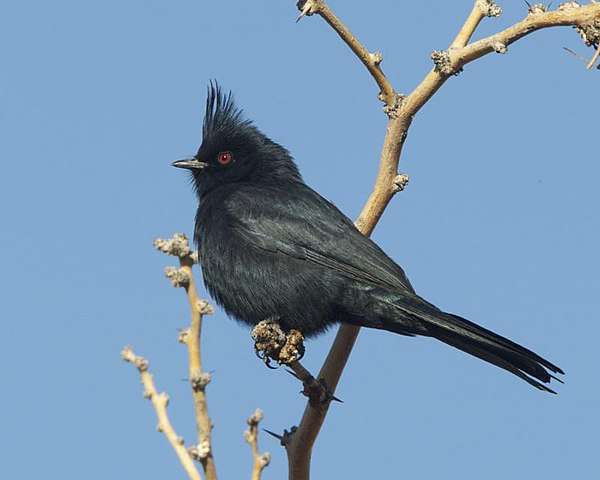
The female is a more subdued but equally elegant counterpoint. She is a pale, uniform gray, lacking the iridescence of the male, but she still maintains the noticeable crest and the characteristic white wing patches, though they are less conspicuous than those of her mate. Both sexes have bright red eyes, which stand out sharply against their dark heads, adding an element of intense watchfulness to their demeanor.
The Duel Residency: A Two-Season Lifestyle
Perhaps the most compelling aspect of the Phainopepla’s life is its dual residency, a migration pattern that follows its primary food source: the berries of mistletoe.
The Phainopepla is a specialist frugivore (fruit-eater) whose diet revolves almost entirely around the parasitic plants of the genus Phoradendron (Mistletoe). To secure a constant supply of ripe berries, the birds undertake two distinct breeding cycles in two distinct habitats:
Spring/Summer Breeding (Desert): From late winter into spring (roughly January to May), the Phainopeplas inhabit the dense scrublands and washes of the low desert (like the Sonoran and Mojave Deserts). Here, they nest in the mesquite and paloverde trees, feeding primarily on the berries of Desert Mistletoe (Phoradendron californicum). This early breeding period takes advantage of the brief window when desert conditions are mildest.

Phainopepla Late Summer/Fall Breeding (Coastal/Higher Elevation): As the desert summer becomes scorching, these birds undertake a local migration westward and upward to higher elevations or coastal areas (often California’s oak woodlands and sycamore groves). They begin a second nesting period, this time feeding on the different species of Oak Mistletoe (Phoradendron villosum).

This highly unusual strategy ensures they can raise two clutches of young, maximizing their reproductive success by always being in an area where their specific parasitic plant food is in peak season.
An Unwitting Gardener
The Phainopepla's dependence on mistletoe has led to a fascinating symbiotic relationship. When a Phainopepla consumes a mistletoe berry, it digests the fleshy pulp but excretes the sticky, gelatinous seed quickly—often within minutes.
Because the bird is often perched directly above a branch while eating, the sticky feces containing the seed adheres firmly to the branch below. This act is crucial for the mistletoe's survival, as the parasite cannot establish itself on a host tree without being deposited directly onto the bark. In essence, the Phainopepla is the principal, if not sole, disperser of mistletoe seeds in its habitat, an essential service that ensures the continuation of its own food supply.

Behavior and Vocalizations
Despite the "flycatcher" designation, the Phainopepla's behavior is more varied. They are often seen perched conspicuously atop the highest point of a mesquite or saguaro cactus, providing excellent views of their territory.
From this vantage point, they engage in two primary activities:
Aerial Flycatching: They occasionally sally out to catch flying insects, especially during the warmer months, justifying their secondary name.
Mimicry: Like mockingbirds, Phainopeplas are adept vocal mimics. Their songs are often a series of short, warbling notes interspersed with astonishingly accurate imitations of other birds they encounter, including Flickers, Kestrels, and other desert songbirds. Their own call is a soft, rising "whurp" note.
Conservation Status
The Phainopepla is currently classified as a species of Least Concern. Its large range across the southwestern U.S. and into northern Mexico, combined with its ability to exploit a readily available food source (mistletoe), provides it with a measure of ecological stability.
However, as a species closely tied to the density and health of desert and riparian woodlands, habitat destruction remains a threat. The preservation of the mesquite and paloverde forests—the very trees that host the mistletoe—is essential for the continuation of its two-part life cycle.
The Phainopepla is a vibrant thread in the tapestry of the American desert. Whether flashing its white wing patches against the deep blue sky or silently distributing the next generation of mistletoe, this elegant, crested bird is a perfect symbol of the unique and often unseen ecological dependencies that govern life in the arid landscape.
