

The Peregrine Falcon (Falco peregrinus) is not merely a bird of prey; it is a living symbol of speed, tenacity, and conservation triumph. Found across a vast range of environments in the United States, from remote coastal cliffs to the dizzying heights of urban skyscrapers, this magnificent raptor holds a singular title: the fastest animal on Earth. Its sleek design and specialized hunting tactics have secured its place as one of the most respected predators in the avian world.
This profile explores the Peregrine Falcon's exceptional adaptations, its remarkable recovery from the brink of extinction, and its enduring presence in the American landscape.
The Ultimate Avian Athlete: Speed and Hunting
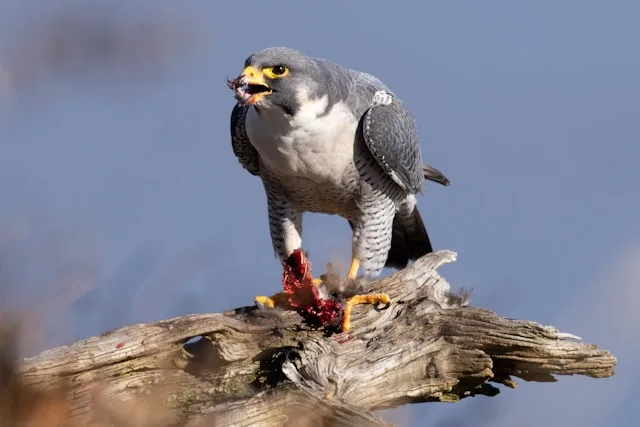
The Peregrine Falcon is a master of aerial pursuit, perfectly built for high-velocity hunting.
The Anatomy of Speed
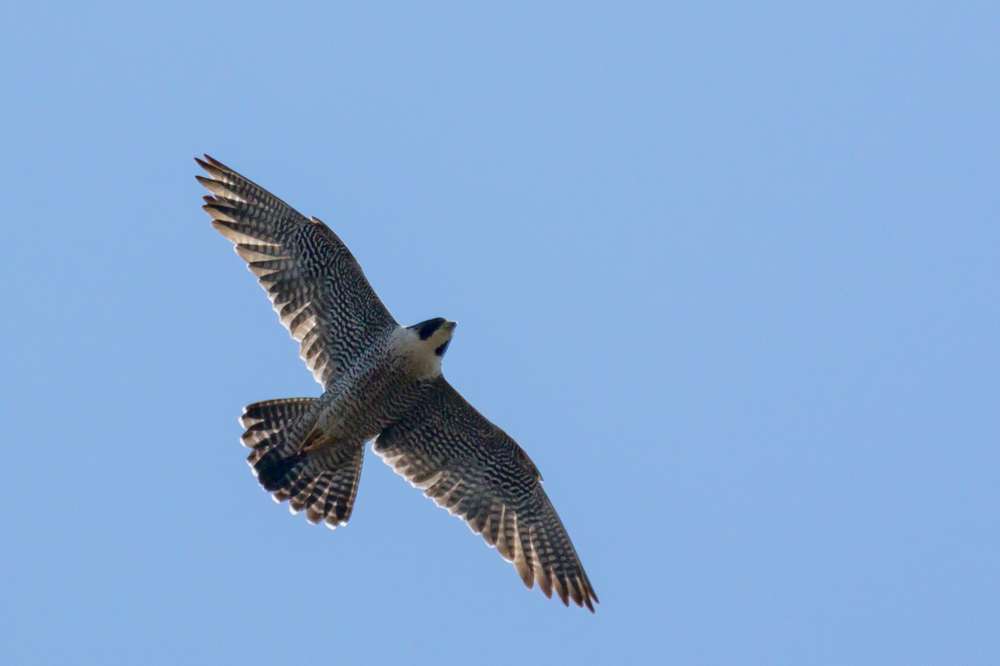
Adult Peregrine Falcons are crow-sized raptors with a compact, powerful body and long, pointed wings that span about three feet. Their physical features include:
- Distinctive Plumage: Adults have a striking slate-gray or bluish-gray back and crown, with a contrasting white or pale chest barred with thin, dark streaks.
- The Black Hood: The most characteristic feature is the black hood and the heavy, black "mustache" or malar stripe that runs down the side of the face. This stripe is believed to function like the black grease worn by athletes—it reduces solar glare, enhancing the bird's already keen vision during high-speed dives.
- The Tomial Tooth: Like all falcons, the Peregrine has a sharp, notched beak (the tomial tooth) used to quickly dispatch prey by severing the spinal column at the neck.
- Sexual Dimorphism: As is common with many raptors, the female is noticeably larger and heavier than the male, sometimes by as much as 30 percent. The male is often called a "tiercel," a term derived from the old English word meaning "one-third," referencing the size difference.

Peregrine Falcon
The Legendary "Stoop"
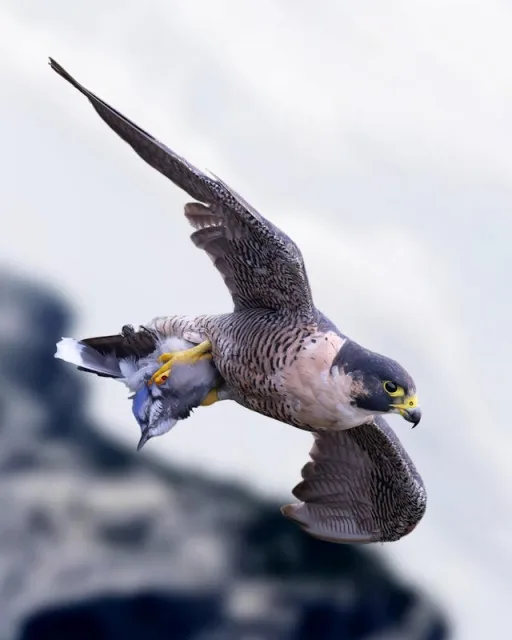
The Peregrine’s fame rests on its primary hunting technique, the "stoop." This is a steep, controlled power-dive that begins hundreds or even thousands of feet above its target.
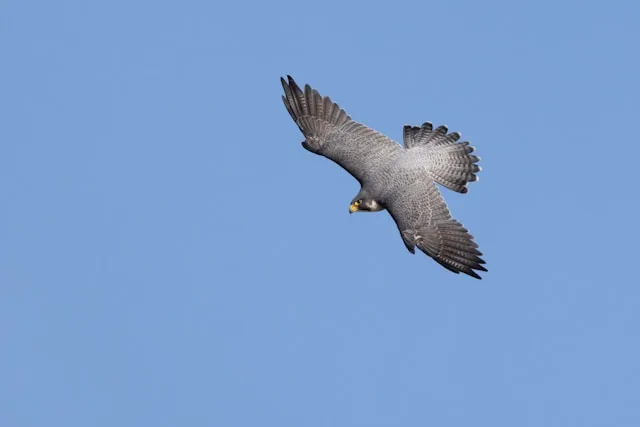
- Unrivaled Velocity: During a stoop, the falcon tucks its wings tightly against its body, transforming into a streamlined projectile that has been clocked at speeds exceeding 200 miles per hour, making it the fastest animal known to science.
- The Strike: The attack is almost always aimed at other birds, which the falcon catches in mid-air (earning it the old North American folk name "duck hawk"). The falcon strikes its prey with a powerful blow of a clenched foot, often stunning or killing the victim instantly, before circling back to catch the falling bird.
- Diverse Diet: While their diet includes a vast array of North American bird species—from starlings and pigeons in urban settings to ducks and shorebirds near water—they will also opportunistically consume bats.
A Conservation Triumph: The Comeback Story
The Peregrine Falcon's modern history in the United States is inseparable from the environmental crisis of the mid-20th century.
The DDT Crisis
From the 1940s through the 1960s, Peregrine Falcon populations crashed throughout North America. The cause was the widespread use of the synthetic pesticide DDT (dichlorodiphenyltrichloroethane).
- Bioaccumulation: The chemical accumulated up the food chain, eventually reaching high concentrations in the falcons. While DDT didn't directly kill adult birds, it interfered with the female falcon’s ability to metabolize calcium.
- Reproductive Failure: This resulted in eggs with dangerously thin shells that would crack and break under the weight of the incubating parent. By the mid-1960s, the entire nesting population of Peregrines in the eastern United States was wiped out, and western populations had plummeted by as much as 90 percent.
Recovery and Delisting
Following the banning of DDT in the U.S. in 1972, a massive, coordinated conservation effort began.
- Endangered Status: The Peregrine Falcon was officially listed under the federal Endangered Species Act (ESA) in 1970.
- Captive Breeding: Organizations like The Peregrine Fund pioneered techniques to successfully breed the birds in captivity. Over the next few decades, thousands of captive-bred chicks were released back into the wild using a method called "hacking," where young birds are placed in sheltered boxes high on cliffs or towers and cared for until they are ready to fledge.
- The Urban Adaption: The recovery was aided by the falcon’s remarkable adaptability. Instead of being restricted to remote mountain cliffs, falcons readily accepted man-made structures—skyscrapers, tall bridges, and towers—as substitutes for their traditional nesting ledges. These urban environments offered an abundant, year-round food source: the Rock Pigeon.
- Success: This unprecedented recovery led to the Peregrine Falcon being successfully removed from the federal endangered species list in 1999, a landmark moment in American conservation history. Today, the U.S. breeding population is estimated to be well over 1,650 pairs, a testament to the power of environmental regulation and dedicated wildlife restoration.
Habitat, Migration, and Nesting
The name "peregrine" means "wanderer," a fitting moniker for a bird that undertakes one of the longest migrations of any North American raptor.
A Cosmopolitan Resident
The Peregrine Falcon has the broadest distribution of any raptor, occurring on every continent except Antarctica. In the U.S.:
- Breeding Range: Peregrines breed across the country, but are most widely distributed in the western states, Alaska, and along coastal areas. They are also stable in many urban centers across the Midwest and East.
- Migration: Northern populations, especially those from Arctic regions, are long-distance migrants, traveling south through the U.S. to Central and South America. Other populations, particularly those adapted to city life, may be non-migratory residents.
- Habitat Diversity: While historically favoring open country with high, exposed cliffs for nesting, the Peregrine now thrives in diverse habitats, including coastlines, mountain ranges, river valleys, and, crucially, metropolitan areas.
Nesting Habits
Peregrine Falcons typically mate for life and return to the same nesting territory each year.
- Nest Placement: They do not build complex stick nests. Instead, the female chooses a high ledge on a cliff, a bridge support, or a tall building where she creates a simple "scrape"—a shallow depression dug into the gravel or substrate.
- Territoriality: Pairs are fiercely defensive of their nests and will vigorously chase away eagles, owls, and even human intruders, demonstrating the powerful instinct that allowed the species to rebound from near extinction.
The Peregrine Falcon is more than just a speed record-holder; it is an enduring symbol of wildness and resilience. Its graceful flight, fierce hunting style, and stunning recovery continue to inspire awe and remind Americans of the delicate balance between human activity and the natural world.
