

If you find yourself walking along a fenceline or a coastal scrub patch in the early spring, you might notice a small, brownish bird that refuses to sit still. It isn’t skulking in the canopy like its cousins; instead, it’s down in the dirt, tail pumping vigorously up and down like a nervous habit. Meet the Palm Warbler (Setophaga palmarum), one of North America’s most distinctive, hardy, and ironically named migratory songbirds.
Despite its tropical moniker, the Palm Warbler is a creature of the Great North, and its presence in the United States is a celebrated signal of the changing seasons.
A Name That Misleads
The "Palm" in Palm Warbler is something of a historical quirk. The bird was first described by naturalists who observed it on its wintering grounds in the Caribbean, often flitting among palm trees. However, for the majority of birdwatchers in the U.S. and Canada, the name feels like a bit of a mismatch.
You won't find this bird nesting in a coconut grove. Instead, the Palm Warbler is a specialist of the boreal muskegs—the damp, peat-filled bogs of Canada and the extreme northern fringe of the United States (primarily Minnesota, Wisconsin, and Maine).
Identification: The Tail Tells the Tale
The Palm Warbler is a medium-sized warbler with a fairly understated palette compared to the neon oranges of a Blackburnian or the deep blues of a Cerulean. However, what it lacks in flash, it makes up for in character.
Key Field Marks:
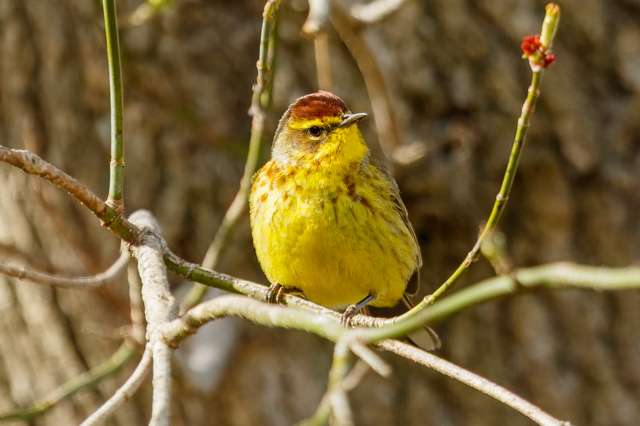
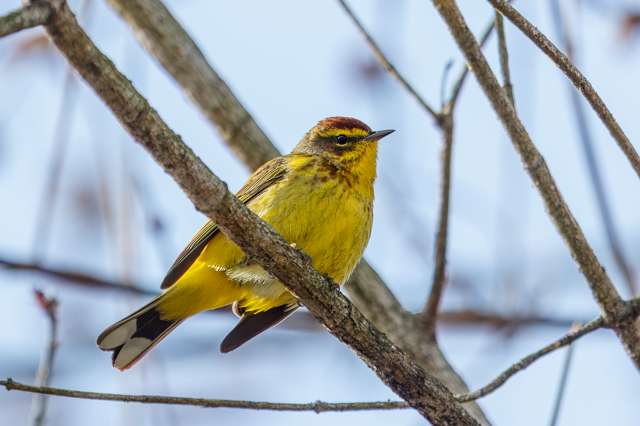
The Rusty Cap: In breeding plumage, adults sport a bright chestnut-red cap that sits atop a yellow "eyebrow" (supercilium).
The Yellow Undertail: Regardless of the season or subspecies, the undertail coverts are almost always a bright, buttery yellow.
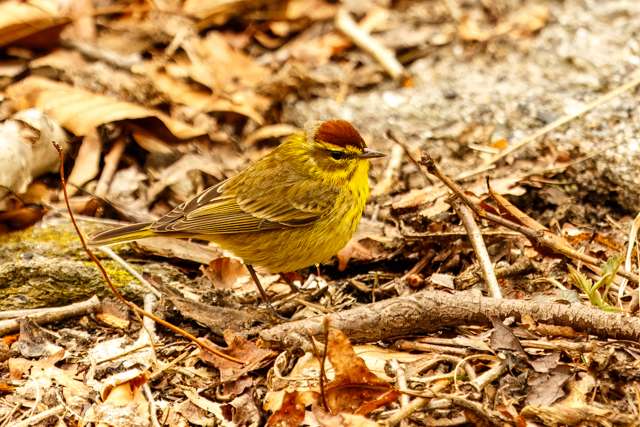
The Tail Wag: This is the "smoking gun" for identification. Palm Warblers constantly pump their tails downward. If you see a small bird on the ground or a low branch doing "push-ups" with its tail, it is likely a Palm Warbler.
There are two distinct populations: the "Yellow" Palm Warbler of the East, which is saturated with yellow across its entire underbelly, and the "Western" Palm Warbler, which is drabber and grayer with yellow restricted mostly to the throat and undertail.
Habitat and Life Cycle: From Bogs to Beaches
The Palm Warbler's life is a study in geographical extremes. Their breeding season is spent in the quiet, soggy solitude of the North.
Breeding and Nesting
Unlike most warblers that nest high in deciduous or coniferous trees, the Palm Warbler is a ground-dweller. They build their cup-shaped nests out of grass, strips of bark, and feathers, tucked away in the sphagnum moss at the base of a small spruce or larch tree. By nesting on the ground in boggy terrain, they avoid many of the predators that stalk the higher branches, though they must contend with damp conditions.
Migration: The Early Bird
The Palm Warbler is one of the earliest migrants to arrive in the U.S. during the spring. While other warblers wait for a massive hatch of caterpillars in May, the Palm Warbler often arrives in late March or April. They are versatile foragers, happily switching from insects to seeds and berries if the weather turns cold.
During migration, you can find them in "edge" habitats:
Open fields and pastures
Gardens and city parks
Coastal dunes and marshes
Behavior: The Ground Specialist
If you watch a Palm Warbler for five minutes, you’ll realize it behaves more like a sparrow or a pipit than a traditional warbler. They spend an inordinate amount of time on the ground, hopping through the grass to snatch up beetles, flies, and spiders.
This terrestrial lifestyle makes them much easier to photograph and observe than the "warbler neck"-inducing species that stay 50 feet up in the oak trees. They are also relatively bold, often allowing birders to get within a dozen feet before fluttering to a nearby low shrub.
Conservation Status
Currently, the Palm Warbler is considered a species of Least Concern. Because their breeding grounds are in remote, northern bogs that are largely unsuitable for agriculture or heavy development, their nesting success remains high.
However, they face the same threats all migratory birds face:
Habitat Loss: Development of coastal wintering grounds in Florida and the Caribbean.
Window Collisions: Because they migrate at night, they are susceptible to light pollution and glass in urban centers.
Climate Change: As the boreal forests warm, the delicate balance of the muskeg ecosystems may shift, potentially moving their range further north.
Why We Love Them
The Palm Warbler is the "everyman" of the warbler world. It is hardy, adaptable, and easy to find. For many birders, seeing that first rusty cap and the rhythmic wag of a tail against a backdrop of melting April snow is the definitive proof that winter has lost its grip. It is a tiny, feathered bridge between the tropical Caribbean and the wild, silent bogs of the North.
