
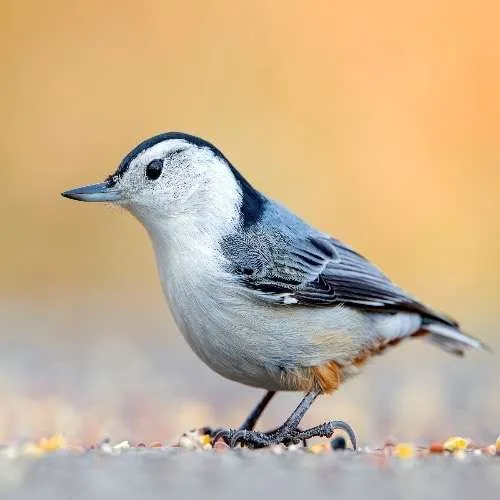
The Nuthatch family (Sittidae) may be small in terms of the number of species in the United States, but these birds are giants in personality and skill. Known universally for their distinctive habit of descending tree trunks head-first—an avian feat virtually unmatched by any other American bird—nuthatches are compact, energetic, and indispensable residents of North America's forests.
In the U.S., four main nuthatch species are regularly found, each occupying a specific ecological niche based primarily on the type of conifer or deciduous forest they inhabit. These four species are the White-breasted Nuthatch, the Red-breasted Nuthatch, the Brown-headed Nuthatch, and the Pygmy Nuthatch. They all share a fundamental body plan—short tails, large heads, and powerful feet—perfectly adapted for life spent defying gravity on bark.
White-breasted Nuthatch (Sitta carolinensis)

The White-breasted Nuthatch is the largest and most widespread nuthatch in North America. It is the only species found throughout almost the entire contiguous U.S., wherever deciduous or mixed deciduous-coniferous woodlands are present.
Habitat and Range
This species prefers mature, open deciduous forests or mixed woodlands, often utilizing oaks, hickories, and pines. Its massive range extends from southern Canada deep into Mexico, and it is a permanent resident across its entire territory, rarely migrating. This familiarity makes it a frequent visitor to backyard feeders, where its bold behavior is easily observed.
Identification and Behavior
The White-breasted Nuthatch is easily recognized by its:
Large Size: About 5 to 6 inches long, noticeably larger than its cousins.
Coloration: It has a blue-gray back, a prominent black cap that extends to the nape (in males), and, as its name suggests, pure white underparts.
Call: Its most common call is a distinct, nasal, and high-pitched "yank-yank-yank."
Feeding: It is the quintessential "upside-down bird," known for probing bark crevices for insects and spiders. It earns the "nuthatch" name from its habit of jamming large seeds or nuts into bark and then hatching (or hammering) them open with its strong, sharp bill.

White-breasted Nuthatch
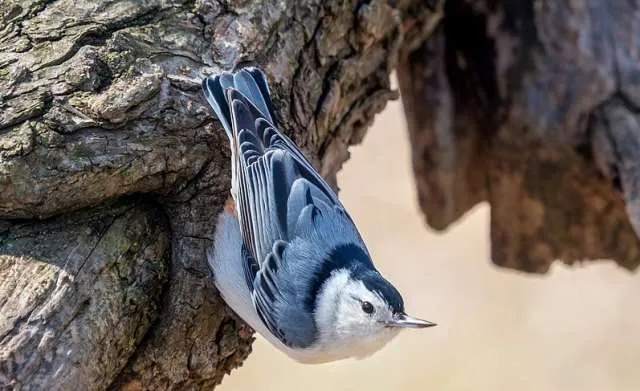
The White-breasted Nuthatch is a vital part of the forest ecosystem, consuming pests like bark beetles and contributing to forest health year-round.
Red-breasted Nuthatch (Sitta canadensis)
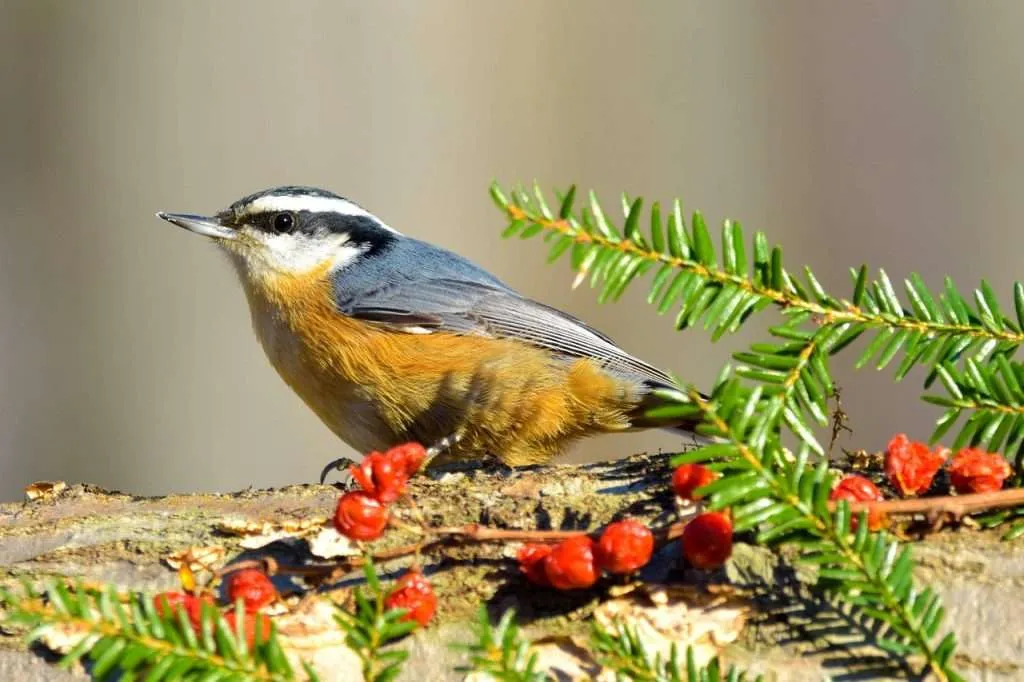
The Red-breasted Nuthatch is the classic nuthatch of the northern forests, easily distinguished from its white-breasted relative by its colors and its nomadic tendencies.
Habitat and Range
This species is strongly associated with coniferous forests, preferring spruce, fir, and pine. Its core breeding range is the boreal forest of Canada and the high-elevation conifer forests of the Rocky Mountains, the Pacific Northwest, and the Appalachians.
Irruptions and Migration
Unlike the White-breasted Nuthatch, the Red-breasted Nuthatch is known for irruptive migration. In years when the northern cone crop fails (meaning food is scarce), huge numbers of these birds will flood south into the central and southern U.S. or move to lower elevations. Birders in states like Texas and Florida often experience an exciting influx of these northern visitors during irruption years.
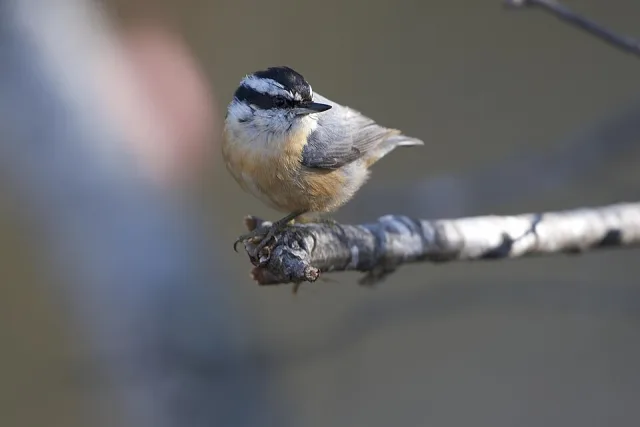
Identification and Behavior
Size: Smaller and more compact than the White-breasted Nuthatch.
Coloration: It features a rusty-red breast, a striking black eye-line (eyebrow), and a blue-gray back.
Call: Its call is quite different—a high-pitched, thin, and rather nasal "ink-ink-ink" or "yeeen-yeeen-yeeen."
Adaptation: It regularly uses pitch from sap and tree resin to plaster around the entrance of its nesting hole, likely to deter predators or competitors from entering. This unique behavior highlights its strong adaptation to resinous conifers.
Brown-headed Nuthatch (Sitta pusilla)
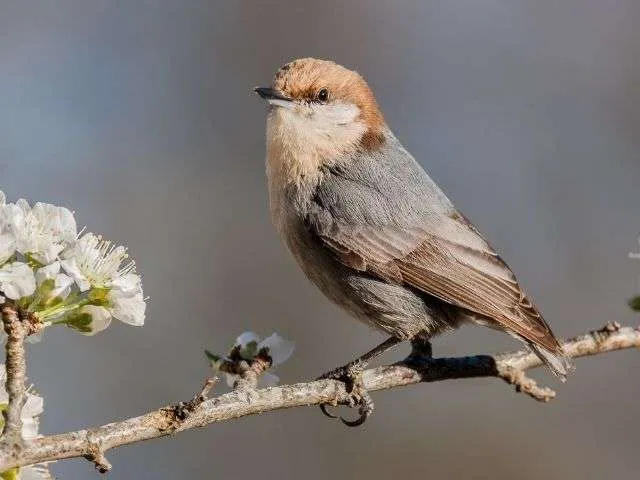
The Brown-headed Nuthatch is the small, specialized nuthatch of the Southeastern United States, a true endemic of the pine forests.
Habitat and Range
This species is almost exclusively confined to mature pine forests, particularly those dominated by Longleaf Pine and Loblolly Pine. Its range stretches across the Coastal Plain and Piedmont from eastern Texas to Florida and north to Delaware. Its survival is intrinsically linked to the health of the southern pine ecosystem.
Behavior and Tool Use
The Brown-headed Nuthatch is famed for its unique behavior and small size. It is the smallest U.S. nuthatch and has one of the most remarkable behaviors: it is one of the few bird species known to use tools.
Tool Use: They frequently use a small piece of bark or wood fragment as a lever or wedge to help pry open other pieces of bark to search for insects.
Sociality: Unlike the largely solitary Red and White-breasted Nuthatches, the Brown-headed Nuthatch is highly social. They often forage in noisy, fast-moving groups and practice cooperative breeding, where young birds from previous clutches help the parents raise the current brood.
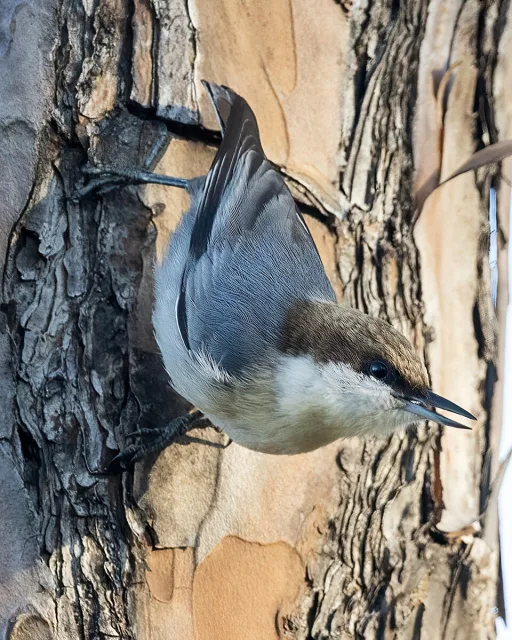
Identification
Coloration: It has a gray-brown cap that blends into the blue-gray back, and pale, dull-white underparts.
Pygmy Nuthatch (Sitta pygmaea)
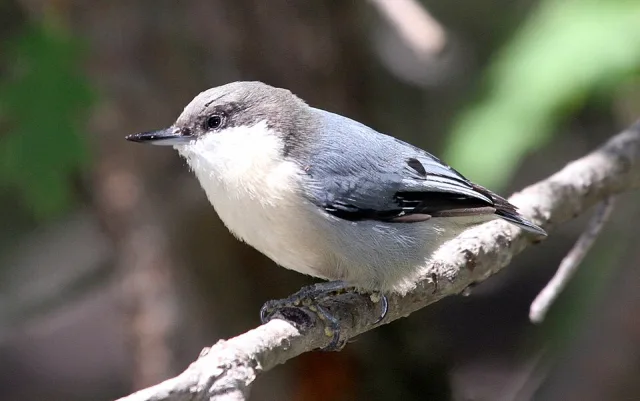
The Pygmy Nuthatch holds the title of the U.S.'s smallest nuthatch and is a social resident of the western mountains.
Habitat and Range
This bird is tied almost exclusively to Western coniferous forests, particularly those dominated by Ponderosa Pine. Its range follows the spine of the Rocky Mountains, the Sierra Nevada, and the Pacific Coast mountains, typically at higher elevations.
Sociality and Roosting
The Pygmy Nuthatch is arguably the most social of the U.S. species. They live in large family groups and, most remarkably, exhibit extreme communal roosting.
Huddling Behavior: In cold weather, dozens (sometimes over a hundred) of Pygmy Nuthatches will cram themselves into a single tree cavity to share body heat. This behavior, which dramatically reduces energy expenditure during cold nights, is one of the best examples of avian communal thermoregulation.
Voice: Their primary call is a high-pitched, rapid, squeaky chatter often described as "pip-pip-pip," which helps flocks stay in constant contact as they forage.
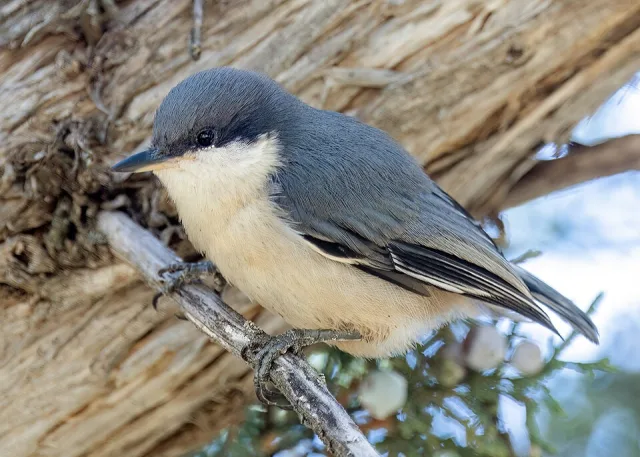
Identification
Size: True to its name, it is tiny, measuring only about 3.5 inches long.
Coloration: It has a warm brown cap, a blue-gray back, and a white spot on the back of the neck (nape), which is sometimes obscured.
The Nuthatch Niche: An Upside-Down Advantage
The success of all nuthatch species comes down to their mastery of an exclusive niche: downward foraging.
Most tree-climbing birds, like woodpeckers and creepers, rely on their stiff tail feathers for support, which means they can only ascend a trunk or go sideways. Nuthatches, lacking the rigid tail feathers for propping, compensate with extraordinarily strong legs and long claws. This allows them to descend head-first, giving them a unique perspective that other birds lack. They can effectively check the bottom side of bark flakes and crevices, spotting insects and eggs that have been missed by upward-climbing foragers. This distinct feeding style reduces competition, ensuring all four species maintain a specialized role in their respective forest environments.
Profile of the Upside-down Bird : The White-breasted Nuthatch
