

A silent hunter, a master of aerodynamic grace, and an unmistakable sign of summer in the American South and Midwest—the Mississippi Kite (Ictinia mississippiensis) is one of North America's most elegant raptors. Unlike the aggressive, heavy-bodied birds of prey that often dominate the skies, the Mississippi Kite is characterized by its light build, buoyant flight, and a surprisingly gentle demeanor, making it a fascinating subject for birders and urban dwellers alike.
Identification: The Gray Ghost
The Mississippi Kite is a medium-sized raptor, noticeably smaller and sleeker than the common Red-tailed Hawk. Its appearance is striking yet subtle, earning it the nickname "Gray Ghost" in some regions.
Key identifying features include:
Coloration: Adults possess a beautiful, uniform ash-gray body, a pale gray or almost white head, and darker gray to black flight feathers.
Eyes: They have distinctive, large red eyes that contrast sharply with their light head.
Wings and Tail: Their wings are long, narrow, and pointed, giving them a decidedly falcon-like silhouette when soaring. The tail is long and squared, lacking the prominent banding found on many other raptors.
Juveniles: Younger birds are mottled brown with streaking on the chest and a boldly banded black-and-white tail, a look that changes dramatically as they mature into the solid gray adults.
Their flight is perhaps their most defining characteristic. They are incredibly buoyant and graceful flyers, often seen performing acrobatic maneuvers with slow, deliberate wingbeats or long, effortless glides. They frequently soar at high altitudes, giving the impression of an arrowhead against the blue sky.
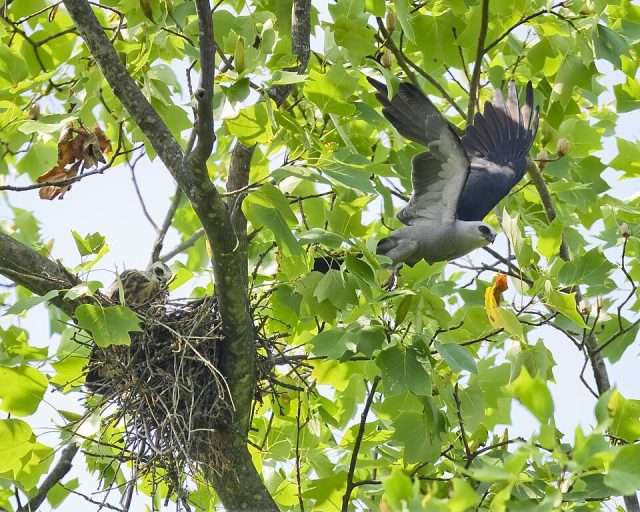
Habitat and Range: From the Plains to the Parks
The Mississippi Kite's range spans much of the central and southern United States. They are Neotropical migrants, spending the breeding season primarily in the southeastern U.S., extending west into the Great Plains states like Oklahoma and Kansas, and sometimes as far north as southern Iowa.
What makes their presence particularly notable is their tolerance for, and adaptation to, urban environments. Unlike many raptors that require vast, unbroken wilderness, Mississippi Kites frequently choose to nest in mature, tall trees within city parks, suburban neighborhoods, and even busy residential areas, especially those near water. This urban adaptability has allowed their populations to remain stable, even as surrounding habitats undergo development.
In the fall, their entire population undertakes a massive migration south, funneling through Central America and wintering almost entirely in the Chaco region of South America, specifically in central Bolivia, Paraguay, and northern Argentina. This long-distance journey underscores their reliance on healthy ecosystems across two continents.

The Master Insectivore: Diet and Hunting
The diet of the Mississippi Kite is remarkably specialized and almost entirely composed of large insects, setting it apart from other raptors that rely on rodents and birds. They are considered obligate insectivores during the summer months, with their primary prey including:
Dragonflies: A significant component of their diet, which they often catch in mid-air.
Cicadas: Their emergence provides a seasonal feast for the kites.
Grasshoppers and Katydids: Easily snatched from vegetation or the ground.
Flying Termites: Another abundant source during swarming events.
Kites are aerial foragers, and their hunting technique is a marvel to watch. They rarely pursue prey on the ground. Instead, they patrol the airspace, using their keen eyesight to spot flying insects. Once prey is sighted, the kite executes a swift, precise dive or chase, often catching the insect with its talons. The bird then transfers the prey to its beak while still in flight and consumes it without ever landing. This aerial dining is a key field mark for identifying a feeding kite.
On occasion, particularly when feeding young, they will opportunistically take small vertebrates, such as lizards, small snakes, or young birds, but this forms a minor part of their overall diet.
Nesting and Social Behavior
Mississippi Kites are generally monogamous and return to the same general area, sometimes even the same nest tree, year after year.
Nesting: Nests are built high in the canopy of large, mature trees (often Oaks, Elms, or Cottonwoods). The nest itself is a relatively small, flimsy-looking structure made of sticks and twigs, lined with green leaves—a characteristic that likely helps camouflage the eggs and young. They typically lay one to three eggs.
Defense: While generally non-aggressive, Mississippi Kites are fiercely protective of their nests and young. During the nesting season (late spring/early summer), a kite will perform a spectacular, rapid dive on perceived threats, which can include humans, dogs, or other large birds that approach the nest too closely. Though they usually pull up at the last second, these "stoops" can be unnerving and serve as a clear warning to give nesting areas a wide berth.
Sociality: Kites are surprisingly social. Outside of the nesting period, they often forage and roost in large groups. Post-breeding season, they form communal roosts where hundreds of birds gather nightly before beginning their mass migration south.
The Mississippi Kite's ability to thrive in proximity to human settlements makes it an enduring symbol of how nature can adapt and flourish even in developed landscapes. Its presence is a seasonal gift—a silent, soaring shadow that reminds us of the long-distance travelers passing overhead and the fragile, beautiful networks of life that connect the Americas.
The White Comet of the Southern Sky: Profiling the Swallow-tailed Kite

Great article about these beautiful birds. We live in Alabama, and the Mississippi Kite has recently graced our back yard with its presence. I heard one for the first time in July (the Merlin app identified it) and have heard it several times since then. I’ve not yet been fortunate to see one.
Thanks Rebecca. They are lovely birds, keep looking and I'm sure you'll spot one soon.