
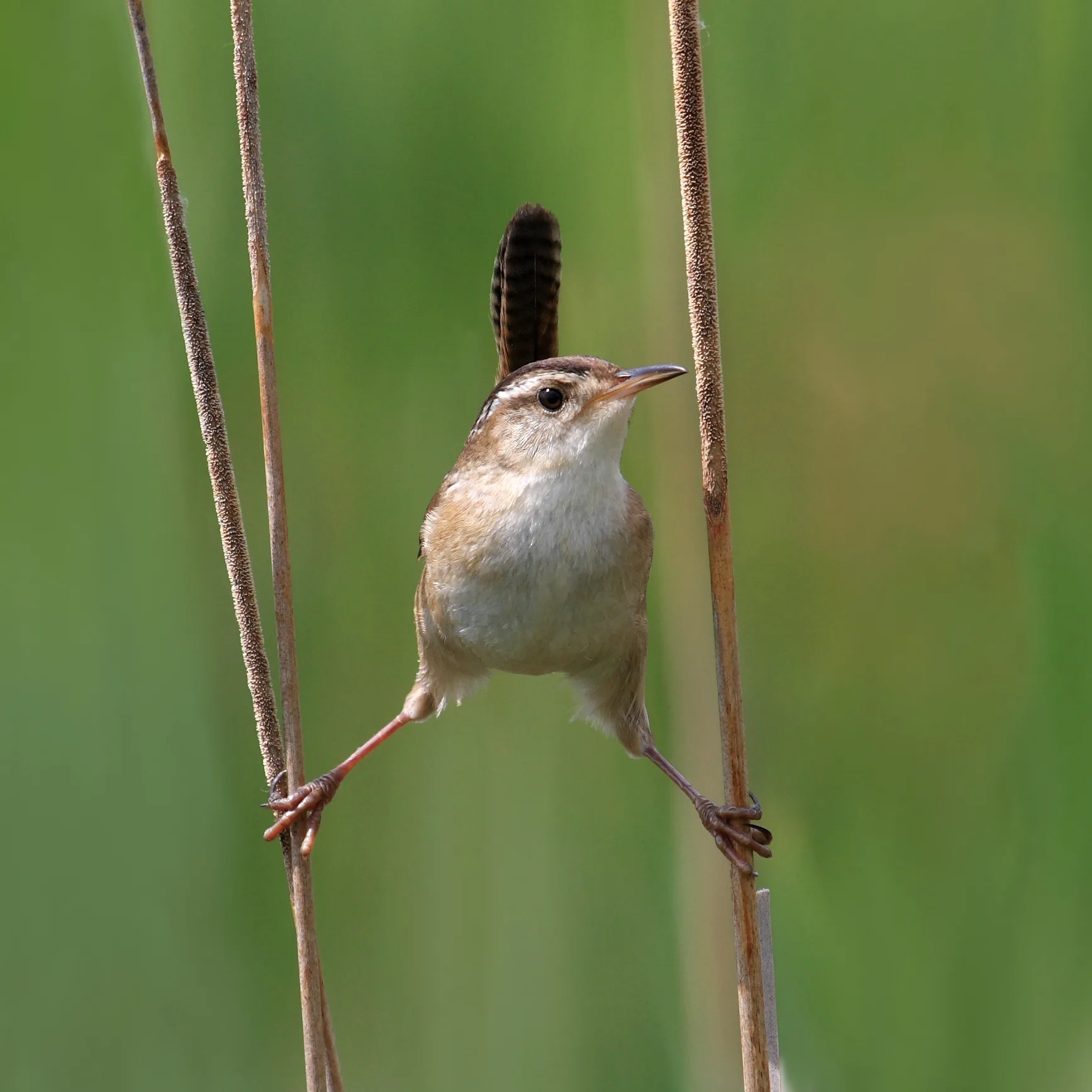
The Marsh Wren (Cistothorus palustris) is a small, energetic songbird, a characteristic resident of the dense, reedy wetlands of North America. Known for its incredible vocal prowess, hyperactive nature, and complex, almost architectural nesting habits, this tiny avian dynamo is a quintessential part of the marsh ecosystem. While easily overlooked among the towering cattails and rushes, its persistent, bubbly song and remarkable social life make it one of the most intriguing avian inhabitants of the continent’s freshwater and brackish wetlands.
Identification: A Brown Blur with Attitude
The Marsh Wren is a diminutive bird, measuring only about 12.5 cm (5 inches) in length, yet it possesses a robust body and a personality that far exceeds its size.
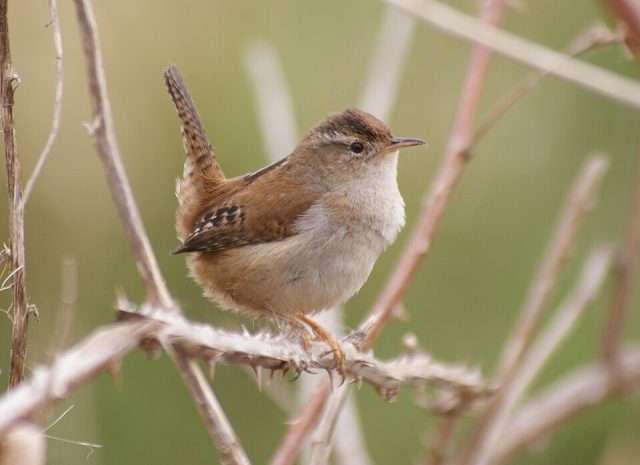
Plumage: Its overall coloring is a warm brown above, contrasting with a dull white or pale gray underside. The head is darker brown, often with a subtle white stripe above the eye (supercilium).
Back: A key field mark is the white striping on the dark back, giving it a streaked appearance.
Bill and Tail: It possesses a thin, slightly decurved bill typical of insectivores. Like many wrens, it habitually holds its short tail cocked straight up over its back, a perpetual posture of feisty alertness.
Behavior: Marsh Wrens are notoriously difficult to observe clearly. They spend most of their time actively clambering, creeping, and slipping through the dense vertical stems of marsh vegetation. They are constantly in motion, darting in and out of view, rarely pausing for long.
The Voice of the Reeds
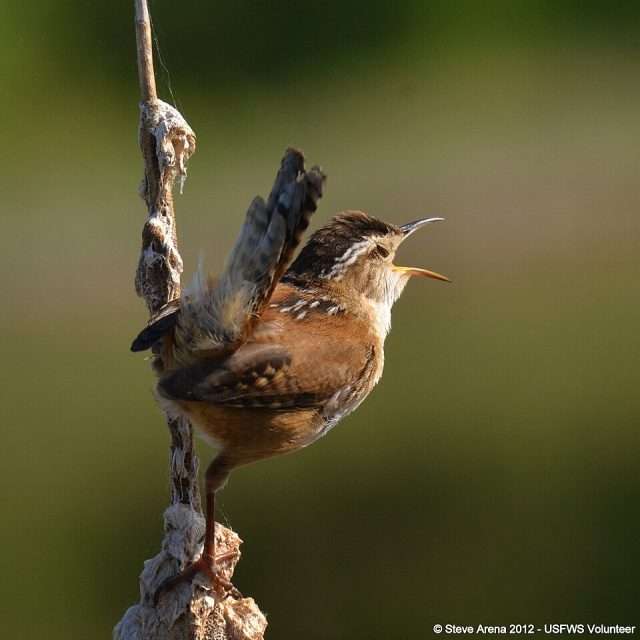
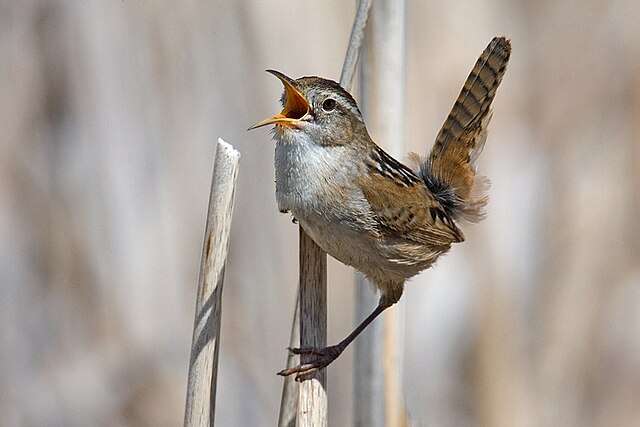
The Marsh Wren is famous for its high-energy, complex song. The male sings almost incessantly throughout the day during the breeding season, often delivering his rapid, metallic trill from the top of a cattail stalk or rush.
The song is a fast, bubbly, sputtering machine-gun rattle, typically described as a series of low gurgles followed by a high, mechanical trill or buzz. This impressive vocalization serves multiple functions:
Territory Defense: The song is used to demarcate and fiercely defend its small territory against neighboring males.
Mate Attraction: The intricacy and persistence of the song are signals of the male's fitness and quality to prospective females.
Unlike some other songbirds, the Marsh Wren has two distinct song types: a "whisper song" used near the nest, and the loud, territorial song used for distance communication.
Habitat and Range: Wetland Specialist
The Marsh Wren is a habitat specialist, almost entirely restricted to wetlands dominated by tall, emergent vegetation.
Preferred Vegetation: It shows a strong preference for dense stands of cattails, bulrushes, or cordgrass. The vertical stems provide both the structural support for its elaborate nests and the dense cover required for safety.
Geographic Range: The species is widespread across the North American continent.
Breeding: It breeds across the southern half of Canada and the northern half of the contiguous United States.
Migration: Northern populations are migratory, moving south to winter along the southern US coastlines, the Mexican border states, and central Mexico.
Resident: Populations along the Pacific Coast and the Gulf Coast are often non-migratory year-round residents.
Architect of the Marsh: Nesting and Social Dynamics
The breeding behavior of the Marsh Wren is one of the most complex and fascinating among North American songbirds, revolving around its unique nesting strategies and polygynous mating system.
The Dummy Nests
The male Marsh Wren is an incredibly prolific nest builder. Upon establishing his territory, he constructs numerous incomplete, non-functional nests called "dummy nests" or "cock nests."
Purpose: These woven, globe-shaped structures serve multiple purposes:
Advertising: They are visual advertisements of the male's vigor and quality, attracting females to his territory.
Decoys: They may function as decoys, confusing predators and preventing them from locating the single true, occupied nest.
Construction: All nests are spherical or oval structures woven tightly around several vertical stems, using wet grasses, cattail fluff, and mud. They feature a side entrance, making them exceptionally well-camouflaged.
The Polygynous System
Marsh Wrens are often polygynous, meaning one male mates with multiple females. The quality of a male's territory, measured by the density of the marsh and the number of dummy nests he has built, determines the number of mates he attracts (up to four).
True Nest: Once a female chooses a mate, she will select one of the male's dummy nests or build a new one herself, lining it with fine materials like down, feathers, and hair to transform it into the functional, insulated true nest where she lays 4 to 10 eggs.
Parental Care: The female undertakes nearly all incubation and chick-rearing duties, while the male remains focused on defending his territory and attracting additional mates.
Diet and Ecological Role
Marsh Wrens are primarily insectivores. Their diet is composed almost entirely of the small invertebrates that thrive among the dense marsh vegetation:
Prey: They consume huge numbers of spiders, beetles, flies, aquatic insect larvae, damselflies, and moths.
Foraging: They are highly acrobatic foragers, picking insects off of reeds, chasing flies through the air, and probing into crevices in the plant stems.
This highly specialized diet makes them excellent controllers of marsh insect populations and links them inextricably to the health of the wetland environment.
Conservation Status and Outlook
While the Marsh Wren is currently listed as a species of Least Concern globally due to its vast range, the species is an important barometer for wetland health.
Threat: The single greatest threat to Marsh Wrens is the loss and degradation of marsh habitat due to drainage, filling, pollution, and invasive plant species (like Phragmites, which create habitat less suitable than native cattails).
Indicator Species: Because they are so highly dependent on dense, specific marsh vegetation, their local population health serves as a direct indicator of the ecological integrity of a wetland. Conservation efforts focused on protecting, restoring, and managing North American wetlands are crucial for the long-term prosperity of this tiny, dynamic architect of the reeds.
The Marsh Wren, the lively, loud, and clever master of camouflage, remains one of the most fascinating characters to seek out in North America's invaluable, yet threatened, marsh ecosystems.
