

The Limpkin (Aramus guarauna), also known by the evocative names Carrao or Crying Bird, is a unique and intriguing wading bird of the Americas. As the sole member of its family, Aramidae, it represents an evolutionary blend, sharing traits with both the rails and the cranes. This large, long-legged bird is most renowned for its haunting, wailing calls and its highly specialized diet, which ties its distribution closely to a single type of prey.
Range and Habitat
The Limpkin is found across a wide geographic range in the Western Hemisphere, from the southeastern United States (primarily Florida and southern Georgia) through the Caribbean and Central America, and extensively into South America as far south as northern Argentina. Its presence is almost exclusively dictated by the availability of its preferred food.
They inhabit freshwater wetlands such as marshes, swamps, and the shores of slow-moving rivers and lakes. Their long toes allow them to walk easily across floating vegetation, a behavior crucial for hunting in their dense, watery environment. While generally non-migratory, some populations may move seasonally in response to wet and dry periods.
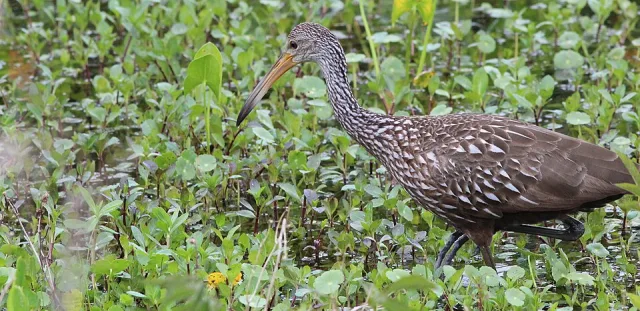
The Apple Snail Specialist
The Limpkin is a true dietary specialist, earning the title of a molluscivore. Its diet is overwhelmingly dominated by the Apple Snail (Pomacea genus).
Unique Adaptations
The bird's bill is a marvel of specialization. It is long, heavy, and slightly downcurved, yellowish with a darker tip. Crucially:
The tip often curves slightly to the right, which perfectly matches the coil of the apple snail's shell, allowing for efficient extraction.
It has a slight gap just behind the tips of the mandibles, which acts like a pair of tweezers to grip and manipulate the snail's shell and remove the meat.
When foraging, the Limpkin walks slowly through shallow water or on floating mats of vegetation, looking for snails. Once prey is secured, it is carried to firm ground or a feeding perch where the bird expertly uses its bill to sever the snail's adductor muscle and pull the meat from the intact shell.

Distinctive Appearance and Vocalizations
The Limpkin is a medium-to-large bird, measuring about 64–73 cm (25–29 in) in length. Its plumage is a drab dark brown or olive, heavily marked with conspicuous white streaks and spots, particularly on the head, neck, and upper body.
Its common name, Limpkin, is derived from its unusual, high-stepping gait as it walks across uneven, vegetated surfaces, giving the impression it is limping.
However, the Limpkin is often easier to hear than to see. Its most distinctive feature is its call—a loud, wild, and piercing wail or scream, often described as a repeated "krrr-eeeow" or "klAAAar." This memorable vocalization is most frequently heard at dawn, dusk, and throughout the night, lending credence to its other common name, the "Crying Bird."

Conservation Status
Despite being historically overhunted in some areas like Florida in the early 20th century, the Limpkin population has generally recovered and is currently listed as Least Concern by the IUCN. Nevertheless, the species remains vulnerable to habitat loss (wetland drainage) and the resulting decline in its essential food source, the Apple Snail.
7 Rare Birds Americans Are Spotting More Than Ever—And Where to Find Them
