

In the vibrant tapestry of the avian world, where every feather seems painted with purpose, there occasionally appears a bird that stands out dramatically from its peers—a flash of pure white where there should be color, or a strangely mottled pattern that defies identification. This striking phenomenon is often due to leucism, a genetic condition that results in a partial or complete absence of melanin pigment in the feathers. Distinct from albinism, leucism gives rise to some of the most captivating and sometimes hauntingly beautiful individuals in the bird kingdom, prompting fascination among birdwatchers and scientists alike.
What is Leucism? Unpacking the Science
At its core, leucism is a genetic mutation that affects the production and/or deposition of melanin pigments in the feathers, and sometimes in the soft parts (beak, legs, eyes) as well.
Melanin: The Master Pigment
To understand leucism, we first need to understand melanin. Melanin is the most common pigment found in bird feathers, responsible for shades of black, gray, and brown. It also provides structural integrity to feathers, making them stronger and more resistant to wear and tear.
How Leucism Works
Unlike albinism, which results from a complete inability to produce melanin due to a defect in the enzyme tyrosinase, leucism arises from problems with the melanin cells themselves. These cells (melanocytes) may:
- Fail to Differentiate: The melanocytes don't develop properly in certain areas of the feather.
- Fail to Migrate: Melanocytes don't reach all parts of the feather.
- Fail to Produce/Deposit: Melanocytes might produce melanin, but they can't effectively deposit it into the growing feather.
The key result is that feathers are grown without melanin, appearing white.

Leucism vs. Albinism: A Crucial Distinction
This is where the most common confusion lies. While both conditions result in white feathers, they are fundamentally different:
An important point for identification is the eye color. A leucistic bird will typically have dark, normal-colored eyes because the melanin in the iris is often unaffected. An albino bird, lacking melanin entirely, will show the red blood vessels of the eye through a clear iris.
The Spectrum of Leucism: From Patches to Pure White
Leucism is not an all-or-nothing condition. It exists on a spectrum, leading to a variety of appearances:
- Partial Leucism (Pied or Mottled): This is the most common form, where a bird has irregular white patches on an otherwise normal-colored body. It can manifest as white wings, a white head, or random white blotches on the chest or back. This is often the result of a less severe genetic mutation affecting only certain areas.
- Dilute Leucism: In this form, the melanin is produced but is much sparser, resulting in a faded or washed-out appearance. A bird that should be black might appear light gray, or a brown bird might look pale tan.
- Total Leucism: In rare cases, a bird can be almost entirely white due to a complete absence of melanin in all feathers. Such birds can look very similar to albinos, but their normal eye color remains the key distinguishing factor.

Challenges and Advantages of Leucism
While striking, leucism can present both challenges and, occasionally, unexpected advantages for birds.
The Downside: Survival Challenges
- Camouflage Loss: For species that rely heavily on cryptic coloration (like many ground-nesting birds or those that blend into foliage), a sudden patch of white can make them highly conspicuous to predators.
- Melanin's Strength: Feathers lacking melanin are weaker and more brittle. This means they can wear out faster, potentially affecting flight efficiency and insulation, and requiring more frequent molting.
- Social Disadvantage: Leucistic birds may sometimes be ostracized or have difficulty attracting mates, as their atypical appearance can be seen as a sign of ill health or genetic inferiority by conspecifics.
- UV Sensitivity: While not as severe as in albinism, some leucistic birds might experience increased sensitivity to UV radiation due to reduced melanin in the skin under their feathers.
The Upside: Rare Observations
- Easier Spotting: For birdwatchers, leucistic birds are often easier to spot and track due to their unusual appearance. This can provide valuable data points for citizen science projects, even if the bird's condition is an anomaly.
- Unusual Courtship: In rare instances, a unique appearance might even be advantageous for attracting a mate, particularly if it's perceived as novel or exceptional. This is far less common than the disadvantages, but possible.
Leucism in Action: Notable U.S. Examples
Leucism has been observed in virtually every bird family across the United States. Here are a few prominent examples:
1. American Robin (Turdus migratorius)

Partial leucism is relatively common in American Robins, often manifesting as stark white feathers on the head, wings, or tail. A robin with a pure white head contrasting with its otherwise typical gray back and rusty breast is a frequent and surprising sight in suburban backyards.
2. Red-tailed Hawk (Buteo jamaicensis)

Seeing a Red-tailed Hawk with significant white areas on its body, particularly the wings, is a striking experience. These large raptors rely on their typical brown and reddish tones for camouflage while hunting. A leucistic individual stands out dramatically against the landscape.
3. Common Raven (Corvus corax)
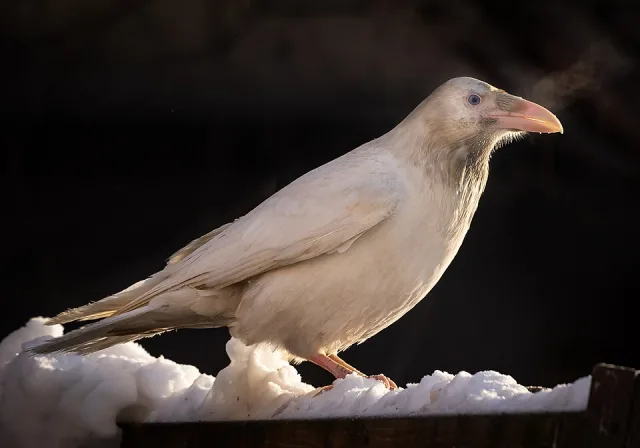
While the default raven is jet black, leucistic ravens, particularly in certain populations like those on Vancouver Island, can be quite stunning. They may have large white patches or appear entirely white, presenting a ghostly figure against the often dark forest background. These birds are a testament to the fact that even the most uniformly colored species can harbor genetic surprises.
The American Birding Association's 2024 Report: Changes to Species
