
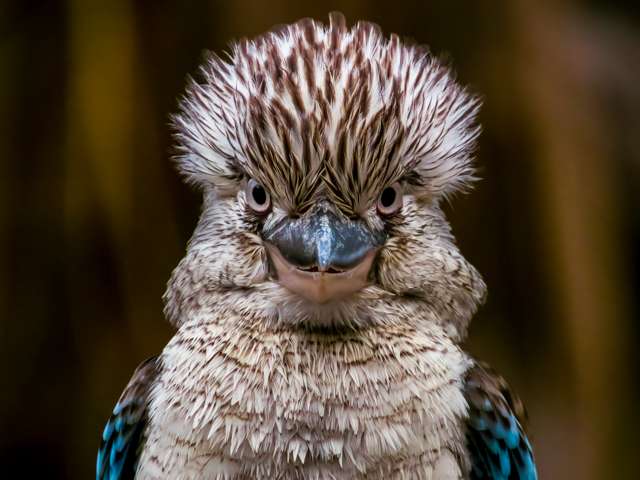
The kookaburra, with its iconic, boisterous call, is one of Australia’s most beloved and recognizable birds. Far more than just a sound, this large, stocky bird is a fascinating predator, a social creature, and a symbol of the Australian wilderness. Its "laugh" is not one of joy or amusement, but a complex vocalization that serves a vital purpose in its life—from marking territory to communicating with its family.
While commonly associated with Australia, the kookaburra’s story is a deep dive into its unique biology, social structure, and its role as a powerful, cunning predator in a land of diverse and often challenging prey.
The Sounds of the Bush: Anatomy of the Kookaburra's Call
The laughing call of a kookaburra is an unforgettable sound, a cascade of raucous, human-like laughter that echoes through the trees at dawn and dusk. This vocalization is the key to their social and territorial behavior. The sound is not made by a single bird, but is often a chorus involving several members of a family group. The call typically begins with a soft chortle from one bird, which then builds in volume and intensity before being joined by the rest of the group in a full-throated, cackling chorus. The calls are usually heard most frequently in the early morning and late evening, serving as a form of social "roll call" and a clear signal to neighboring groups about their territorial boundaries.
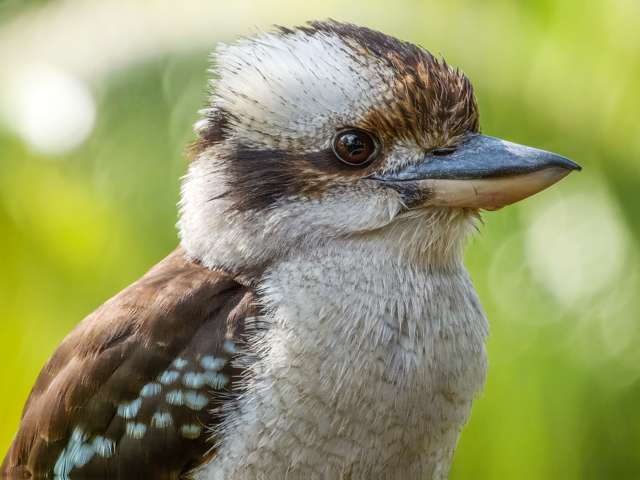
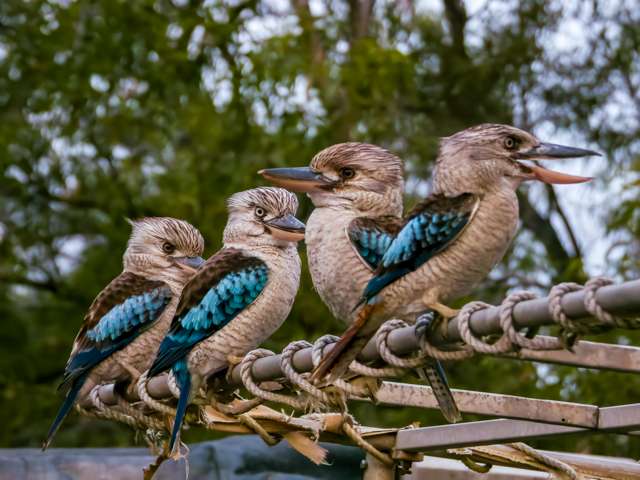
There are two species of kookaburra: the Laughing Kookaburra (Dacelo novaeguineae), which is the most well-known, and the slightly smaller Blue-winged Kookaburra (Dacelo leachii). Both have a distinctive laugh, but the Blue-winged Kookaburra's call is often more guttural and jarring. While the sound is charming to human ears, to a kookaburra, it is a serious business—a powerful tool for communication that reinforces their social bonds and warns off rivals.
A Bird of Prey in a Kingfisher's Body
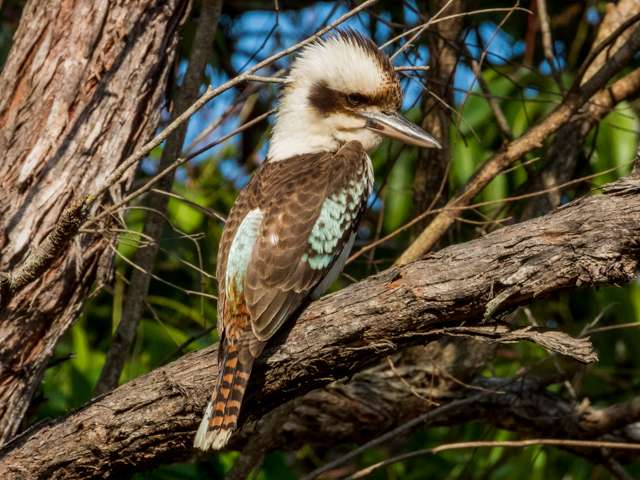
Kookaburras belong to the tree kingfisher subfamily, a classification that might seem strange given their size and terrestrial habits. Unlike their brightly colored, fish-eating relatives, kookaburras are built for a different kind of hunting. They are large, stocky birds, measuring up to 45 centimeters (18 inches) in length, with a proportionally huge head and a massive, dagger-like beak. Their plumage is a blend of earthy tones, with a brown back, a cream-colored belly, and a distinctive dark stripe that runs through the eye. The Blue-winged Kookaburra has a blue patch on its wing and a less prominent eye stripe.
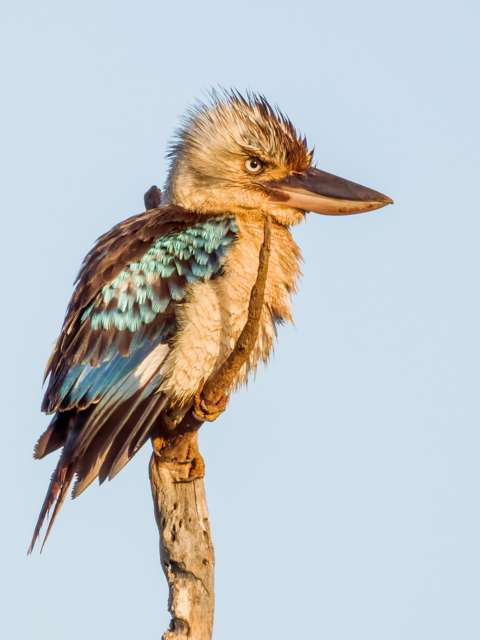
This powerful build is a necessity for their predatory lifestyle. Kookaburras are carnivores with a diverse and sometimes surprising diet. They are master ambush hunters, perching silently on a branch and patiently scanning the ground below. When they spot prey, they swoop down with astonishing speed and precision, using their powerful beaks to snatch their meal. Their diet includes a wide range of prey, from insects and worms to lizards, small snakes, and even rodents. Their ability to take on venomous snakes, a feat for which they are famous, is a testament to their strength and quick reflexes. Once caught, the prey is often bashed against a hard surface, such as a branch or a rock, to kill it and break its bones before consumption.
A Social Life: Family and Cooperative Breeding
The kookaburra is a highly social bird, living in family groups or cooperative breeding groups that can consist of a mated pair and several of their offspring from previous seasons. These groups are strongly territorial, defending their patch of forest or bush from rival groups. The morning and evening choruses of laughter are the primary way they communicate their territorial claims.
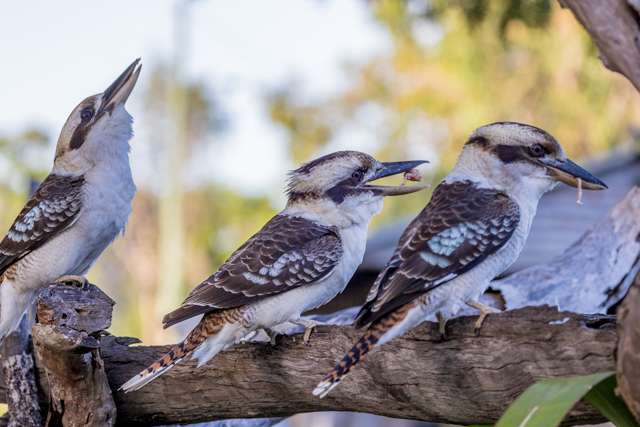
Within the family unit, life is a cooperative effort. Older siblings often act as "helpers," assisting their parents in raising the new generation of chicks. These helpers play a crucial role in foraging for food, feeding the young, and defending the nest from predators. This communal effort significantly increases the survival rate of the chicks, as it ensures they receive a constant supply of food and protection from threats. This is a vital adaptation in an environment where resources can be unpredictable and competition is fierce.
Nesting takes place in a hollow tree or, less commonly, in a burrow excavated in a termite mound. The nest is typically a simple, unlined cavity where the female lays a clutch of two to four eggs. Both parents, along with their helpers, share the duties of incubation and chick-rearing. The cooperative breeding system is a key to the kookaburra's success and is a strong example of complex social behavior in the avian world.
Kookaburras in Australian Culture
The kookaburra’s unique voice and striking appearance have cemented its place in Australian culture. It is an icon of the bush, a symbol of resilience, and a fixture in folklore, songs, and children's literature. It features prominently in the famous children's song, "Kookaburra Sits in the Old Gum Tree," which has been a staple of Australian childhoods for generations. The kookaburra’s reputation as a "laughing jackass" has given it a charming, almost mischievous persona in the national psyche.
Beyond its cultural significance, the kookaburra plays a crucial ecological role. As a top predator, it helps to control populations of snakes, lizards, and rodents, contributing to the balance of its ecosystem. The introduction of the Laughing Kookaburra to Tasmania and parts of New Zealand in the late 19th and early 20th centuries has had mixed results, with some concern about its impact on native species. However, on the Australian mainland, it is a native and cherished member of the faunal community.
Wrapping Up
The kookaburra, with its signature laugh, is far more than a novelty. It is a highly evolved predator, a social strategist, and a powerful symbol of the Australian wilderness. Its massive beak and cooperative breeding habits are a testament to its success in a challenging environment. The next time you hear its call echoing through the trees, remember that it is not just a laugh, but a complex communication, a territorial marker, and a song that has been sung for generations in the heart of the Australian bush. The kookaburra is a living legend, a bird that captures the spirit of a wild and untamed land.
Want more weird birds? Read all about the Dodo.
