

Kentucky, often celebrated for its bluegrass fields, bourbon heritage, and the rugged beauty of its eastern mountains, harbors a spectacular secret that draws wildlife enthusiasts and birders from across the continent every winter: the immense congregations of Sandhill Cranes (Antigone canadensis). The heart of this avian spectacle lies in the south-central region of the state, centered around the Barren River Lake State Resort Park and the surrounding network of wildlife management areas and agricultural fields. Here, thousands of these magnificent, prehistoric-looking birds descend each season, transforming the quiet wetlands into a vibrant, noisy stage for one of North America's great migration stories.
The Migration Magnet: Why Kentucky?
Sandhill Cranes are among the most numerous crane species globally, and the population that funnels through Kentucky belongs to the Eastern Population. These birds breed primarily in the Great Lakes region and eastern Canada, and spend their winters in the wetlands and agricultural fields of Florida and southern Georgia.
Kentucky's position along the Mississippi Flyway makes it a crucial staging ground—a vital stopover for cranes to rest and refuel before the final push to their wintering grounds. The Barren River area, in particular, offers the perfect combination of habitat elements that cranes demand:
Roosting Safety: The extensive, shallow waters of Barren River Lake and nearby Barren River Lake Wildlife Management Area (WMA) provide safe, predator-free overnight roosting sites. Cranes wade into the water to sleep, protected by their excellent visibility and the water barrier.
Foraging Abundance: The surrounding landscape is a patchwork of moist agricultural fields—especially harvested corn and soybean fields—and dense, fertile wetlands. The cranes feed heavily on waste grain, tubers, and invertebrates, building up the energy reserves necessary to sustain them through the winter.
Mild Climate: While Kentucky experiences winter weather, it is generally mild enough to keep the water open and the ground accessible for foraging throughout the peak winter months.
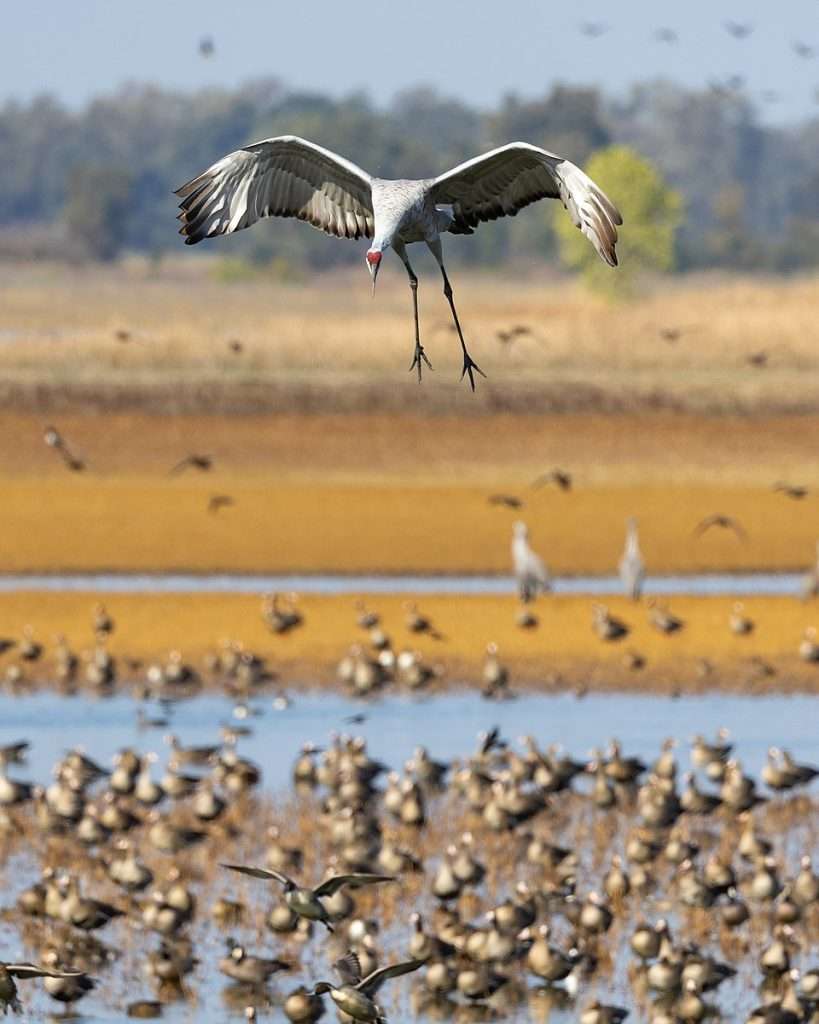
The Arrival: Timing the Spectacle
The Sandhill Crane migration through Kentucky is primarily a late-fall and winter event.
Arrival: The first large flocks typically begin arriving in late October or early November, though scattered groups may appear earlier.
Peak Season: The largest numbers are generally present from December through February. During this peak, counts often range between 15,000 to 25,000 birds, though annual totals vary widely based on weather patterns and food availability further north. If conditions remain harsh on the breeding grounds, the birds move south earlier. Conversely, if the winter is mild in Indiana or Ohio, the cranes may linger farther north.
Departure: The migration reverses in late February and early March, as the birds begin their return journey to the breeding grounds.
The best time to witness the most dramatic activity is at sunrise and sunset. At dawn, the cranes depart their watery roosts en masse, filling the sky with their calls as they disperse to the surrounding fields to feed. At dusk, the spectacular reverse commute occurs, with long, undulating V-formations descending back to the safety of the Barren River roosts.
Profiling the Sandhill Crane

The Sandhill Crane is one of the most readily identified birds in the American skies, recognizable by sight and sound.
Identification
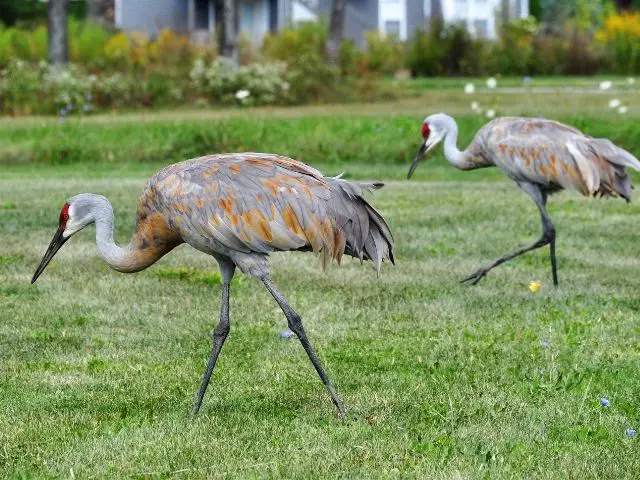
Size and Structure: Sandhill Cranes are large, tall, gray birds, standing nearly four feet high with an imposing wingspan that can reach up to 6.5 feet. In flight, they hold their long neck and legs straight out, a key difference from herons, which tuck their necks in an 'S' shape.
Coloration: They are predominantly gray, but adults exhibit a striking patch of unfeathered, bright red skin on their foreheads and crowns. They often appear tinged with rust or brown, a coloration acquired naturally from preening with mud rich in iron oxides—a process known as "preening with paint".
Call: Their call is perhaps their most defining feature. It is a loud, ringing, rattling bugle that can be heard from miles away. This sound is produced by their long trachea (windpipe), which is coiled deep within the breastbone (sternum). This deep resonance allows flocks to keep in contact during long migratory flights.
Behavior and Ecology

Sandhill Cranes are known for their strong monogamous pair bonds and their communal nature.
Dancing: Cranes are famous for their "dances," an elaborate series of jumps, bows, running, and wing-flapping. While often part of courtship, cranes will also dance year-round simply as a social activity or a display of aggression, making it a frequent behavior to witness during the Kentucky winter.
Longevity: They are long-lived birds, capable of surviving for 20 years or more in the wild, which contributes to the stability of their pair bonds.
Foraging: Their powerful legs and sharp beaks allow them to probe deeply into soft soil for invertebrates and plant tubers, making them effective tillers of the soil. Their preference for waste grain from harvested crops makes them highly reliant on agricultural landscapes during the winter months.
Premier Viewing Locations in Kentucky

While the entire region surrounding the Barren River is essential habitat, a few specific locations offer the best, most reliable viewing opportunities.
1. Barren River Lake WMA and Resort Park
The lake itself and the surrounding Barren River Lake WMA are the primary focus. Viewing platforms and accessible areas near the water's edge can offer good looks at birds coming into roost. Resort Park staff often have the most up-to-date information on current roost sites. Early morning drives around the adjacent rural roads are essential for finding the feeding flocks.
2. Cecilia State Wildlife Management Area (WMA)
Located slightly north, near Elizabethtown, the Cecilia WMA is another critical stopover point for the Eastern Population, offering a secondary viewing location that sometimes holds thousands of birds. It features large open fields and wetlands.
3. Crane Creek Road (Local Knowledge)
A network of rural backroads, often bordered by cornfields, runs throughout Barren, Monroe, and Hart Counties. Following roads designated locally as "Crane Creek Road" (or similar names pointing to known wetlands) is often the best way to find the dispersed feeding flocks during the day. Birders must remember to pull over completely and respect private property boundaries while observing.
Conservation and Respect
The success of the Sandhill Crane population in Kentucky is a reminder of the importance of intact wetland and agricultural areas working in concert.
Refuge: The cranes are protected by the Migratory Bird Treaty Act, and the WMAs play a crucial role in providing disturbance-free zones.
Observation Ethics: Due to their sensitivity, observers are urged to use powerful binoculars and spotting scopes rather than trying to approach the birds closely. Flushing a large flock of cranes costs them precious energy and can displace them from optimal feeding areas. A minimum distance of 200 to 300 yards is recommended to ensure the birds are not disturbed.
The annual appearance of the Sandhill Cranes in the Barren River area is a testament to the enduring power of migration and the ecological richness of Kentucky's less-traveled landscapes. The sight of thousands of these majestic birds wheeling against the rising sun, accompanied by their ancient, bugling calls, is an experience that connects the observer to the rhythm of the wild continent.
Birds Of Kentucky: 28 Species Col. Sanders (May Have) Loved!
