
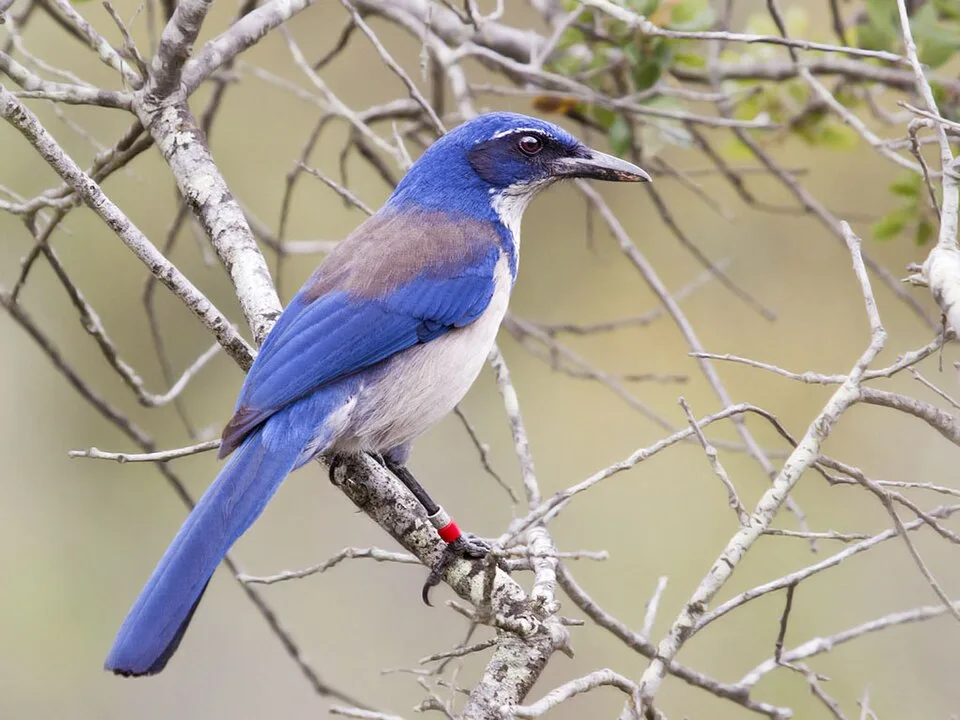
The Island Scrub-Jay (Aphelocoma insularis) holds a unique and precarious position in the avifauna of North America. It is the only bird species in the continental United States and Canada that is endemic to a single island, making it an avian jewel with the smallest geographic range of any bird on the continent. This brilliant blue corvid is a living lesson in island evolution, a bird that has adapted to isolation and whose continued existence relies on the careful stewardship of its tiny, spectacular home: Santa Cruz Island, the largest of California’s Channel Islands.
A Product of Isolation: Size, Plume, and Personality
The Island Scrub-Jay is not merely a misplaced version of its mainland relative, the California Scrub-Jay; it is a distinct species. Genetic analysis suggests it diverged from its closest mainland kin approximately 150,000 years ago, evolving in isolation to become a bolder, larger, and more richly colored bird.
The Island Scrub-Jay is a prime example of the "island rule" in evolution, where small-bodied mainland species tend to become larger in an island environment where resources may be plentiful and predators are fewer. It is noticeably 15% larger and 40% heavier than the California Scrub-Jay, with a disproportionately long, stout bill. This powerful bill is perfectly adapted for its island diet, particularly for hammering open the thick-shelled acorns of the island's oak woodlands.
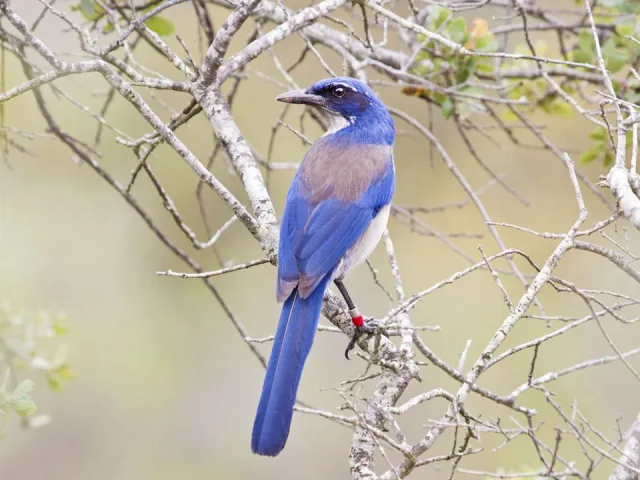
In appearance, the Island Scrub-Jay is a deeper, more vibrant blue—an ultramarine on the crown, nape, wings, and tail—with a prominent dark gray or brownish patch on the back and a contrasting white throat. They also exhibit a bolder, more inquisitive personality than their mainland counterparts, often approaching humans out of curiosity and a lack of fear. In a world with a population estimated at under 3,000 individuals, their striking beauty and unique behavior make them a top priority for bird conservationists.
Ecology of the Island
Santa Cruz Island, located about 18 miles off the coast of Santa Barbara, provides a remarkably diverse habitat for a single-island endemic. The Island Scrub-Jay occupies almost every available habitat type, demonstrating an adaptability that has been key to its survival.
Habitat and Range
The jay's primary habitats are the oak woodlands dominated by coast live oak, canyon live oak, and island oak, as well as the dense, scrubby chaparral where island scrub oak is prevalent. They also utilize riparian scrub and even patches of relict pine forest. The jays establish and defend permanent, year-round territories, a resource that is often saturated on the island, meaning younger birds may delay breeding for several years until a territory becomes available.
Diet and Behavior
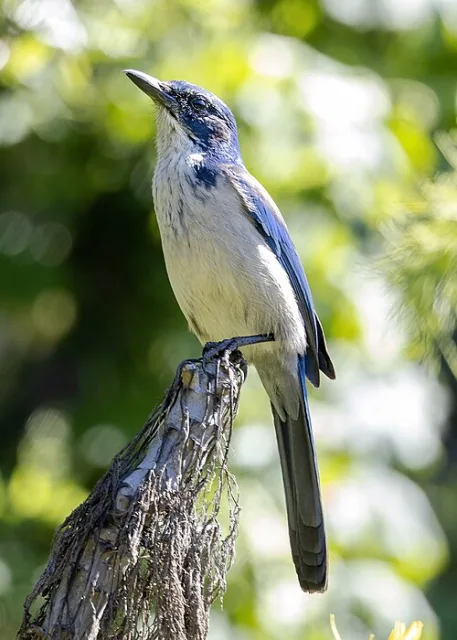
As omnivores, their diet is varied and critical to the island's ecosystem. Acorns form the major food source, especially in the fall. The jays engage in intense caching behavior, burying thousands of acorns annually for later consumption. This action effectively makes the Island Scrub-Jay a key disperser and planter of the island's native oak trees.
Beyond acorns, they feed on pine and grass seeds, a variety of insects and spiders, and will opportunistically take small vertebrates, including lizards, snakes, mice, and the eggs and nestlings of other bird species—a typical predatory streak for a corvid. Their foraging involves hopping on the ground, flipping over objects with their bill, and even tearing pieces of bark from oaks to uncover insects.
Reproduction
Island Scrub-Jays are generally monogamous and mate for life, though they are non-cooperative breeders, unlike their close relative, the Florida Scrub-Jay. Both the male and female construct a large, bulky cup nest of twigs and rootlets, typically placed 7 to 10 feet up in a dense tree or shrub. The female lays a clutch of two to five pale blue-green eggs, and both parents share the duties of feeding and caring for the young. Due to the intensive parental care and year-round territorial defense, pairs often raise only one brood per year.
The Tightrope of Conservation
The single-island endemism that makes the Island Scrub-Jay so scientifically fascinating is also its greatest weakness. The species is classified as Vulnerable by the International Union for Conservation of Nature (IUCN), largely because its entire population is concentrated in one small, isolated place. This isolation puts the species on a conservation tightrope, constantly vulnerable to a single, catastrophic event.
Major Threats
The most significant contemporary threats to the Island Scrub-Jay are disease and catastrophic environmental events.
- West Nile Virus (WNV): This invasive pathogen, which has caused widespread mortality in mainland bird populations, poses the most immediate and devastating threat. An outbreak on Santa Cruz Island could potentially wipe out a significant portion of the entire species, making vaccination and intense surveillance a primary conservation strategy.
- Wildfire: A large, uncontrolled wildfire, exacerbated by climate change and prolonged drought, could destroy the majority of the oak woodland and chaparral habitat, resulting in a sudden and massive population crash.
- Lack of Genetic Diversity: The small, isolated population has limited genetic diversity. While this isn't an immediate crisis, it reduces the species' capacity to adapt quickly to new threats, such as a novel disease or rapid changes in climate.
A Conservation Success Story
The Island Scrub-Jay population is, however, currently more stable than it was decades ago. This is a direct result of decades of conservation action. Historically, the island's ecosystem was severely degraded by non-native feral sheep, pigs, and cattle introduced by early ranching operations. Their overgrazing destroyed the understory and prevented the regeneration of native oaks and chaparral—the jay's essential habitat.
The successful removal of these non-native ungulates by The Nature Conservancy and the U.S. National Park Service has led to a remarkable ecological recovery, allowing the native scrub and oak woodlands to regenerate and stabilize. This habitat restoration is credited with the Island Scrub-Jay population's modest increase over the last few decades.
Looking to the Future: The Call for a Second Home
To mitigate the existential risk of single-island endemism, conservationists are actively pursuing a bold, proactive strategy: establishing a second, geographically separate population on a nearby island, likely Santa Rosa Island.
Translocation—moving individuals to a new habitat—is seen as the best way to safeguard the species against a single, catastrophic outbreak of WNV or a devastating fire. While this process is complex and resource-intensive, the ecological imperative is clear: distributing the population is the only way to shift the Island Scrub-Jay from its dangerously "Vulnerable" status toward a truly secure future.
The Island Scrub-Jay remains one of California’s most precious and irreplaceable species, a shimmering blue sentinel of Santa Cruz Island, whose fate is inextricably linked to the careful management of its tiny, isolated world.
