

The term "heron" evokes an image of a stoic, long-legged wading bird, a master of stillness poised at the water's edge. While the herons belong to the same family, Ardeidae, as the dazzling, typically white egrets, the herons themselves present a fascinating array of colors, sizes, and hunting behaviors. In the wetlands, marshes, and waterways of the United States, several distinctive heron species thrive, each playing a vital role in its ecosystem. By focusing on the core species commonly designated as "herons"—Great Blue Heron, Green Heron, Tricolored Heron, Little Blue Heron, Black-crowned Night-Heron, and Yellow-crowned Night-Heron—we can appreciate the diversity within this graceful avian group.
The Widespread Majesty: Great Blue Heron
The Great Blue Heron (Ardea herodias) is arguably the most recognizable and widespread heron in North America. This colossal wading bird is a commanding presence, often standing over four feet tall with an impressive wingspan that can reach nearly six feet. Its plumage is predominantly slate-gray, accented by a chestnut and black stripe running up its flanks, and a white face with a pair of black or slate plumes extending from the eyes to the nape.

The Great Blue Heron’s range is extensive, covering most of the continent, from Alaska and southern Canada down to Central America. They are incredibly adaptable, inhabiting almost any type of wetland: freshwater and saltwater marshes, river edges, flooded meadows, and even developed areas with a nearby water source. Foraging is a slow, methodical affair. The heron stands motionless or walks with deliberate, slow steps in shallow water, neck coiled in an "S" shape, waiting for prey. Its diet is remarkably varied, consisting mostly of fish, but also including amphibians, reptiles, small mammals like voles, and even other birds. Northern populations are migratory, but many in the southern US remain year-round residents, surviving northern winters as long as the water remains unfrozen. They typically nest colonially in "rookeries," building large stick platforms high in trees near water.
The Hidden Jewel: Green Heron
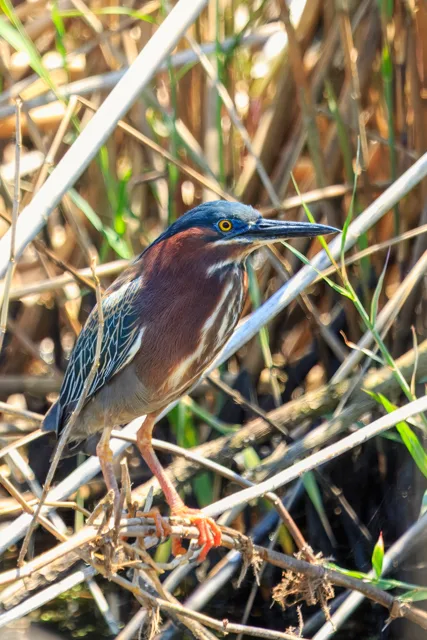
In stark contrast to the Great Blue Heron's towering stature is the Green Heron (Butorides virescens), a small, stocky, and often secretive species. It is the second smallest heron species in the US. Measuring around 16 to 22 inches, its small size and preference for dense cover make it easy to overlook. The bird's most striking features are its dark cap, chestnut-colored neck, and a back glossed with an iridescent dark green or blue-green, which often looks simply dark in poor light. It also has short, bright orange-yellow legs.
The Green Heron is widespread across the US, preferring vegetation-fringed ponds, streams, lakes, and marshes. Unlike many of its colonial relatives, the Green Heron often nests as an isolated pair. Its hunting technique is a masterclass in calculated ambush. It often crouches low at the water's edge, patiently waiting. What makes it famous, however, is its occasional use of tools. It has been documented dropping small items—such as a twig, feather, or piece of bread—onto the water's surface to lure small fish within striking distance, making it one of the few known tool-using birds. Its diet, while mainly small fish, also includes crayfish and aquatic insects.
The Coastal Acrobat: Tricolored Heron
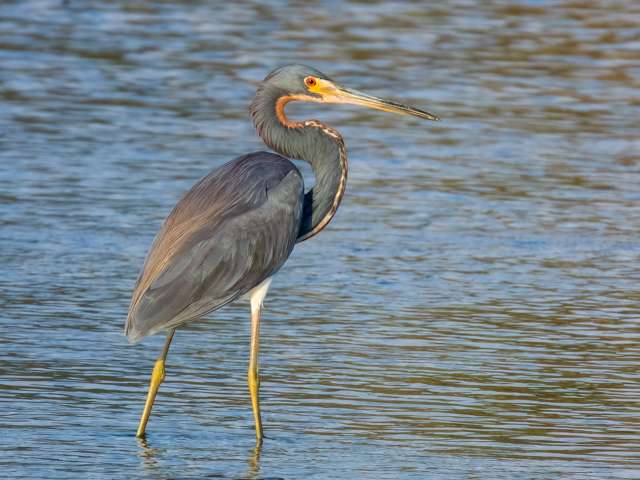
The Tricolored Heron (Egretta tricolor), formerly known as the Louisiana Heron, is a sleek and slender heron primarily found in the coastal regions of the southern United States. Its name, "tricolored," refers to its complex plumage: a blue-gray back and upper wings, a distinct white stripe down the middle of its sinuous neck, and a white belly. In breeding plumage, it also sports long, filamentous plumes on its head, neck, and back.
This medium-sized heron is known for its active foraging style. Unlike the Great Blue Heron's slow stalk, the Tricolored Heron is known for its energetic "dance." It will run, chase, and suddenly stop with quick turns and starts. It even employs a technique similar to the Reddish Egret (which is an egret and therefore excluded by name), where it extends its wings to create shade on the water, luring fish to the surface. It is a colonial nester, building stick nests in trees or shrubs, usually on islands in coastal estuaries, saltmarshes, and mangrove swamps, reflecting its strong preference for saline or brackish wetland habitats.
The Chameleon: Little Blue Heron
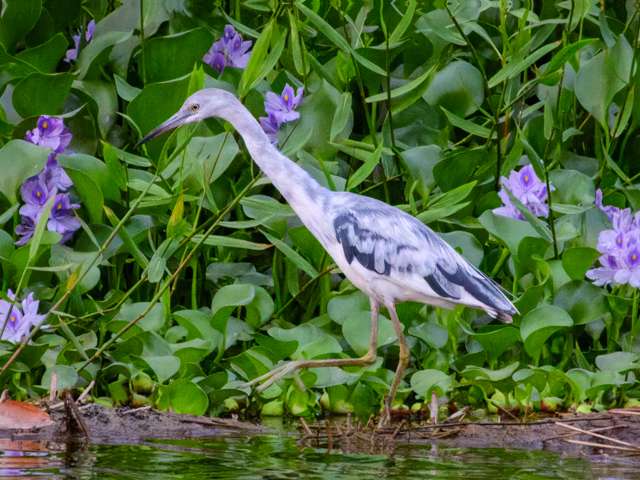
The Little Blue Heron (Egretta caerulea), a small to medium-sized heron, is unique for its dramatic plumage change from juvenile to adult. The adult is a dark, handsome bird with a dark slaty-blue body and a rich purple-maroon head and neck. In contrast, the juvenile is almost entirely white, with only a slight dusky tip to its outer wing feathers. This juvenile white plumage often leads to misidentification with white egrets.
The Little Blue Heron is a resident or migratory species in the southeastern US, extending its range north in summer. It inhabits a variety of wetland types, from tidal flats and estuaries to freshwater swamps and streams. Like many herons, it is a stand-and-wait predator, preferring to stalk slowly or remain stationary, patiently watching the water for small fish and aquatic invertebrates. This behavior helps distinguish it from more active foragers like the Tricolored Heron. The intermediate stage of its maturation is a patchwork of white and blue feathers, a true avian teenager transitioning to its adult identity.
The Nocturnal Hunters: Night-Herons
The night-herons represent a unique subfamily within the Ardeidae, specialized for crepuscular and nocturnal hunting. The US is home to two primary species: the Black-crowned and the Yellow-crowned.
Black-crowned Night-Heron
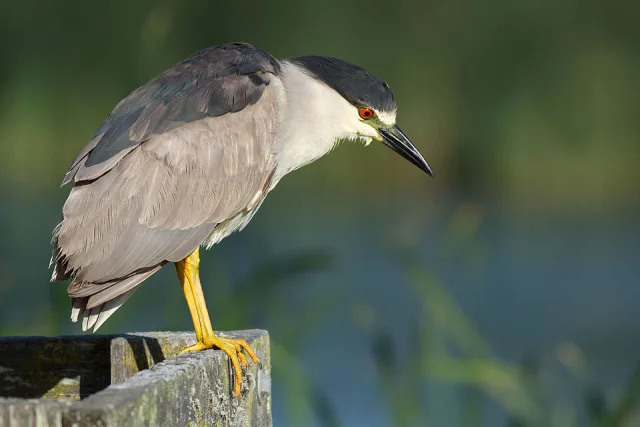
The Black-crowned Night-Heron (Nycticorax nycticorax) is perhaps the most widespread heron in the world. The adult is a stocky, rather chunky-looking bird with a short neck and legs. It has a striking pattern: a black cap and back, pale gray wings, and a white to pale gray belly. A long, thin white plume extends from the black cap during the breeding season. It has a short, thick black bill with a yellowish-green base.
Found across most of the US, they are birds of coastal and inland wetlands. During the day, they are typically found roosting communally in trees or dense vegetation, becoming active at dusk to hunt. Their diet is diverse, including fish, rodents, eggs, and invertebrates. They nest in colonies, often with other wading birds.
Yellow-crowned Night-Heron
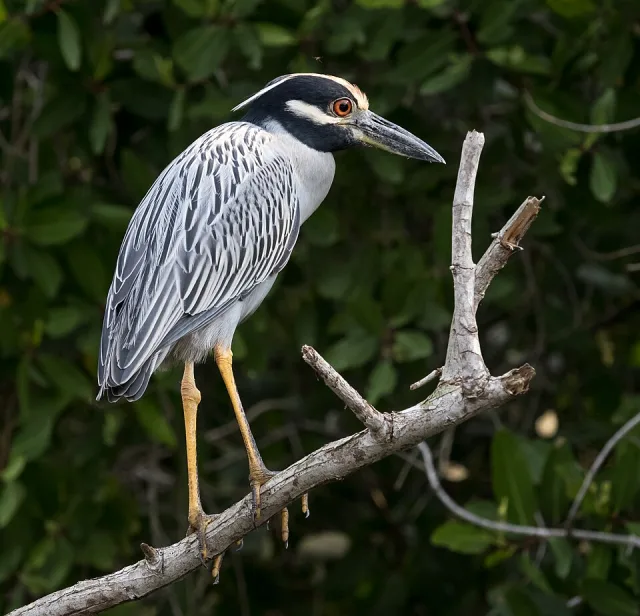
The Yellow-crowned Night-Heron (Nyctanassa violacea) is more of a southern and eastern species in the US, generally preferring coastal environments, swamps, and freshwater marshes. It is more slender and longer-legged than its Black-crowned cousin. The adult's head pattern is its most distinctive feature: a black head with a prominent white cheek patch and a white, slightly yellow-tinged crown. The body is a uniform gray-blue with fine streaking.
A key difference from the Black-crowned is its specialized diet, which consists largely of crustaceans, particularly crayfish and crabs. Its longer, thicker black bill is an effective tool for cracking shells. Like the Black-crowned, it is nocturnal, but juveniles of the two species can be told apart by their bills: the juvenile Yellow-crowned has a mostly black bill, while the juvenile Black-crowned has a pale yellowish base.
Herons in Harmony
From the colossal Great Blue Heron to the diminutive Green Heron, the non-egret herons of the USA showcase remarkable diversity in form, foraging strategy, and habitat. They are all essential components of the country's wetland ecosystems, patiently waiting, actively chasing, or hunting under the cover of darkness. Observing these graceful, often solitary hunters provides a deeper appreciation for the complex tapestry of American wildlife.
