

The Great Blue Heron (Ardea herodias) is one of the most widely recognized and majestic birds in North America. Standing nearly four feet tall with a wingspan that can stretch up to seven feet, this statuesque wader commands attention in any wetland, riverbank, or coastal environment across the United States. Often mistaken for a crane, the heron is an icon of the American waterways, embodying patience, precision, and an ancient grace that links modern landscapes to prehistoric times.
This article provides a deep profile of the Great Blue Heron, examining its unique physical characteristics, its masterly hunting techniques, and its fascinating social behavior in its vast American range.
An Image of Ancient Elegance: Physicality and Flight

The Great Blue Heron’s physical form is a marvel of evolutionary specialization. Despite its imposing size, the bird is remarkably light, typically weighing only five to eight pounds, thanks to its hollow bones.
Distinctive Appearance
The heron’s color palette is a subdued but elegant blend of blues, grays, and blacks, allowing it to blend seamlessly into the shadows of shoreline vegetation.
- Coloration: The body and wings are a slate-blue to gray, while the neck is long and often cinnamon-colored. Adults boast a white head crowned with a black cap and two long, slender black plumes that sweep backward from the eyes. In the breeding season, these plumes, along with shaggy feathers on the neck and back, become more prominent and vibrant, enhancing the bird's courtship displays.
- The S-Shaped Neck: A signature feature is its neck, a muscular and specialized appendage capable of curling into a graceful ‘S’ shape. This curvature is crucial for both aerodynamics in flight and for delivering the rapid strike during a hunt.
- Spear-like Bill: Its bill is a long, dagger-like weapon, yellowish in color, used with lethal precision.
- Specialized Grooming: Herons possess unique adaptations for maintaining their plumage. They have patches of "powder down" feathers on their chest and thighs that continuously break down into a fine, talc-like powder. The heron uses a fringed claw on its middle toe as a comb, applying this powder to its feathers to absorb fish slime and oils, keeping its plumage dry and clean for optimal performance.
Flight Profile

When viewed in the sky, the Great Blue Heron is unmistakable. Unlike cranes or spoonbills, which fly with their necks extended, the heron flies with slow, deep wingbeats, holding its head tucked back onto its shoulders in that characteristic ‘S’ curve, while its long legs trail straight behind, serving as a kind of rudder.
The Art of the Strike: Hunting and Diet
The Great Blue Heron is a supremely patient and efficient carnivore that spends up to 90 percent of its waking hours hunting. Its strategy is a masterclass in stillness and explosive speed.
Hunting Techniques
The heron’s hunting success relies on two primary techniques, both executed in the shallow waters where it typically forages:
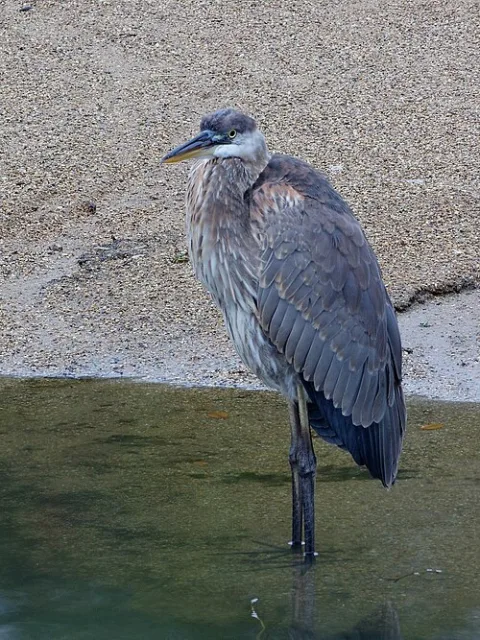
- The Wait-and-Watch: The bird will stand motionless for extended periods—sometimes for hours—in the shallows, or it will walk with an almost imperceptible, slow-motion gait. Its keen eyes are constantly scanning the water for the slightest movement.

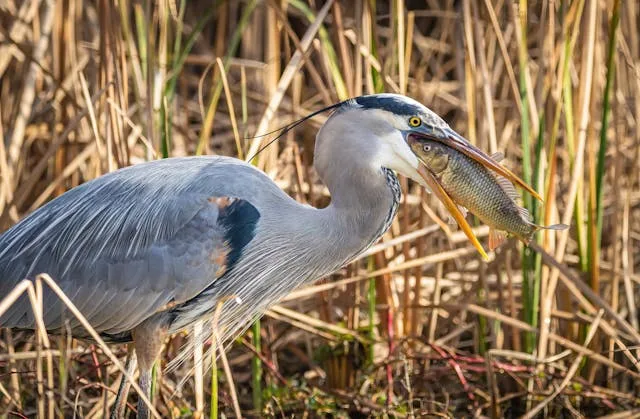
Great Blue Heron - The Lightning Thrust: When a fish, amphibian, or small mammal comes into striking distance, the heron's coiled neck snaps forward with incredible speed. The strike is so fast that it often appears as a blur. The prey is either grasped crosswise in the sharp mandibles or, for larger fish, impaled with the bill. It then swallows the prey whole, often headfirst.
A Highly Adaptable Diet
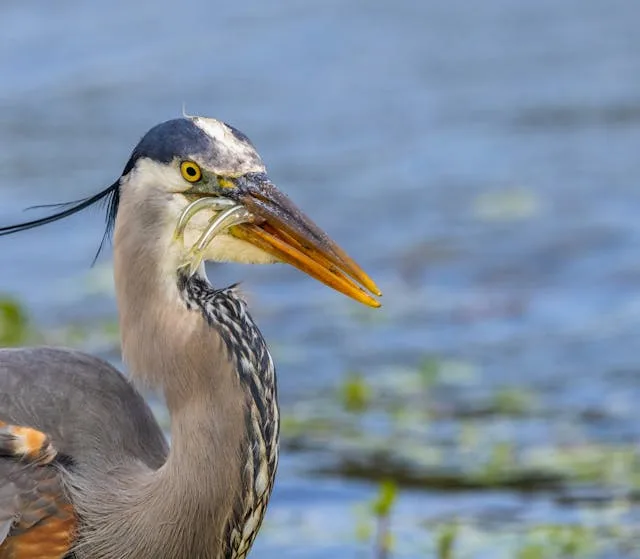
While fish (such as perch, minnows, and eels) are the staple of its diet, the heron is a true opportunistic predator. Its menu is highly variable depending on its location and seasonal availability, making it one of the most adaptable hunters in the U.S. wetlands. Its prey includes:
- Aquatic Life: Frogs, salamanders, snakes, turtles, crabs, and crayfish.
- Small Mammals: In fields and wet grasslands, herons are known to stalk and catch rodents like mice, voles, and gophers, especially during the non-breeding season.
- Other Birds: They will occasionally prey on other birds, including ducklings and rail chicks.
The heron’s digestive system is powerful, allowing it to process bones and scales, though it will regurgitate pellets of indigestible fur or shell material.
The Heronry: Breeding and Social Life
Unlike its solitary demeanor during hunting, the Great Blue Heron is a highly social bird during the breeding season.
The Colonial Nester
Herons nest in large colonies known as heronries or rookeries, which can number from a few dozen to several hundred pairs. These colonies are typically established in isolated areas near foraging grounds, such as wooded swamps, islands, or dense riparian forests, where they are safe from ground predators.
- Nest Construction: Males arrive first to select a nest site, usually high in the canopy of a tall tree (often 50 feet or more above the ground). They then perform elaborate courtship displays, which involve neck-stretching, bill-snapping, and the ceremonial presentation of a stick to attract a female. The female then weaves this material into a large, messy platform nest made of sticks and lined with moss, pine needles, or grass. Nests are often reused and added to year after year, sometimes growing to four feet in diameter.
- Parental Care: The female typically lays 3-7 pale blue eggs. Both parents take turns incubating the eggs for about a month. After hatching, the nestlings are fed by both parents via regurgitation. Due to the staggered hatching and intense competition, older chicks often out-compete or sometimes kill their younger siblings—a harsh but natural survival mechanism known as siblicide—that ensures the strongest one or two chicks survive during times of food scarcity.
Status and Conservation
The Great Blue Heron is a conservation success story and a ubiquitous presence across the American landscape.
- Conservation Status: Unlike the smaller, more sensitive wading birds that suffered major declines due to the plume trade in the 19th and early 20th centuries, the Great Blue Heron has maintained a stable and generally increasing population across most of its range. It is classified as "Least Concern" by the IUCN.
- Threats: Despite its stable status, the heron is still vulnerable to habitat loss, particularly the draining and development of wetlands and the destruction of nesting forests. Human disturbance near colonies, especially during the critical early nesting period, can cause parents to abandon their eggs and young. Furthermore, the heron’s reliance on clean water makes it an important indicator species for water quality and environmental health.
From the Florida mangroves to the rivers of Alaska, the Great Blue Heron stands as a familiar and reassuring sight. Its patient vigil at the water’s edge is a timeless scene, making it a constant reminder of the wild, untamed beauty woven into the tapestry of the American natural world.
