
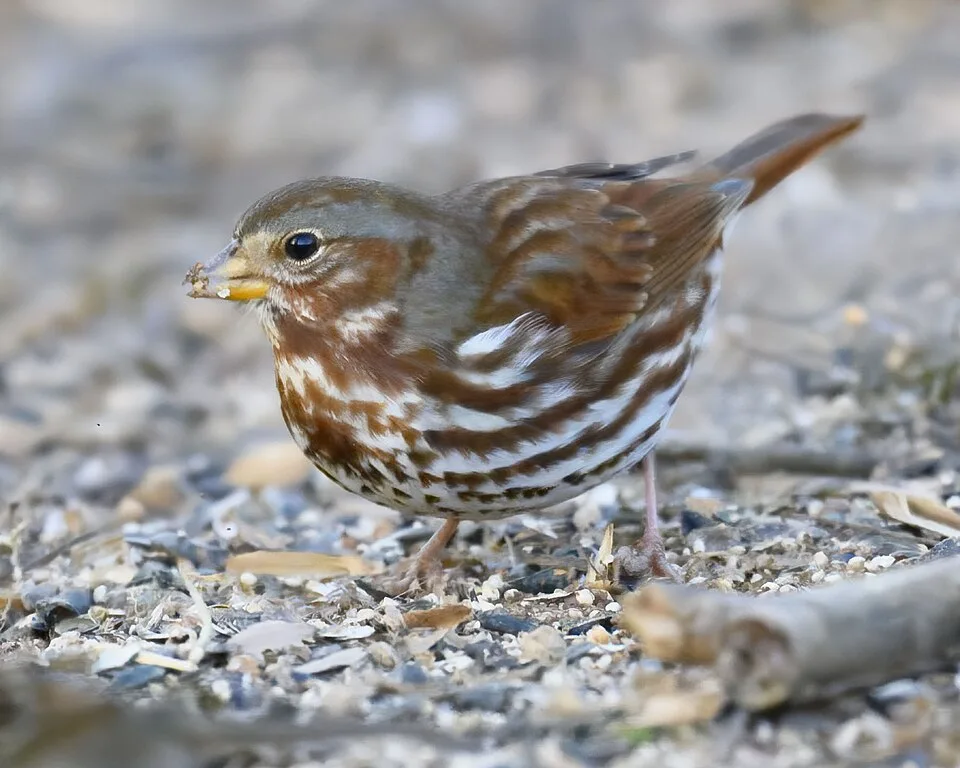
The Fox Sparrow (Passerella iliaca) is a bird that demands attention, not through flashy color, but through its rich, complex song and its determined, almost ferocious foraging style. Unlike the tidy, easily observed feeders of the suburban yard, the Fox Sparrow is a creature of the underbrush, renowned for the noisy, vigorous way it scrapes through leaf litter—a habit that often betrays its presence long before its beauty is glimpsed. This large, robust sparrow is a true northern songster, whose breeding grounds span the dense boreal forests and thickets of North America. Yet, it is most celebrated in the Lower 48 for the stunning array of plumage variations it displays during its winter migrations, transforming it into one of the most geographically diverse and taxonomically challenging birds on the continent.
The Name and Appearance: Rusty Hues and Heavy Spots
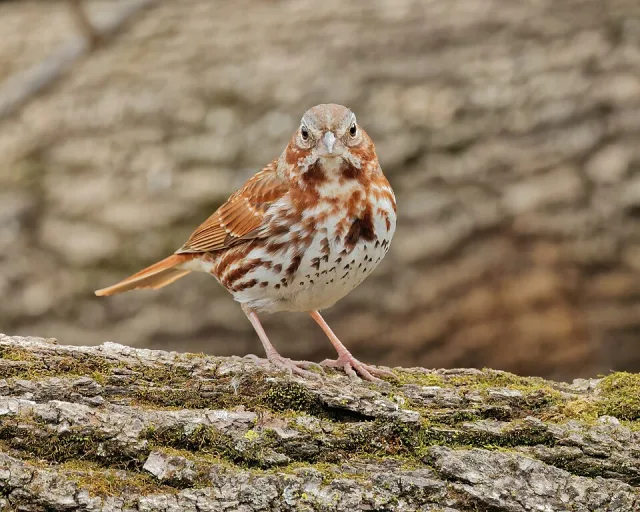
The Fox Sparrow derives its common name from the striking rusty, reddish-brown coloration present in its plumage—colors reminiscent of the common red fox. It is notably the largest sparrow in North America, possessing a heavier build, a longer tail, and a stout, conical bill that allows it to crack large, tough seeds and roots.
The overall pattern across all subspecies is a grayish or brownish head and back, with the underparts marked by heavy, blurry, reddish-brown streaking and spotting that often converges into a prominent central breast spot. However, the depth of color and the pattern of streaking vary so dramatically across its range that ornithologists traditionally grouped the various forms into four major color "groups," which many now consider distinct species: the Red Fox, the Slate-colored, the Sooty, and the Thick-billed forms.
A Tale of Four Sparrows: Geographic Variation
The extreme differences in appearance among the Fox Sparrow populations represent a classic case of clinal variation (gradual change across a geographic range) and allopatric speciation (evolution due to geographic isolation). These variations were historically a point of great confusion, leading to the current recognition of four major groups distinguished by their breeding range and plumage tone:
1. The Red Fox Sparrow (P. i. iliaca)
This is the easternmost and most familiar form. It breeds across the boreal forests of eastern Canada and Newfoundland.
Appearance: Distinctive for its bright, reddish-brown or rusty coloring on the back, wings, and tail. The streaking on the breast is a similarly rich reddish-brown, often forming clean, heavy stripes. The head is grayish, contrasting sharply with the back.
Migration: Undertakes long migrations, wintering across the entire eastern and southeastern United States, and often appearing at backyard feeders.
2. The Slate-colored Fox Sparrow (P. i. schistacea)
This group is native to the mid-continent western mountains.
Appearance: Characterized by a predominantly slate-gray head, nape, and back. The tail and wings are rusty, but less intensely so than the Red Fox form. The streaking on the breast is narrower, more distinct, and a paler brownish-gray.
Range: Breeds in the Rocky Mountain region and winters in the southwestern US, often overlapping with the Thick-billed form.
3. The Sooty Fox Sparrow (P. i. unalaschcensis)
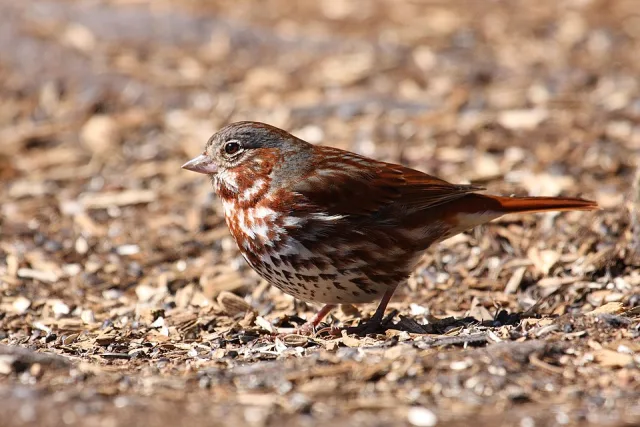
Found along the hyper-humid coastal areas of the Pacific Northwest.
Appearance: The darkest and arguably the most dramatically colored form. It has a very dark, sooty brown or deep olive-brown head and back, often lacking any true gray. The breast streaking is extremely heavy, broad, and blackish-brown.
Range: Breeds from coastal Alaska south through British Columbia. It migrates south to winter along the narrow strip of the Pacific Coast, rarely straying far inland.
https://lovethebirds.com/rise-of-exotic-birds/
4. The Thick-billed Fox Sparrow (P. i. megarhyncha)
Found in the interior mountain ranges of the western US, distinct from the coastal and northern forms.
Appearance: The most distinctive feature is its noticeably larger, thicker bill, perfectly adapted for consuming hard seeds. Its plumage is a drabber, paler gray than the Slate-colored form, with finer, less dense streaking on the breast.
Range: Breeds in the Sierra Nevada and Cascade ranges, and winters primarily in the arid grasslands and chaparral of California and the Southwest.
Habitat and Behavior: The Scraper of the Thicket
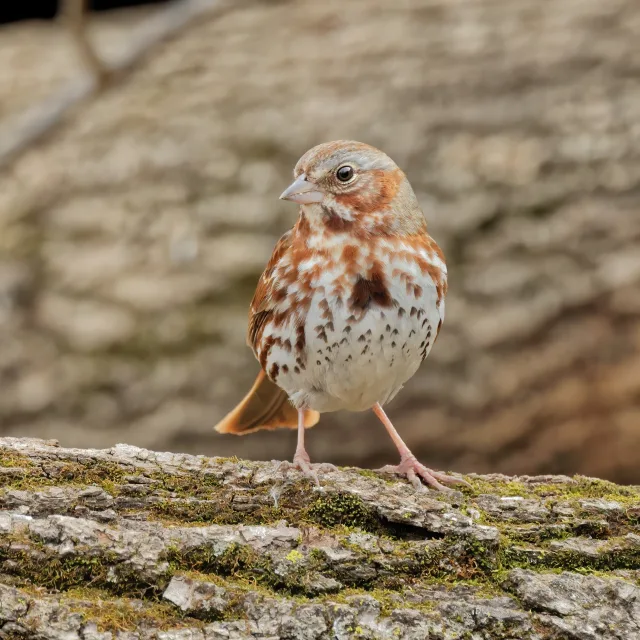
The Fox Sparrow is a bird of dense cover. During the breeding season in the North, it favors the edges of coniferous and mixed forests, particularly areas with thick undergrowth, brush piles, and young growth.
Its most famous behavioral trait is its feeding method, which is unlike any other sparrow. The Fox Sparrow employs a powerful, two-footed kick, leaping forward and backward repeatedly to vigorously scatter leaf litter and soil, exposing insects, larvae, seeds, and small invertebrates hiding beneath. This frantic "double-scratch" produces a surprising amount of noise, making a distinctive chick-chick-chick sound that is often the first clue to its presence in the winter thickets of the southern United States.
It is during this foraging that the bird's common, rusty-brown streaking often serves as perfect camouflage against the damp, decaying leaves of the forest floor, allowing it to disappear almost instantly when threatened.
The Song: Rich and Resonant
Despite its secretive nature, the Fox Sparrow is an exceptionally talented vocalist. Its song is considered one of the finest among North American sparrows—a loud, clear, and rich melody that is often likened to the complex caroling of a thrush. The song consists of three distinct phrases: a sweet, clear opening note, followed by a jumble of rich whistles and trills, and usually ending with a down-slurred, emphatic whistle. The sound is full-throated, complex, and far more resonant than the dry trills of smaller sparrows, making it a prized sound in the cold boreal forests and a welcome sign of spring migration.
Conservation Status and Outlook
Due to its vast, remote breeding range, the Fox Sparrow is currently listed as a species of Least Concern across its overall range. However, monitoring efforts are critical, particularly for the western subspecies, which face ongoing threats from habitat loss. Forest management practices, including logging and excessive road building in the sensitive coastal and montane breeding areas, pose a threat to the specialized habitats required by the Sooty and Thick-billed forms.
The Fox Sparrow, in all its colorful and geographic variations, remains one of the great examples of North American avian diversity. A snowbird to the south and a powerful voice of the northern wildlands, its appearance in the winter thicket is a reminder of the vast, rugged landscapes it calls home—a truly hidden gem waiting to be discovered by the patient and observant birder.
The Sparrows of America: A Closer Look at Common Native U.S. Species
